What is spurious-free dynamic range?
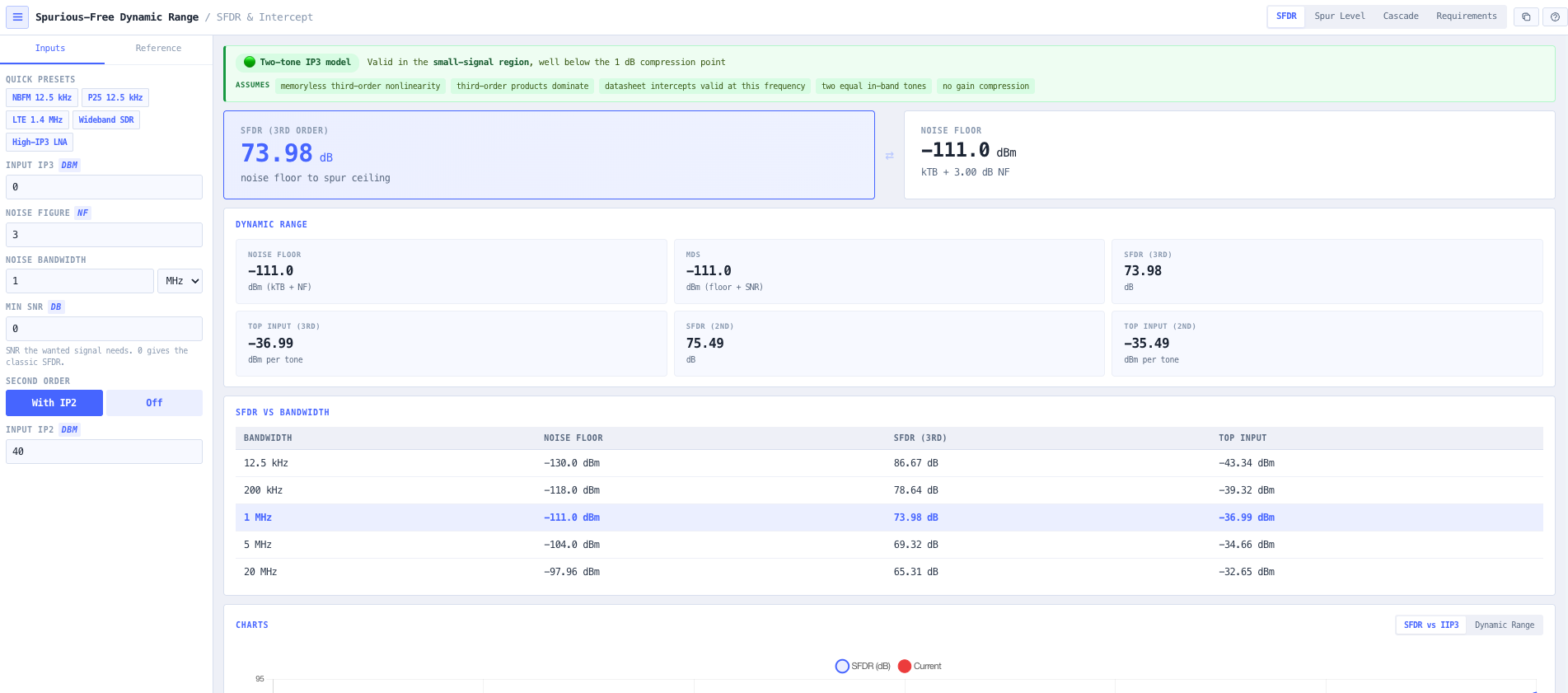
It is the range of input signal over which a receiver is useful: strong enough to be above the noise floor at the bottom, but not so strong that the receiver own third-order intermodulation products rise out of the noise at the top. The bottom is the noise floor, kTB plus the noise figure. The top is where the third-order products reach the noise floor. The result is SFDR = two thirds of the intercept above the noise floor, less the SNR the wanted signal needs.
How do I calculate SFDR from IIP3?
Take the input third-order intercept, subtract the noise floor, multiply by two thirds, and subtract the minimum SNR. SFDR3 = ⅔·(IIP3 − N) − SNR_min, where N = −174 dBm/Hz + 10·log₁₀(B) + NF. For example a receiver with a 0 dBm IIP3, a 3 dB noise figure, and a 1 MHz bandwidth has a noise floor of −111 dBm and an SFDR of about 74 dB. The calculator does this live and also reports the input level at the top of the window.
Why is there a two-thirds factor?
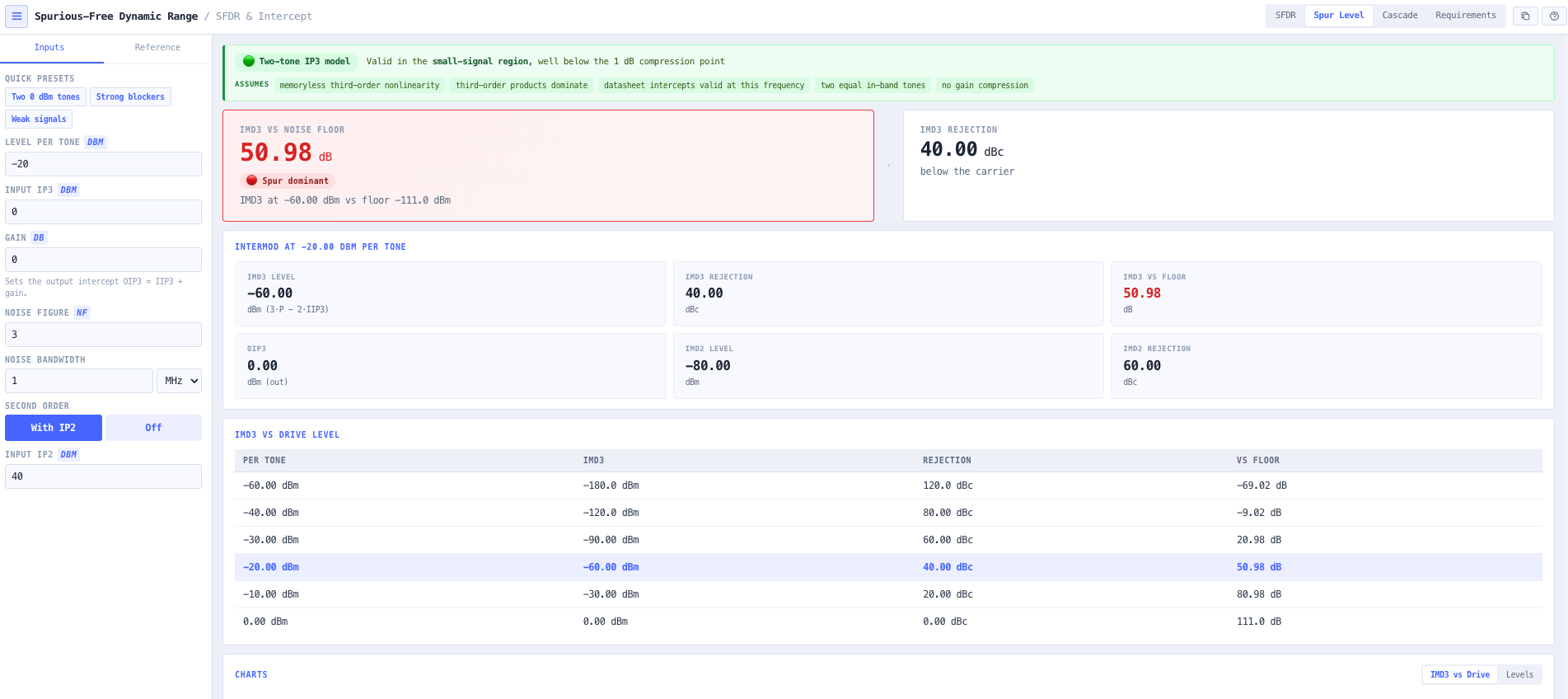
Because the third-order intermod product rises three times as fast as the wanted signal. As the input increases by one dB, the wanted output rises one dB but the intermod rises three dB, so the intermod closes on the noise floor twice as fast as the signal climbs above it. The spurious-free window therefore grows only two thirds of a dB for every dB of extra intercept. That three-to-one slope is the whole reason the third-order intercept is the headline dynamic-range number for a front end.
When does second-order dynamic range matter?
In wideband and direct-conversion, or zero-IF, receivers. A channelised receiver with good filtering ahead of the mixer is usually limited by third-order products, but a wideband or zero-IF front end sees the sum and difference of two strong signals fall directly in band, and those second-order products are set by the second-order intercept IP2. The second-order SFDR is one half of the intercept above the noise floor, reflecting the two-to-one slope. The calculator reports both windows so the governing limit for the architecture is clear.
How does a receiver cascade affect dynamic range?
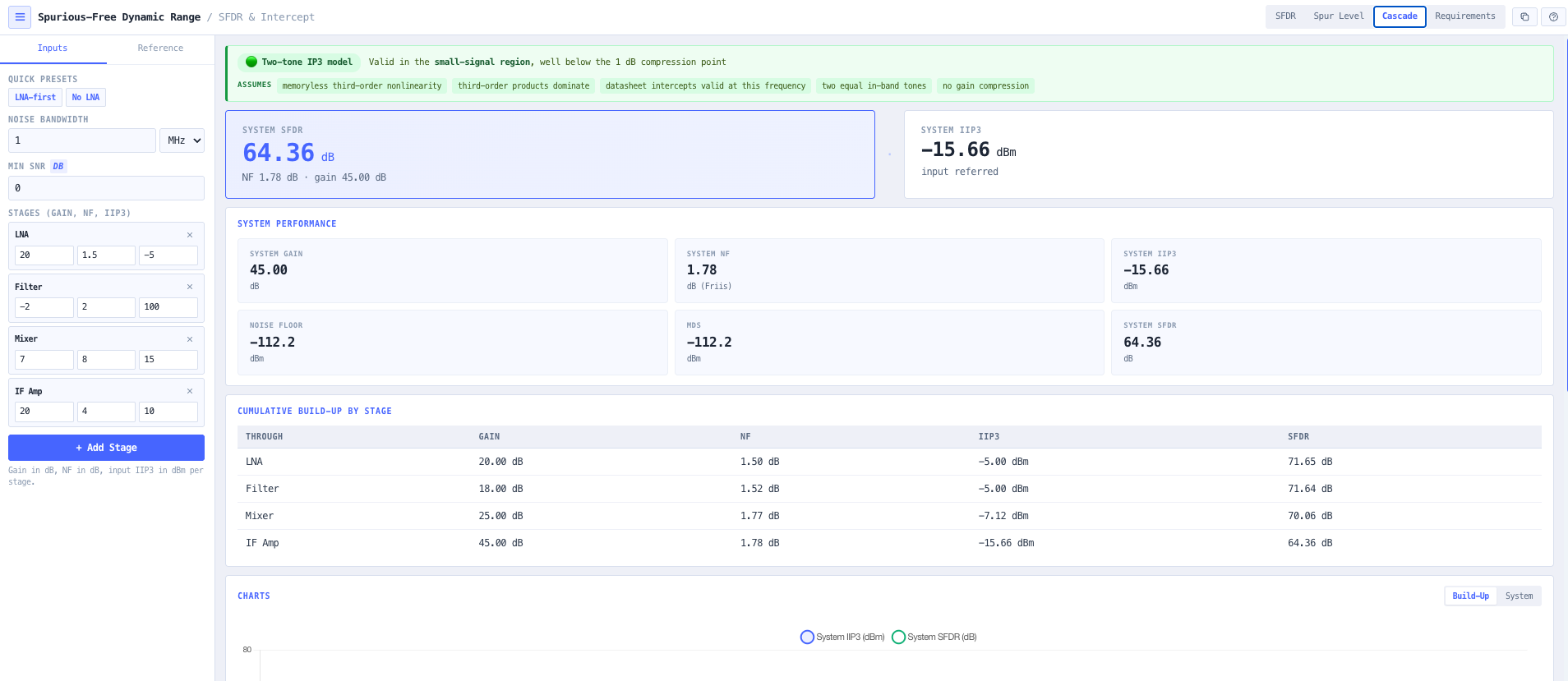
The noise figure and the intercept cascade differently, and they pull in opposite directions. The system noise figure follows the Friis formula, so the first stage dominates and a high-gain low-noise LNA sets a low floor. But the system input intercept follows the intercept cascade, where the gain ahead of a stage refers its intercept back to the input, so that same high-gain LNA pushes the system IIP3 down. Good sensitivity and good dynamic range therefore fight each other, and the SFDR is set by the balance. The Cascade mode computes both and shows the build-up stage by stage.
How do I know if a receiver is good enough for a site?
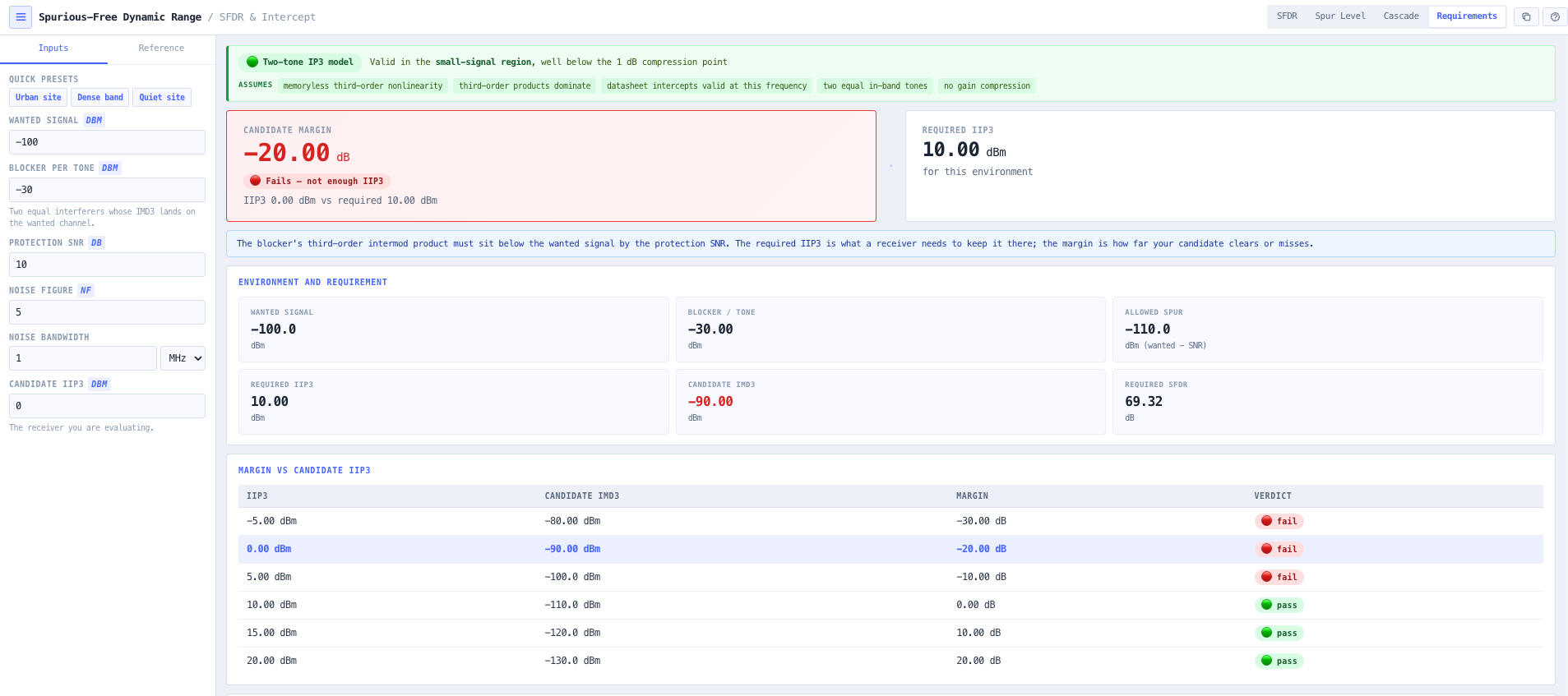
Turn the site into an intercept requirement. Take the weak wanted signal and the strong two-tone blocker whose third-order product lands on the wanted channel. The blocker intermod must sit a protection ratio below the wanted signal, and the IIP3 that achieves it is the requirement. The Requirements mode computes that required IIP3, then checks a candidate receiver: if its intercept meets or beats the requirement it passes, and the margin tells you how much headroom there is. It is the direct way to match a receiver to a real signal environment.
How accurate is the intercept model?
It is a small-signal two-tone approximation, accurate while the receiver is well below its 1 dB compression point. It assumes a memoryless third-order nonlinearity, that third-order products dominate, and that the datasheet intercepts hold at the operating frequency. Near compression the model breaks down and the real intermod rises faster than the three-to-one law predicts, so a front end being driven hard needs a measured two-tone test. The tool carries these assumptions in a prominent confidence indicator on every screen.
Does any data leave my browser?
No. The calculator runs entirely in your browser. No intercept points, noise figures, or signal environments are submitted to a server. Useful for commercially confidential work, classified projects, or environments where information security policy prohibits sending engineering data to third party services.