RF Utilities

Receiver Desensitisation Calculator

Predict, budget and cure receiver desense at colocated radio sites. Work out the sensitivity lost to an in-band interferer, colocated transmitter noise, and reciprocal mixing, and the isolation you need to stay inside a desense budget.

Overview

Receiver desensitisation, or desense, is the loss of sensitivity that happens when unwanted power lands in a receiver passband and raises its effective noise floor. It is the defining problem of a colocated radio site. Put a transmitter and a receiver on the same tower, the same mine headframe, or the same rooftop, and the transmitter broadband noise, or a strong off-channel carrier beating against the receiver local-oscillator phase noise, will steal sensitivity from the receiver even when the two are on completely different channels. A link that worked in isolation can go deaf the day a second system is installed nearby.

The arithmetic behind it is a power sum. If the receiver own noise floor is N and an interference power I falls in the same bandwidth, the effective noise floor rises to the sum of the two, and the rise in dB is the sensitivity lost. A signal only 6 dB below the noise floor already costs about 1 dB of desense; a signal equal to the noise floor costs 3 dB; and once the interference is well above the floor, every dB of interference is a dB of lost range.

The noIM3 Receiver Desensitisation Calculator is built for the systems integrator who has to predict, budget and cure this at a real site, not for the receiver designer. Set the receiver bandwidth and noise figure once and the tool computes the noise floor every mode degrades. Then work the problem from whichever end you have: a measured interferer level, a colocated transmitter datasheet, a desense budget you must not exceed, or a strong blocker and a receiver phase-noise figure.

Capabilities

Desense from any in-band interferer

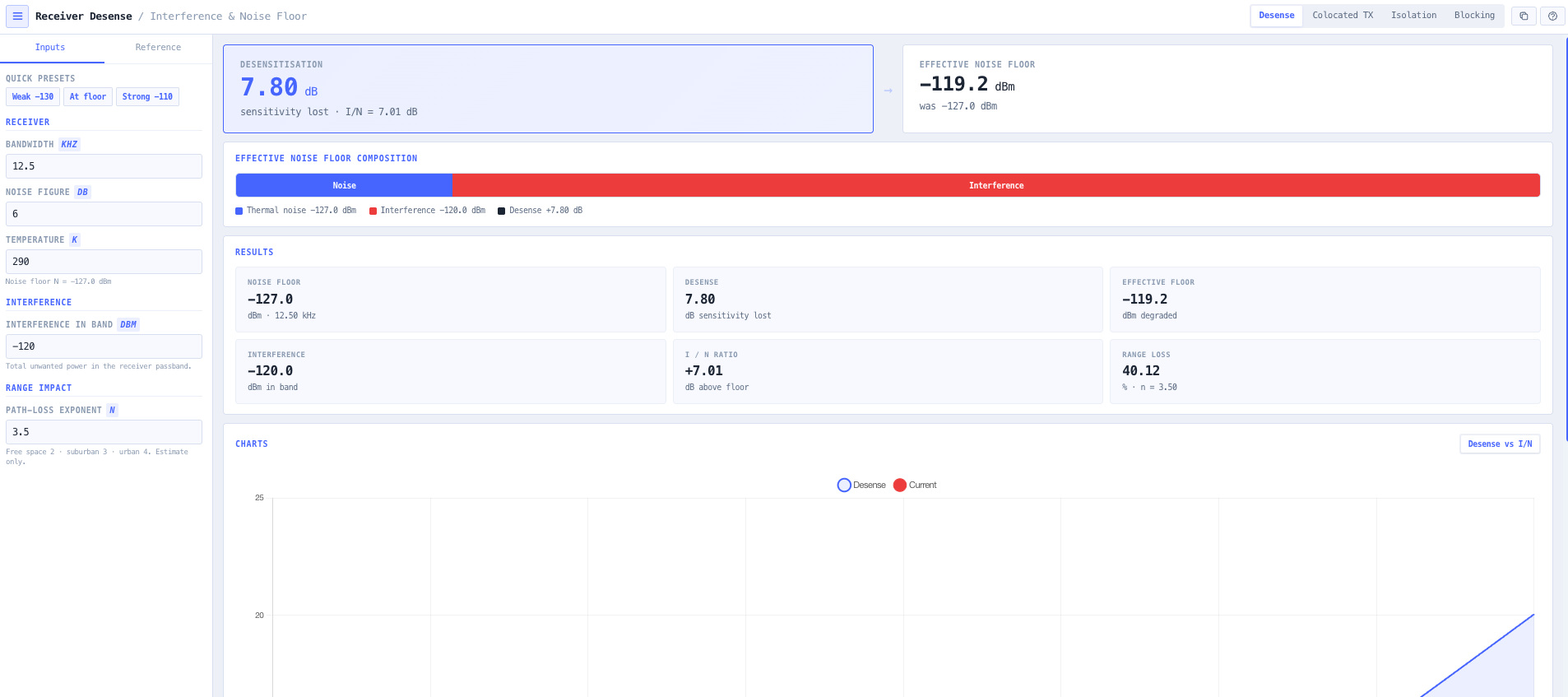
Enter the total unwanted power in the receiver passband and the tool returns the desense in dB, the degraded noise floor, and the I/N ratio. The desense is exactly the sensitivity lost, so it drops straight into a link budget.

Colocated transmitter noise

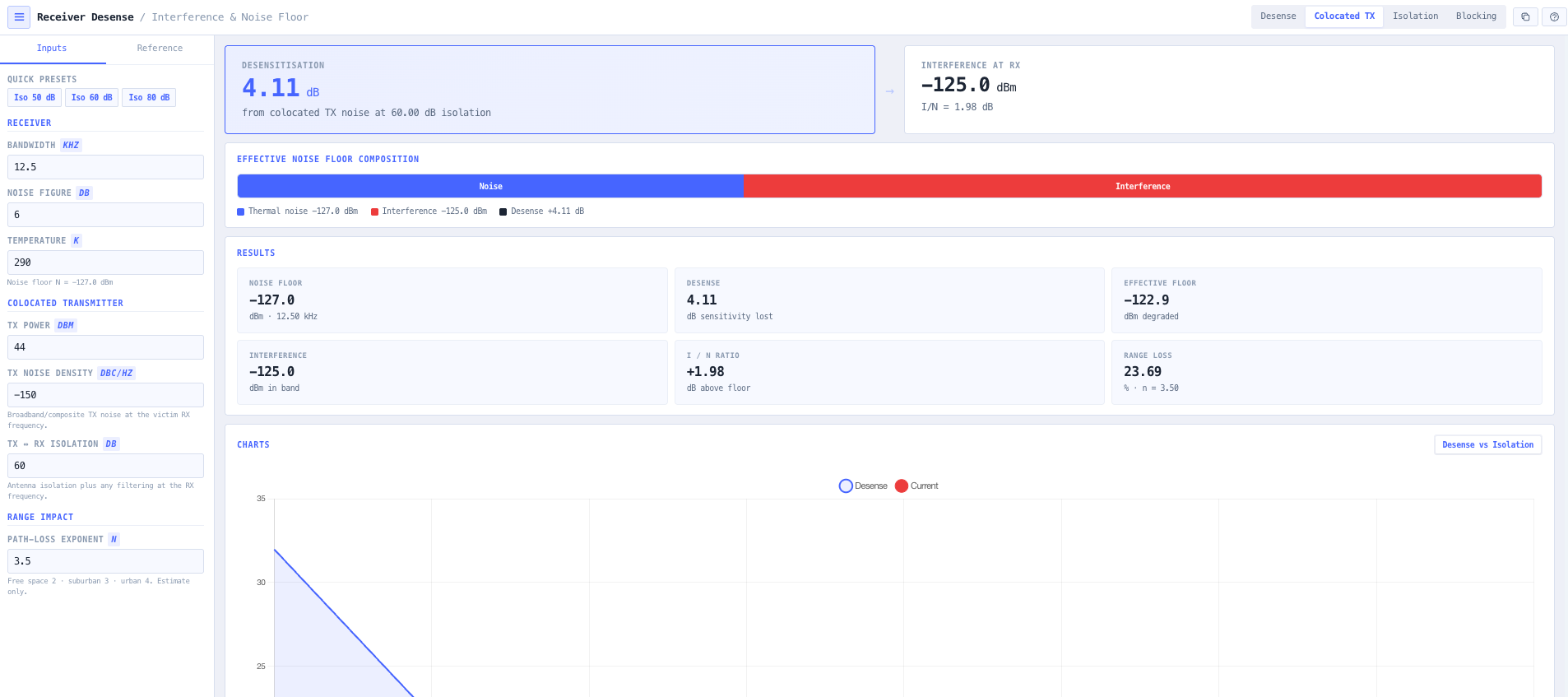
The most common cause of desense at a shared site is the broadband noise a nearby transmitter emits at the victim receive frequency. Enter the transmitter power, its noise density in dBc/Hz at the receive frequency, and the TX to RX isolation, and the tool returns the interference at the receiver and the desense it causes.

Isolation budget

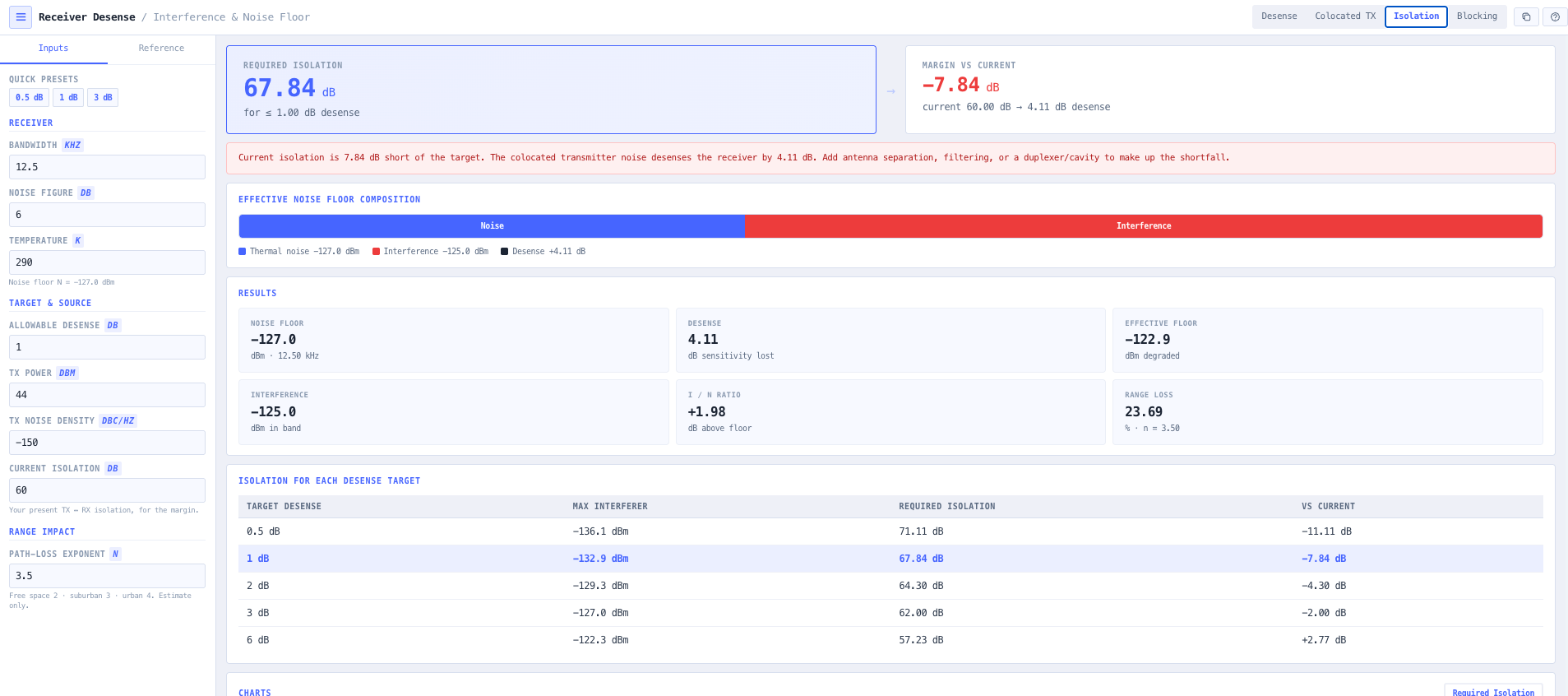
Give a desense you can tolerate, for example 1 dB, and the tool returns the transmitter to receiver isolation required to hold a colocated transmitter to it, with the margin against your current isolation and a table of the isolation needed for every common desense target.

Blocking and reciprocal mixing

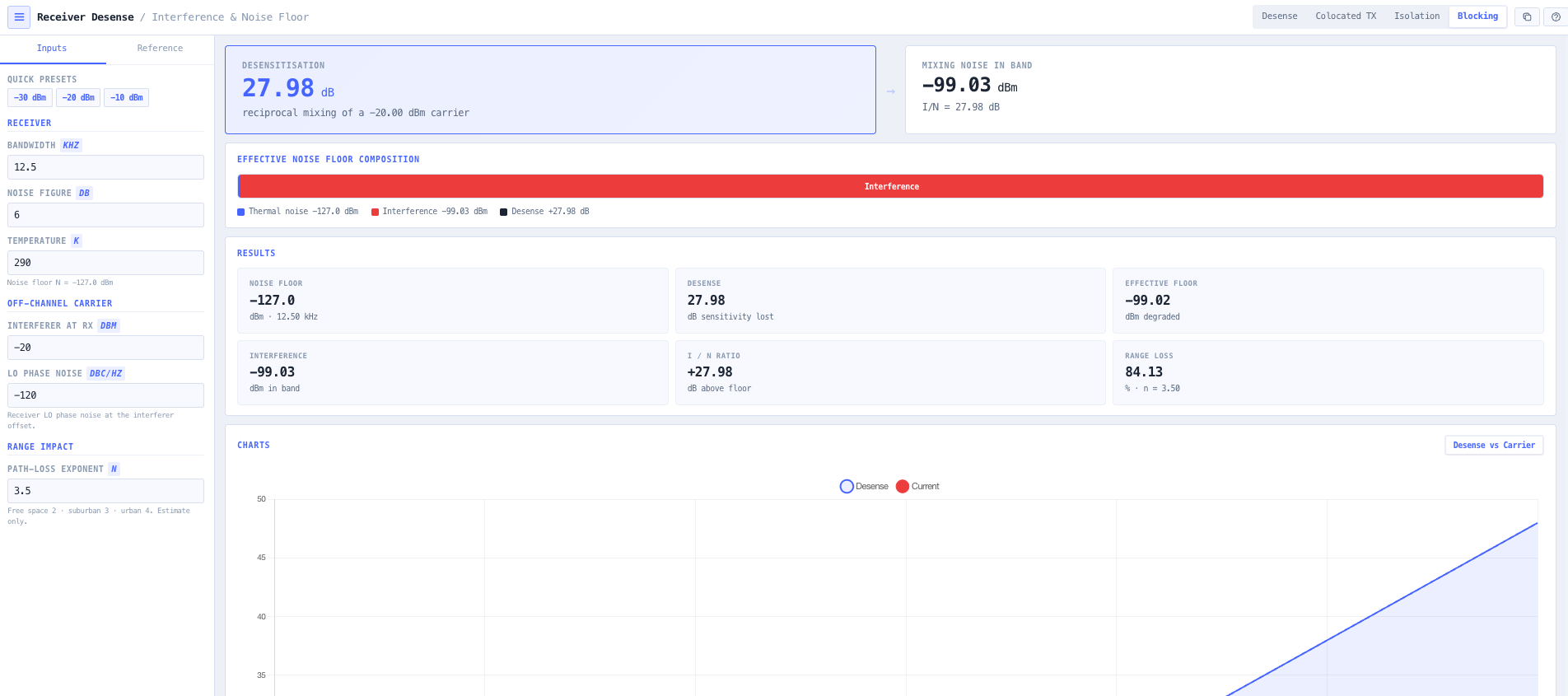
A strong off-channel carrier mixes with the receiver local-oscillator phase noise to produce in-band noise. Enter the carrier level at the receiver and the receiver phase noise in dBc/Hz at the offset and the tool returns the reciprocal-mixing noise and the desense it causes.

Noise floor computed for you

Set the receiver bandwidth, noise figure and temperature and the tool computes the thermal noise floor N = −174 dBm/Hz + 10·log(B) + NF that every mode works from, so interference and noise are always compared in the same bandwidth.

Coverage range impact

Desense in dB is turned into an estimate of the coverage range lost, using a path-loss exponent you set. It makes the operational cost of desense concrete: at a suburban path-loss exponent, 1 dB of desense is roughly 6 percent of range. It is an estimate with an explicit propagation assumption, not a coverage prediction.

Browser only computation

Runs entirely in your browser. No site data, transmitter figures or measurements are submitted to a server. Useful for commercially confidential work or any environment where information security policy prohibits sending engineering data to third party services.

Standards & methodology

  • Desense as the noise-floor rise, D = 10·log(1 + 10^((I − N)/10))
  • Thermal noise floor N = −174 dBm/Hz + 10·log(B) + NF at 290 K
  • Colocated transmitter noise I = P_tx + noise density (dBc/Hz) + 10·log(B) − isolation
  • Required interferer for a target desense, I_max = N + 10·log(10^(D/10) − 1)
  • Reciprocal mixing noise, I = P_int + LO phase noise (dBc/Hz) + 10·log(B)

When to use this tool

  • Predicting whether a colocated transmitter will desense a receiver on the same tower
  • Sizing the antenna separation or filtering needed to protect a victim receiver
  • Turning a 1 dB desense budget into a transmitter to receiver isolation requirement
  • Checking a measured raised noise floor against an interference level
  • Assessing whether a strong off-channel carrier will block a receiver by reciprocal mixing
  • Comparing the desense at 12.5 kHz, 25 kHz and wideband channel bandwidths
  • Deciding between more antenna separation, a cavity filter, or a duplexer at a shared site
  • Estimating the coverage range lost to a given amount of desense
  • Specifying the transmitter broadband noise a colocated system must meet
  • Teaching why a receiver goes deaf when a nearby transmitter is keyed on a different channel

Is this the right tool for you?

Reach for the Receiver Desensitisation Calculator in any of the following situations.

  • You are adding a 25 W repeater transmitter to a tower that already carries a sensitive receiver, and need to know whether the transmitter broadband noise will desense it before you order the antennas.
  • A receiver that worked fine has lost range since a neighbouring system was installed, and you want to know how much desense the new interferer explains.
  • You have a 1 dB desense budget for a public-safety receiver and need the transmitter to receiver isolation that holds a colocated transmitter inside it.
  • You are choosing between more vertical antenna separation and a transmitter bandpass cavity, and want to see how many dB of isolation each has to provide.
  • You are evaluating whether a strong pager or broadcast transmitter down the hill will block your receiver through reciprocal mixing given its published LO phase noise.
  • You are writing a colocation specification and need to state the maximum transmitter broadband noise, in dBc/Hz, that a new system may emit at the existing receive frequencies.
  • You are comparing a narrowband 12.5 kHz channel against a 25 kHz channel and want to see the noise-floor and desense difference.
  • You are estimating the coverage a site will lose if a proposed colocation goes ahead without extra filtering.
  • You are operating under a security regime that prohibits sending design data to third party services and need a calculator that runs entirely in your browser.

Frequently asked questions

What is receiver desensitisation?

Desensitisation, or desense, is the loss of receiver sensitivity that happens when unwanted power lands in the receiver passband and raises its effective noise floor. The receiver does not need to be tuned to the interferer; broadband transmitter noise or reciprocal mixing raises the floor across the band. The rise in the noise floor, in dB, is exactly the sensitivity the receiver loses.

How is desense calculated?

It is a power sum. If the receiver noise floor is N and the interference power in the same bandwidth is I, the effective noise floor becomes 10·log(10^(N/10) + 10^(I/10)), and the desense is the difference from N, which works out to 10·log(1 + 10^((I − N)/10)). An interferer 6 dB below the floor gives about 1 dB of desense, one equal to the floor gives 3 dB, and one well above the floor gives desense roughly equal to how far above the floor it is.

What causes desense at a colocated site?

The two dominant causes are transmitter broadband noise and reciprocal mixing. A nearby transmitter emits wideband noise that falls on the victim receive frequency even though the transmitter is on another channel, and that noise adds directly to the receiver floor. Separately, a strong off-channel carrier beats against the receiver local-oscillator phase noise to create in-band noise. This tool models both, plus the general case of any measured in-band interferer.

How much isolation do I need between a colocated transmitter and receiver?

Enough to bring the transmitter noise at the receive frequency below the level that produces your allowable desense. The tool works this out directly: give it a desense budget, the transmitter power and its broadband noise density, and it returns the transmitter to receiver isolation required, along with the margin against the isolation you already have. Isolation can come from antenna separation, transmitter and receiver filtering, or a duplexer.

How does desense affect coverage range?

Desense reduces sensitivity dB for dB, which shortens the usable range. For a power-law path loss the range shrinks to 10^(−D/(10n)) of its original value, where D is the desense and n is the path-loss exponent. At a suburban exponent of about 3.5, 1 dB of desense costs roughly 6 percent of range and 3 dB costs about 18 percent. The tool reports this as an estimate with an explicit propagation assumption, not a coverage prediction.

Who is this tool for?

Systems integrators, site engineers and radio technicians who install and coordinate colocated radio systems, rather than receiver circuit designers. Everything here is about predicting, budgeting and curing desense in a deployed system: noise floor, interference, isolation and coverage impact. It does not model receiver front-end circuit design.

Does any data leave my browser?

No. The calculator runs entirely in your browser. No site data, transmitter figures or measurements are submitted to a server, which suits commercially confidential work and any environment where information security policy prohibits sending engineering data to third party services.