Antenna Utilities

Antenna Power Density Calculator

RF exposure, EIRP, and compliance assessment for wireless installations. Compute power density, electric field, magnetic field, and minimum safe distance against FCC and ICNIRP reference levels.

Overview

Every transmitter on every site eventually has to answer the same question. How much RF energy is reaching the people standing nearby, and is it within the legal exposure limit? Internationally that limit is set by the ICNIRP reference levels, and the FCC §1.1310 (OET-65) framework covers United States compliance. Australia adopts the ICNIRP 2020 reference levels through ARPANSA Radiation Protection Series S-1, so the ICNIRP setting in this calculator gives the limits that apply to an Australian site. Get the answer wrong on the conservative side and you over engineer signage, exclusion zones, and tower top access procedures. Get it wrong on the other side and you create a regulatory and safety problem that no operator wants.

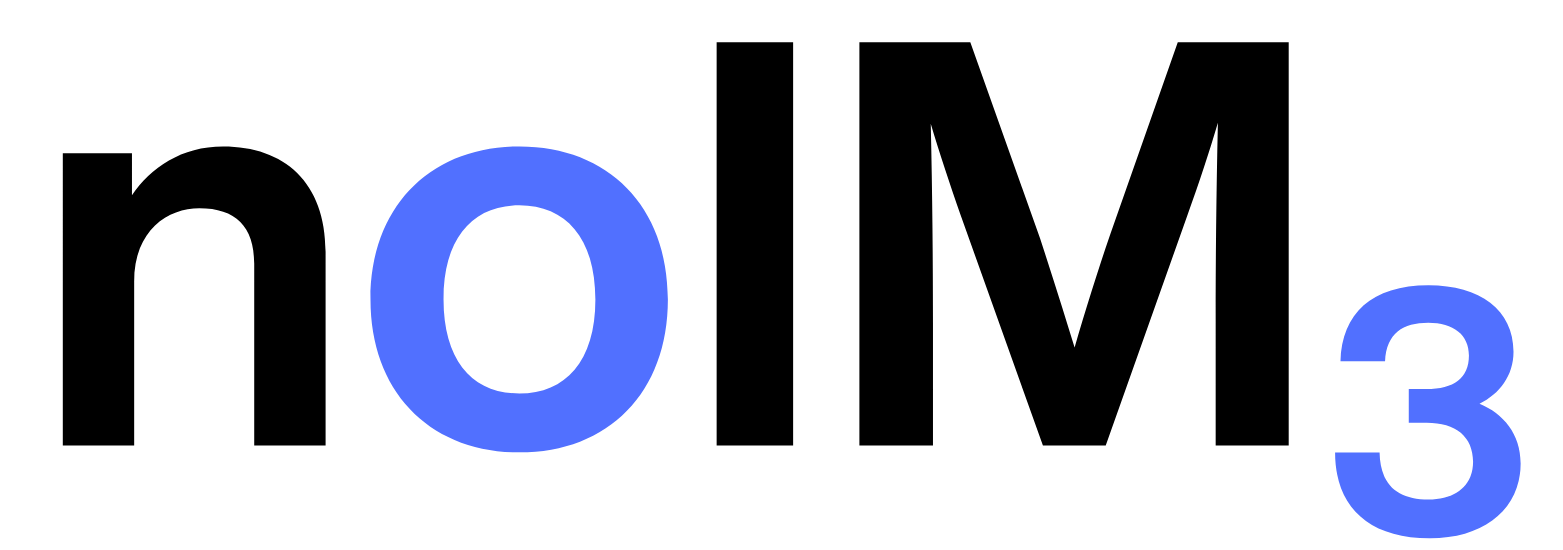
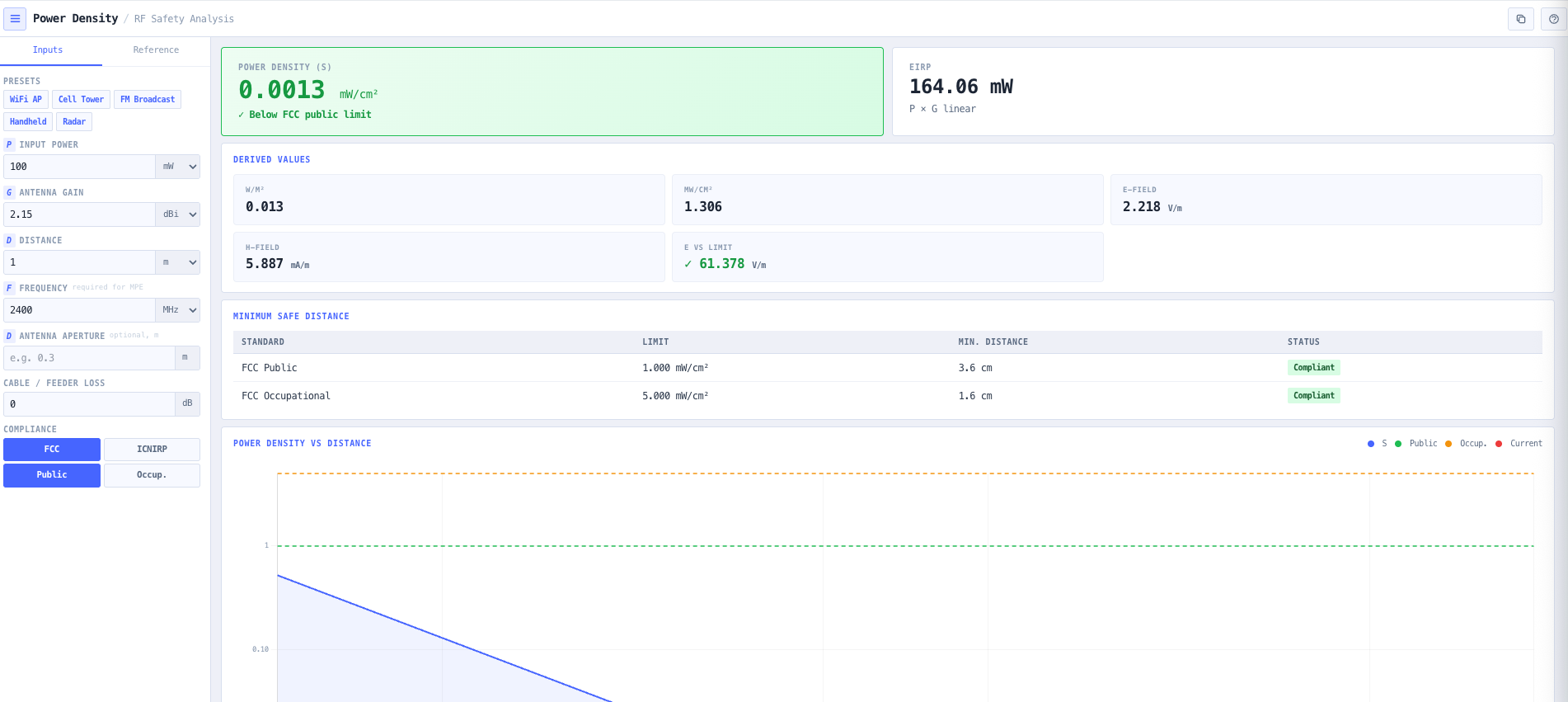
The noIM₃ Antenna Power Density Calculator gives a precise, defensible answer in one workspace. From transmitter input power, antenna gain, separation distance, operating frequency, and feeder cable loss, it computes EIRP, far field power density (in W/m squared, mW/cm squared, and microwatt/cm squared), electric field strength (V/m), and magnetic field strength (A/m). Frequency banded public and occupational MPE limits drive a colour coded compliance verdict, and the minimum safe distance is computed automatically for both the public and occupational limits.

Preset profiles for WiFi access points, cell towers, FM broadcast transmitters, handheld radios, and radar installations get you to a usable answer fast for common configurations while preserving full manual control over every parameter when the deployment is unusual. The interactive distance visualisation shows the inverse square fall off of power density alongside the public and occupational limit lines, so the conservative envelope is obvious to a non specialist stakeholder reviewing the analysis.

Capabilities

EIRP and far field power density

Calculates effective isotropic radiated power (EIRP) from input power and antenna gain, with feeder cable loss in dB subtracted from the input power before the EIRP is formed. Far field power density at a configurable separation distance is then computed from the inverse square law S = EIRP / (4 pi d squared). Output is provided simultaneously in W per square metre, mW per square centimetre, and microwatt per square centimetre for compatibility with engineering, regulatory, and safety documentation.

Electric and magnetic field strength outputs

Beyond power density the calculator derives electric field strength in V per metre via E = square root of (eta_0 times S) and magnetic field strength in A per metre via H = E / eta_0, where eta_0 is the free space wave impedance of 376.73 ohm. The electric field is also compared against the MPE electric field limit, supporting RF safety assessments that quote field strength rather than power density.

FCC and ICNIRP public and occupational limits

Frequency banded MPE limits from FCC §1.1310 (OET-65) for the United States and ICNIRP 2020 reference levels for the international context, which Australia adopts through ARPANSA RPS S-1. A standard selector switches between FCC and ICNIRP and a population selector switches between general public (uncontrolled) and occupational (controlled). The active limit is surfaced alongside the computed value so the compliance check is a glance rather than a spreadsheet lookup.

Minimum safe distance calculation

The minimum safe distance table returns d_safe = square root of (EIRP / (4 pi times S_lim)) for both the public and occupational limits, the smallest separation at which power density drops to each limit, and tags the configured distance as compliant or inside the hazard zone. Useful for placing safety signage, defining exclusion zones, planning tower top access procedures, and confirming an installation meets the limit at the nearest point of public access.

Preset wireless system profiles

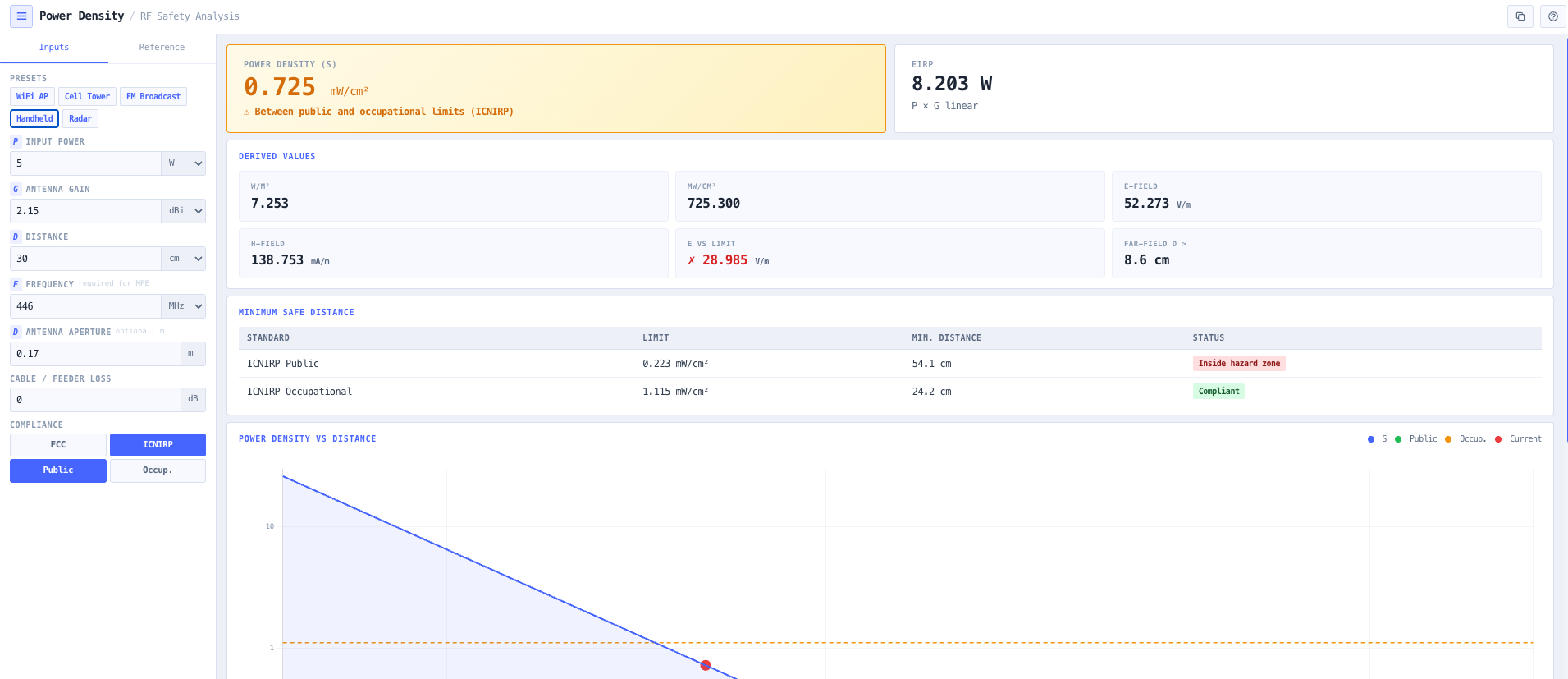
Five quick select presets seed typical configurations with power, gain, distance, frequency, and a representative antenna aperture: WiFi access point (100 mW, 5 dBi, 1 m, 2.4 GHz), cell tower (40 W, 18 dBi, 50 m, 900 MHz), FM broadcast (10 kW, 6 dBd, 100 m, 100 MHz), handheld radio (5 W, 2.15 dBi, 30 cm, 446 MHz), and radar (1 kW, 30 dBi, 10 m, 9.4 GHz). Each gets you to a usable answer in one click.

Near field warning

Enter the largest antenna dimension and the calculator computes the Fraunhofer far field boundary 2 D squared over lambda and raises a warning when the configured distance falls inside it. In the near field the inverse square law is not a valid exposure metric. The far field result is still computed for reference, but the warning makes the validity boundary explicit so a compliance verdict is not relied on inside the near field.

Interactive distance visualisation

A logarithmic chart shows how power density falls with the inverse square of distance, with overlay lines for the public and occupational limits and a marker for the configured distance. Reinforces intuitive understanding of how quickly exposure drops with separation, and gives stakeholders a clear visual that supports the documented analysis.

Browser only computation

Runs entirely in your browser. No transmitter, antenna, or site data is submitted to a server. Results can be copied to the clipboard as a plain text summary. Useful for commercially confidential cellular and broadcast infrastructure work, defence and security installations, or any environment where information security policy prohibits sending engineering data to third party services.
Standards & methodology

  • FCC §1.1310 / OET-65. Evaluating compliance with FCC guidelines for human exposure to radiofrequency electromagnetic fields, frequency banded MPE for general population and occupational exposure
  • ICNIRP 2020. Guidelines for limiting exposure to electromagnetic fields (100 kHz to 300 GHz), general public and occupational reference levels
  • ARPANSA Radiation Protection Series S-1. The Australian RF exposure standard, which adopts the ICNIRP 2020 reference levels — select the ICNIRP setting for Australian compliance

When to use this tool

  • Assessing RF exposure compliance for cellular and broadcast installations
  • Determining minimum safe separation distances for public and occupational areas
  • Evaluating handheld and portable transmitter exposure during normal use
  • Supporting ACMA licence applications and RF exposure compliance documentation
  • Planning antenna placement and exclusion zones for base stations and repeaters
  • Teaching RF safety, EIRP, and inverse square law fundamentals
  • Producing exclusion zone diagrams for site safety management plans
  • Validating tower top access procedures against occupational exposure limits
  • Preparing exposure assessment evidence for community or council enquiries
  • Comparing alternative antenna or power configurations for compliance margin
  • Cross checking a vendor or consultant exposure assessment against an independent calculation
  • Producing FCC OET-65 compliance documentation for United States deployments

Is this the right tool for you?

Reach for the Antenna Power Density Calculator in any of the following situations.

  • You are responsible for a cellular base station installation and need to confirm that public access areas around the site comply with the general public exposure limit.
  • You are planning a broadcast or transmitter site and need to define exclusion zones and minimum safe distances for the general public and occupational populations.
  • You are responding to a community enquiry or council request for evidence that an installation is within the RF exposure limits.
  • You are validating tower top access procedures against the occupational exposure limit before issuing a permit to climb.
  • You are preparing an ACMA licence application or variation that requires evidence of RF exposure compliance, and need the ICNIRP limits that ARPANSA RPS S-1 adopts.
  • You are evaluating handheld radio or portable transmitter use against the occupational reference levels for routine workplace use.
  • You are designing an antenna placement plan for a rooftop installation and need to know the minimum clearance for public and occupational areas.
  • You are comparing two antenna and transmit power options for a cellular site and want to see which configuration delivers better compliance margin.
  • You are auditing an inherited radio installation against current reference levels and need a documented analysis of the exposure margin at the nearest point of public access.
  • You are producing FCC OET-65 compliance documentation for a deployment in the United States and need EIRP, power density, and field strength outputs in the unit families the FCC expects.
  • You are training new RF engineers in exposure assessment and want a teaching tool that surfaces EIRP, power density, electric and magnetic field, and the inverse square law together.
  • You are responsible for a radar or high gain antenna installation and need to verify the boresight power density against the occupational exposure limit at maintenance access positions.
  • You are preparing exclusion zone signage for a transmitter site and need defensible minimum safe distance calculations to size the signed perimeter.
  • You are operating under a security regime that prohibits sending engineering data to third party services and need a calculator that runs entirely in your browser.
  • You are conducting a quick what if analysis on a proposed transmit power increase and want to see the new minimum safe distance against the existing site layout before the modification is approved.

Frequently asked questions

Which exposure standards are referenced?

The calculator carries frequency banded MPE limits from FCC §1.1310 (OET-65) for United States compliance and the ICNIRP 2020 reference levels for the international context. Australia adopts the ICNIRP 2020 limits through ARPANSA Radiation Protection Series S-1, so selecting ICNIRP gives the limits that apply to an Australian site. A standard selector switches between FCC and ICNIRP, and a population selector switches between general public and occupational. The active limit is surfaced alongside the computed power density so the compliance check is immediate.

What is the difference between general public and occupational exposure?

General public (uncontrolled) limits apply to anyone who could be exposed without their knowledge or control, and they are tighter than occupational limits by a factor of typically five (depending on standard and frequency). Occupational (controlled) limits apply to RF aware workers exposed under controlled conditions with appropriate procedures and supervision. The minimum safe distance is returned for both populations, and the compliance verdict reports whether the level sits below the public limit, between the public and occupational limits, or above the occupational limit.

How is EIRP calculated?

EIRP equals transmitter input power times antenna gain (linear). Any feeder cable loss entered in dB is first subtracted from the input power, so a non zero feeder loss is honoured in the EIRP and every downstream result. EIRP is then used to compute far field power density at the configured separation distance via S = EIRP / (4 pi d squared).

What is the far field assumption and when does it apply?

Far field power density calculations assume the observation point is far enough from the antenna that the radiation pattern has fully formed. This is typically taken as 2 D squared over lambda, where D is the largest antenna dimension. Enter the antenna aperture and the calculator computes this boundary and warns when the configured distance falls inside it. Closer than the far field, near field effects can produce higher local power densities than the far field formula predicts, and a more rigorous near field assessment may be required for very high gain installations.

How does minimum safe distance work?

The calculator solves the inverse problem against each MPE limit. Given the EIRP and the limit S_lim, it returns d_safe = square root of (EIRP / (4 pi times S_lim)), the separation distance at which power density drops to the limit. The minimum safe distance table reports d_safe for both the public and occupational limits and tags the configured distance as compliant or inside the hazard zone. Use this for sizing exclusion zones, placing signage, and defining tower top access standoff distances.

Does it cover near field and high gain antennas correctly?

For most cellular, broadcast, and handheld scenarios the far field assumption is appropriate beyond a few wavelengths from the antenna. For very high gain antennas (large parabolic dishes, high gain radar arrays) where points of interest may sit inside the far field boundary, an additional near field assessment is recommended. Enter the antenna aperture and the calculator surfaces the far field boundary and raises a warning, so the limitation is visible rather than hidden.

Does any data leave my browser?

No. The calculator runs entirely in your browser. No transmitter, antenna, or site data is transmitted to a server. Results can be copied to the clipboard as a plain text summary. Useful for commercially confidential cellular and broadcast infrastructure work, defence and security installations, or environments where information security policy prohibits sending engineering data to third party services.
How is this different from the EIRP Calculator?

The EIRP Calculator focuses on the radiated power calculation itself (input power plus antenna gain minus losses) for use in link budgets and compliance limits expressed as EIRP. The Antenna Power Density Calculator extends that to the human exposure assessment, returning power density, electric and magnetic field strength, and minimum safe distance against the FCC and ICNIRP reference levels. Use EIRP for transmit power compliance. Use power density for human exposure compliance.