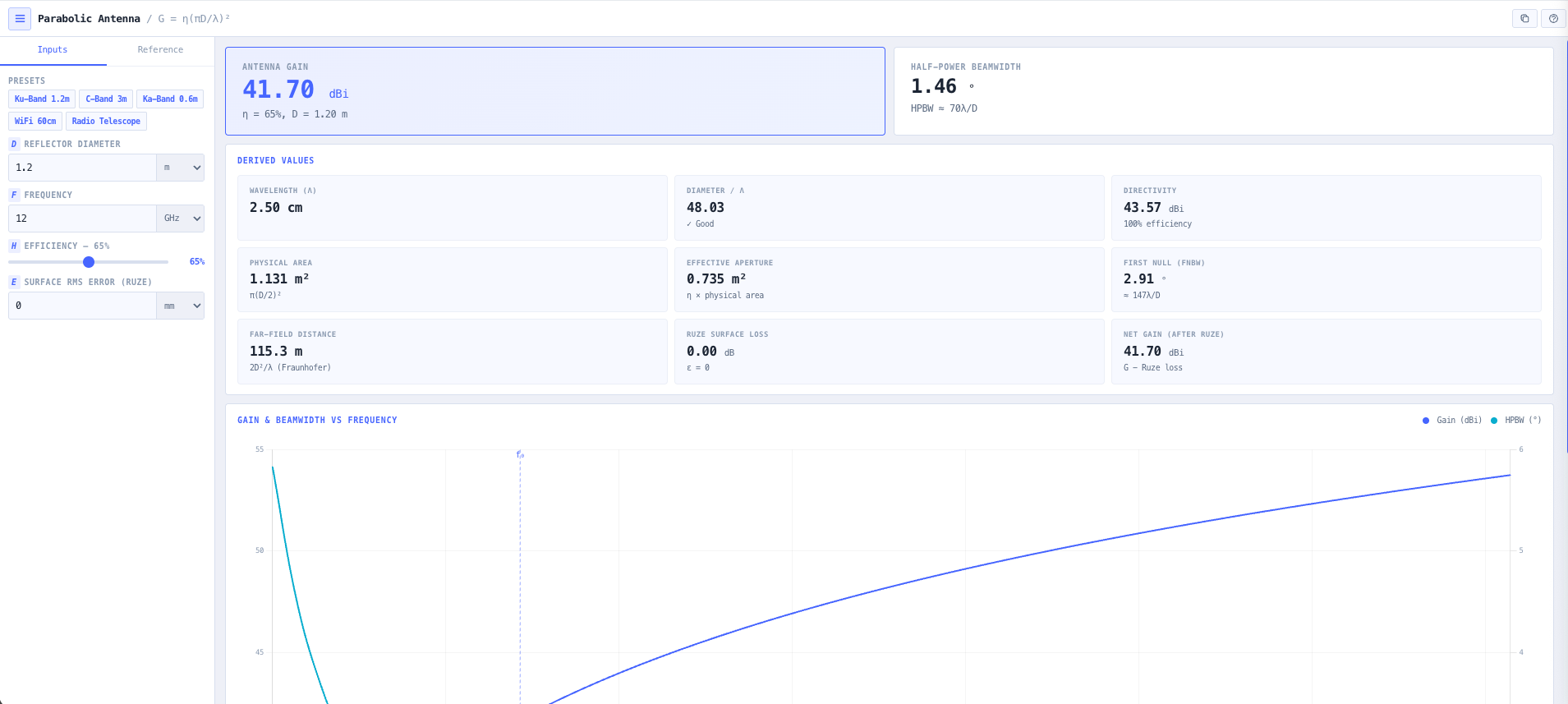
Parabolic dish antennas dominate every link where high gain in a small angular footprint matters. Satellite ground stations, microwave backhaul, point to point millimetre wave, radar, radio astronomy, deep space communications. The physics is the same in every case. A reflector of diameter D collects energy across its physical aperture and focuses it into a narrow beam. Realised gain follows G equals eta times pi D divided by lambda all squared, where lambda is the wavelength and eta is the antenna efficiency. The half power beamwidth follows roughly 70 lambda over D in degrees. From those two relationships every other parameter that engineers actually use (effective aperture, far field distance, pointing tolerance) falls out.
The noIM₃ Parabolic Antenna Calculator computes every one of those parameters from the inputs that engineers actually have on hand. Reflector diameter in metres. Operating frequency in GHz. Antenna efficiency as a percentage with guidance for the common feed configurations (prime focus, offset, Cassegrain). The output is realised gain in dBi alongside theoretical directivity in dBi (so you can see how much performance the feed system is costing you), half power and first null beamwidths in degrees, effective aperture and physical area, far field (Fraunhofer) distance in metres, and the diameter to wavelength ratio that determines whether the reflector is electrically large enough to deliver the gain you want.
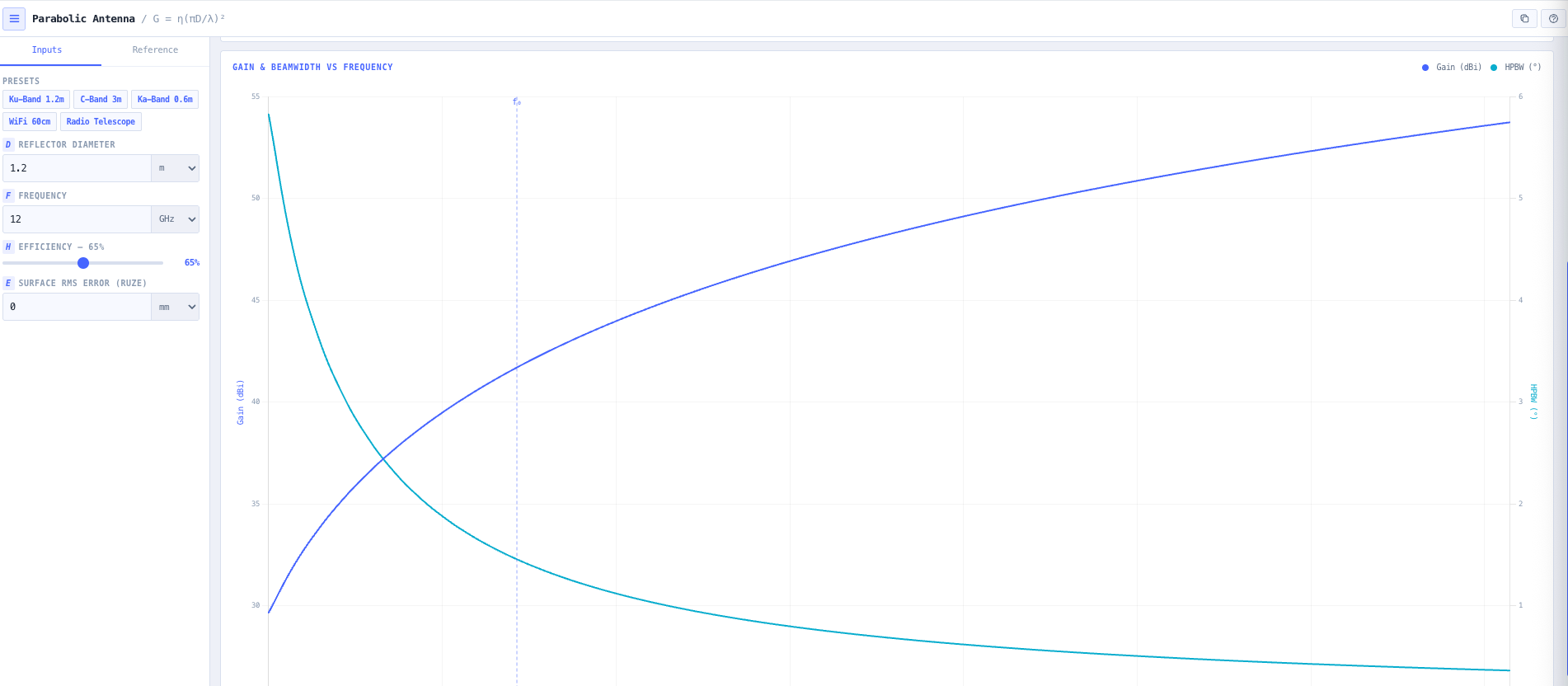
A gain versus frequency sweep visualisation shows how performance scales across bands, which is the right way to evaluate a dish upgrade from C band to Ku band, or to validate that a microwave backhaul antenna keeps its gain across the operator licensed channel range. Built in presets for a Ku band 1.2 m dish, a C band 3 m dish, a Ka band 0.6 m dish, a 60 cm WiFi grid antenna, and a 25 m radio telescope accelerate common workflows. Browser only computation means design data never leaves the machine, which matters for defence, intelligence, and commercially confidential satellite work.