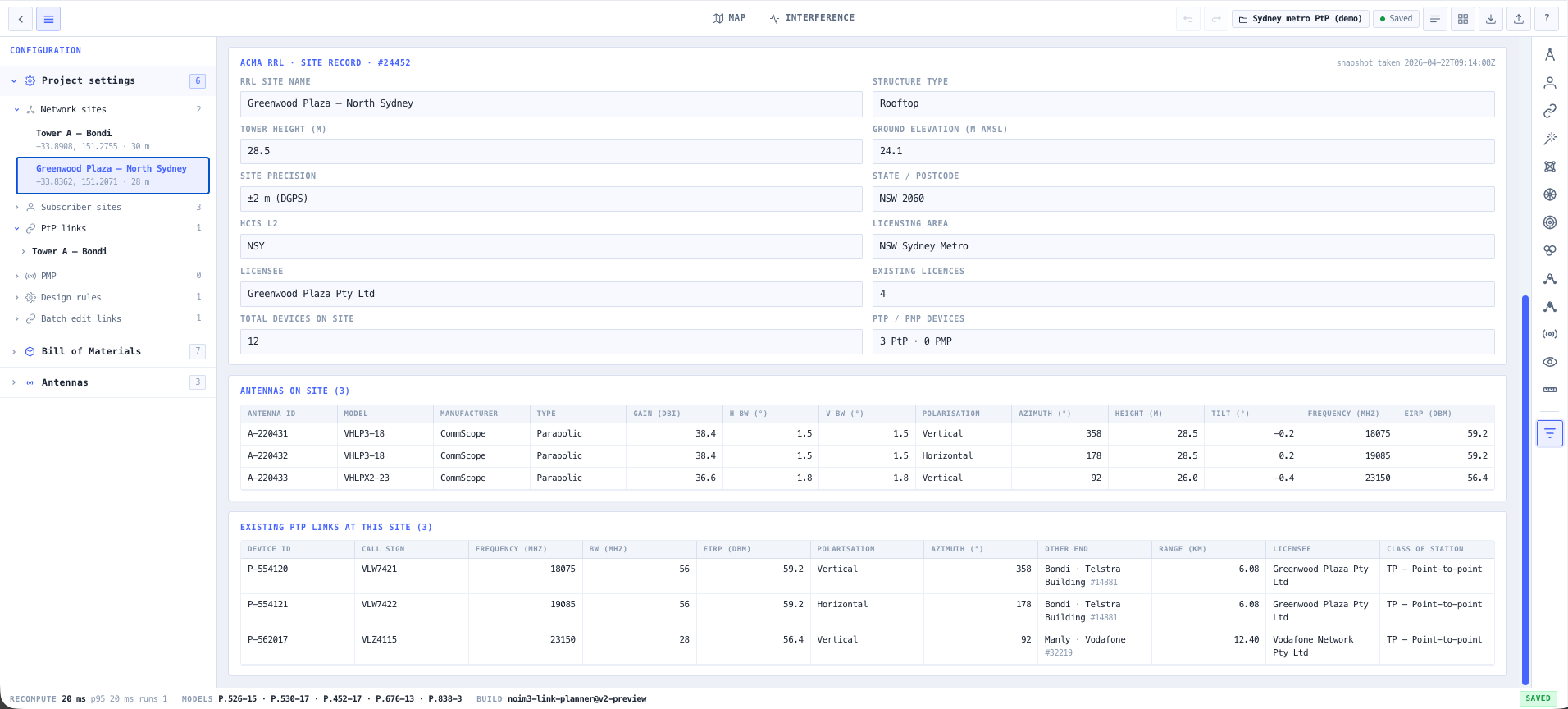
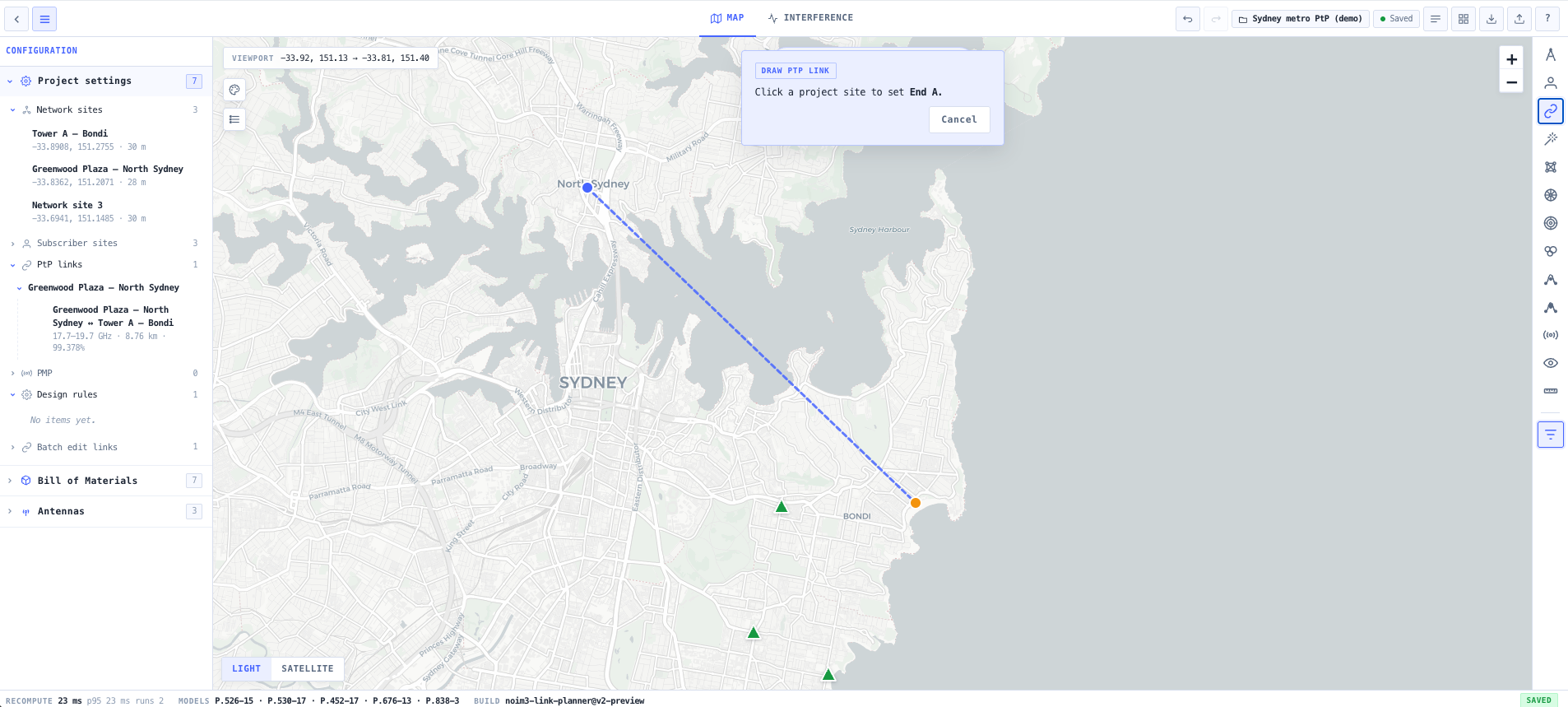
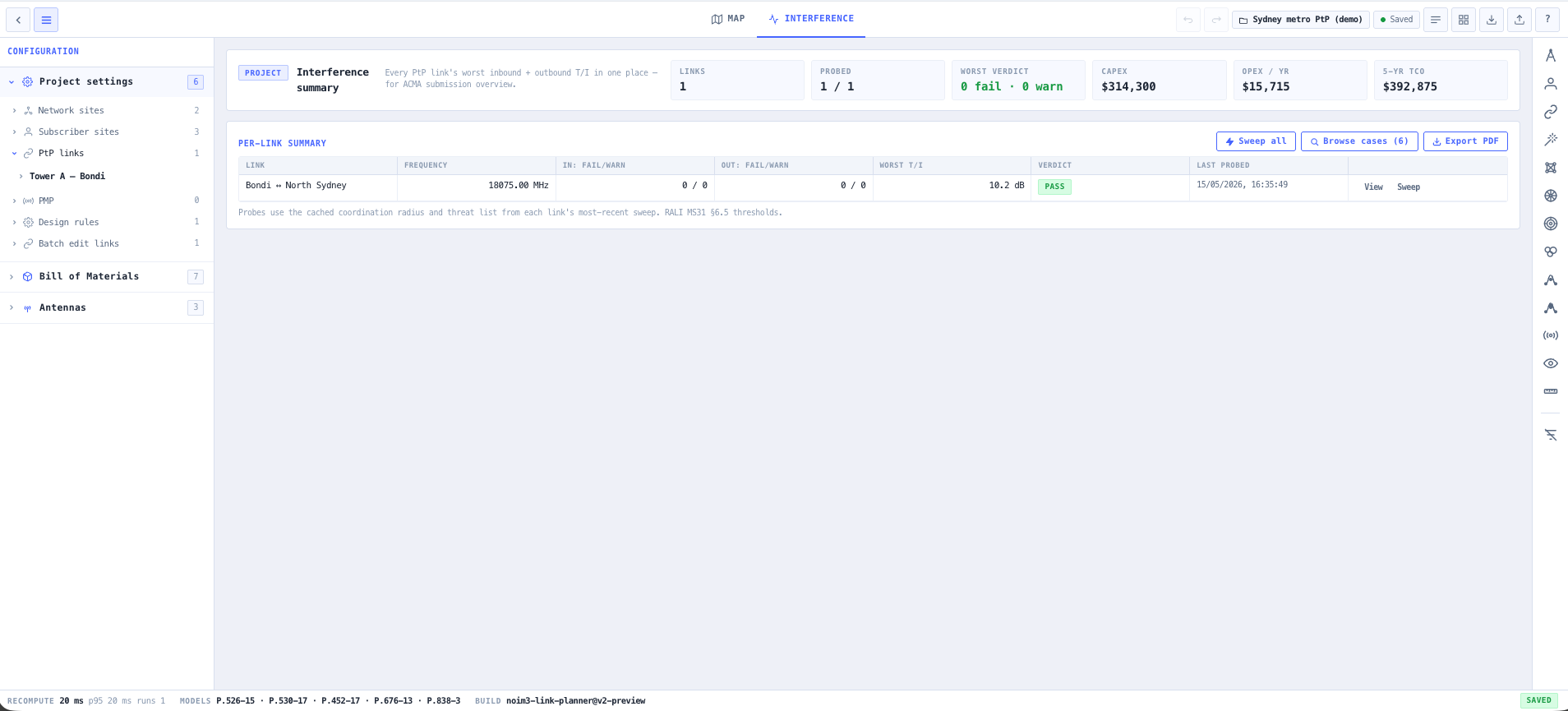
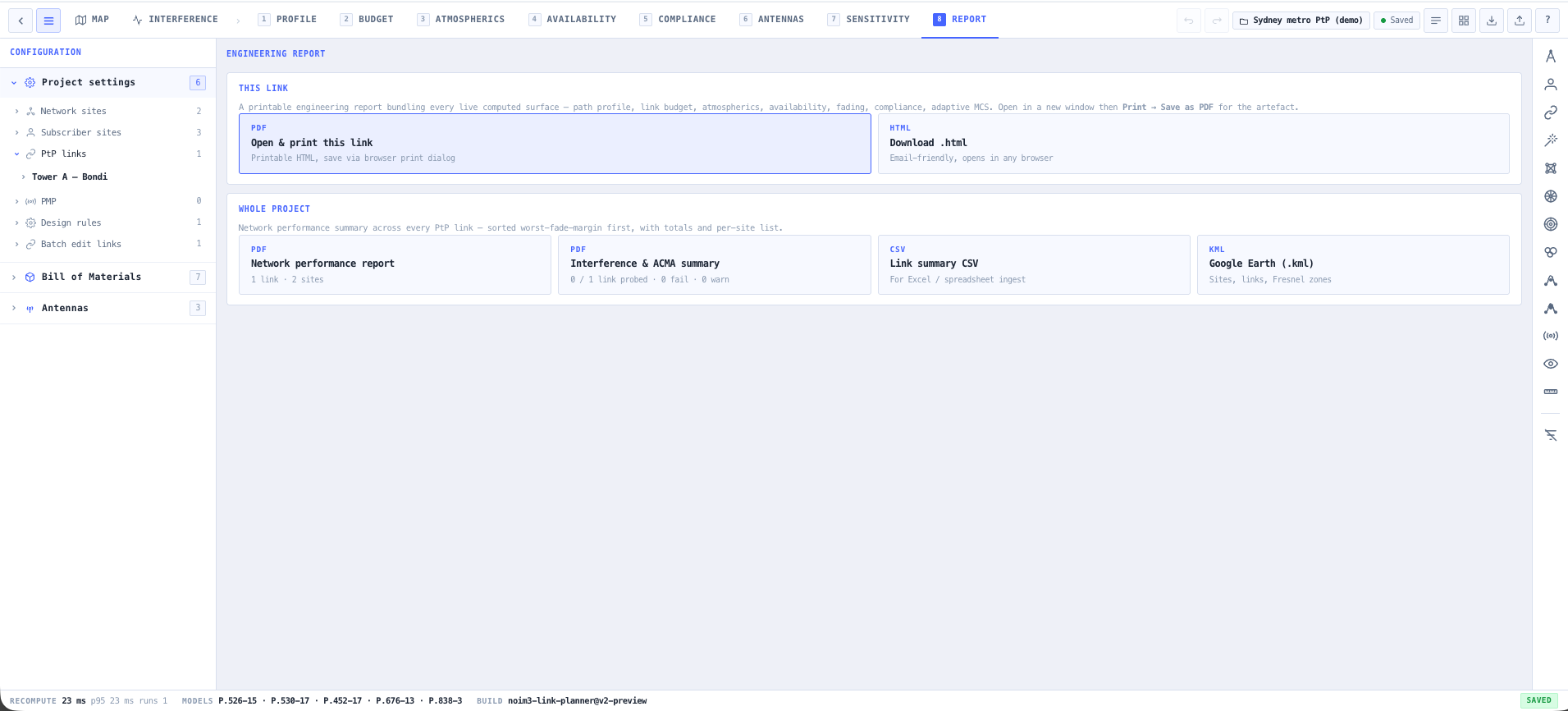
A microwave point to point link looks deceptively simple on paper. Two sites, a clear line of sight, a frequency, an antenna at each end. In practice, getting from a site survey to a link that actually meets its availability target involves terrain modelling, Fresnel zone clearance, atmospheric absorption, rain attenuation, multipath fading, diversity gain, antenna pattern matching, regulatory channel selection, and a coordination check against incumbents. Skip any one of these and the link either fails to perform on the day, or fails coordination during licensing.
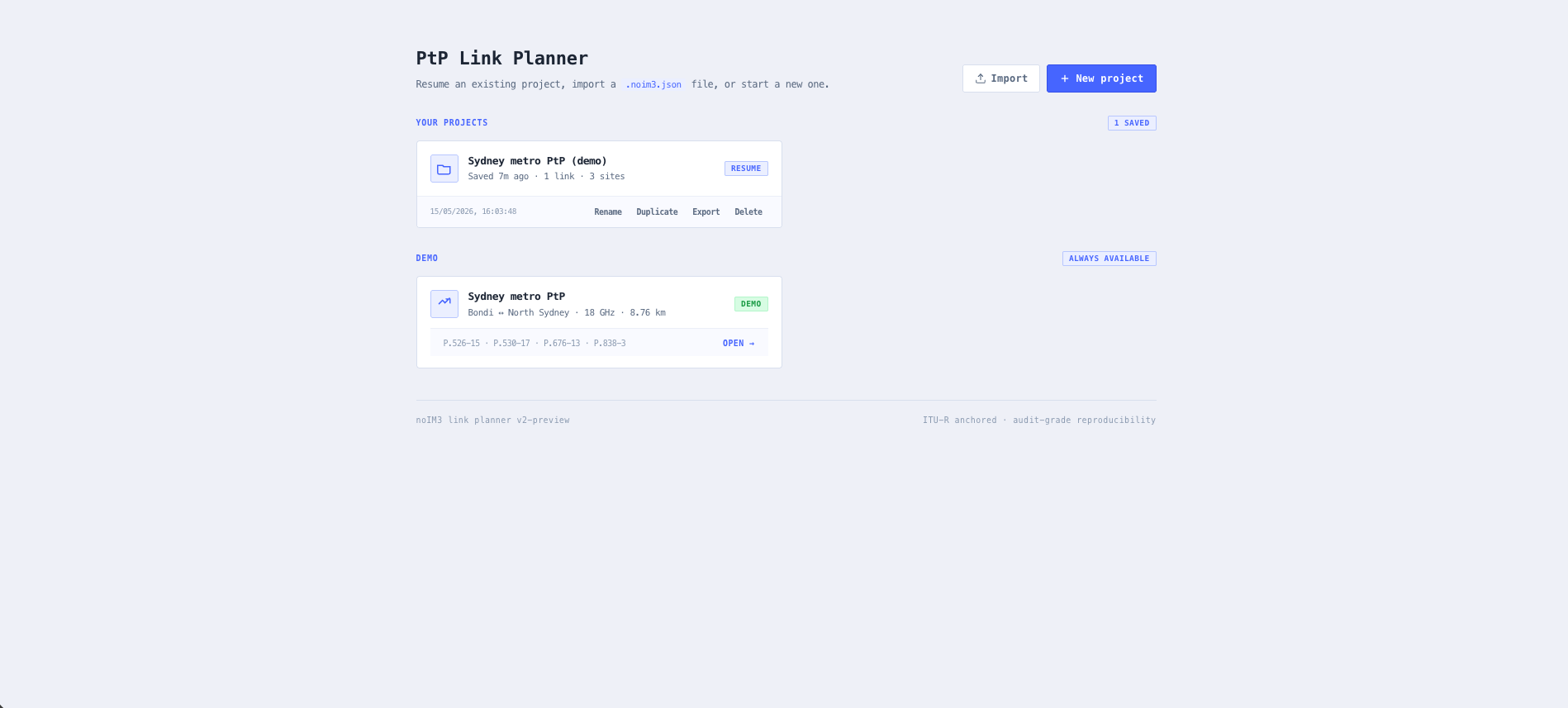
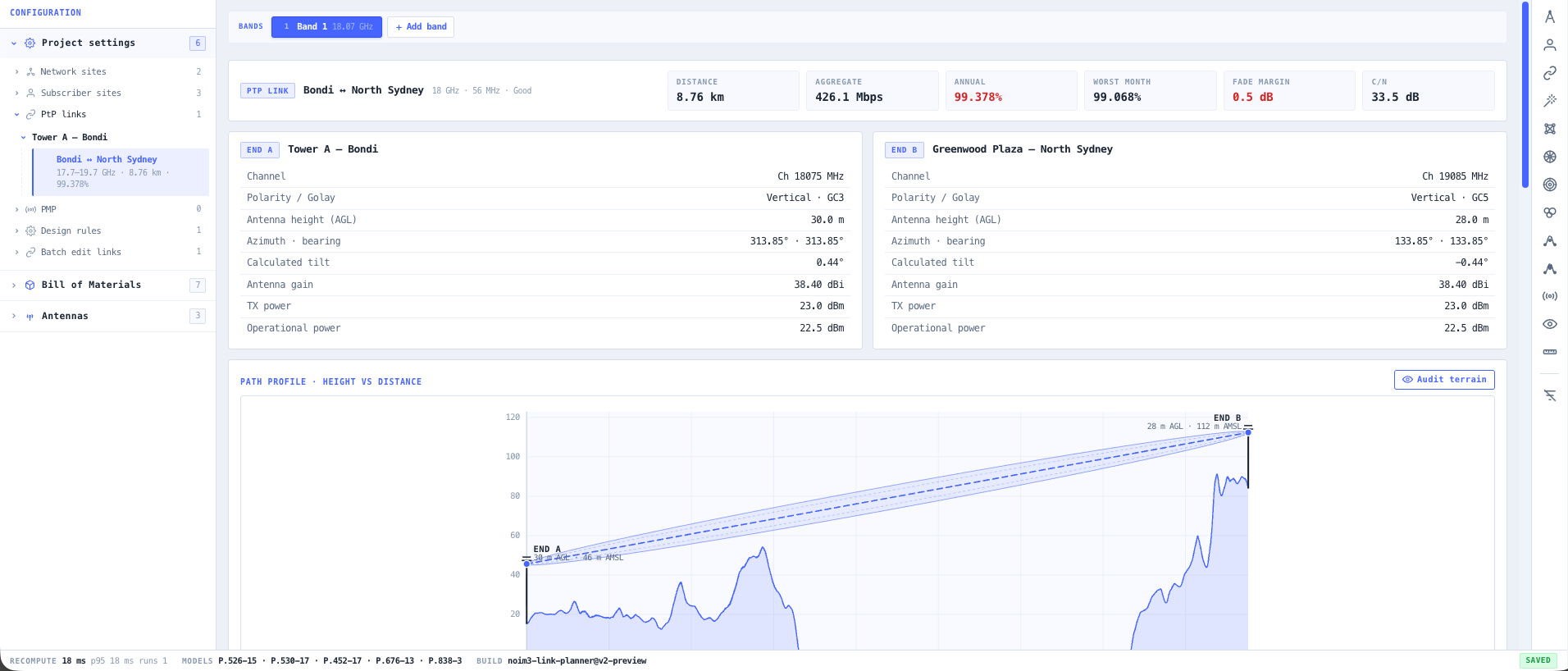
The noIM₃ Point to Point Link Planner is a full ITU anchored RF planning workstation that runs entirely in your browser. It implements ITU-R P.526-16 for diffraction, P.530-19 for line of sight propagation including rain and wet snow, multipath, cross polar discrimination and diversity, P.837-8 for rain rate with annual and monthly statistics, P.676-13 for atmospheric gas absorption, P.838-3 for rain attenuation coefficients, P.839-4 for rain height, P.840-9 for cloud and fog attenuation, and P.2108-1 for clutter loss. Every number on screen is tied back to the input that produced it, so a link budget is not a black box but an auditable engineering artefact.
Path profiles are sampled from the Mapbox global Terrain RGB DEM with configurable sampling density and earth curvature treatment, then evaluated against Fresnel zone clearance and ITU diffraction loss. Antenna patterns are modelled with full elevation and azimuth response so that mechanical tilt, twist, and sway are accounted for in the budget. Rain and gas attenuation are conditioned on the local climate using the ITU rain rate maps and BOM data where Australian sites are involved. The result is a link plan that is defensible to a regulator, a customer, or your future self when the network is in service and a fade event needs investigation.
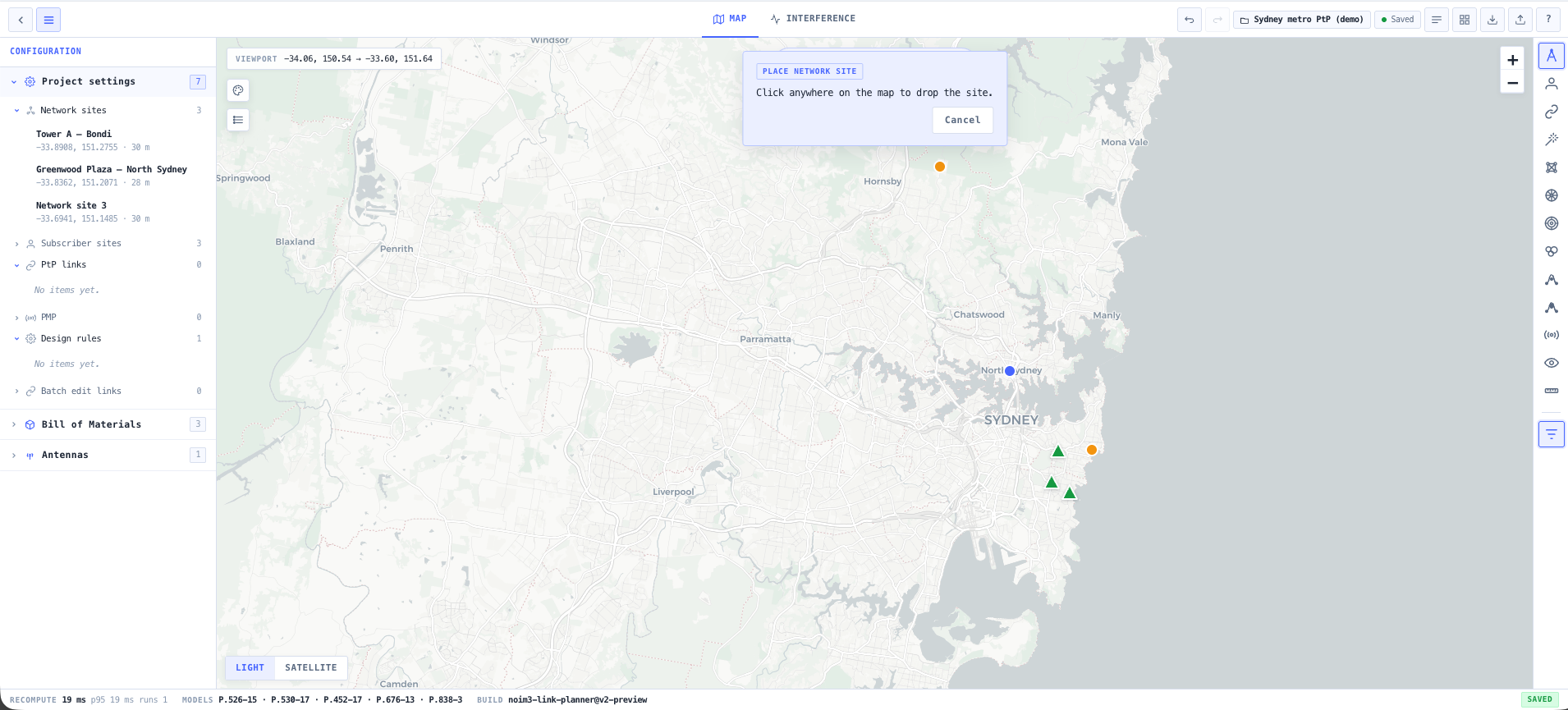
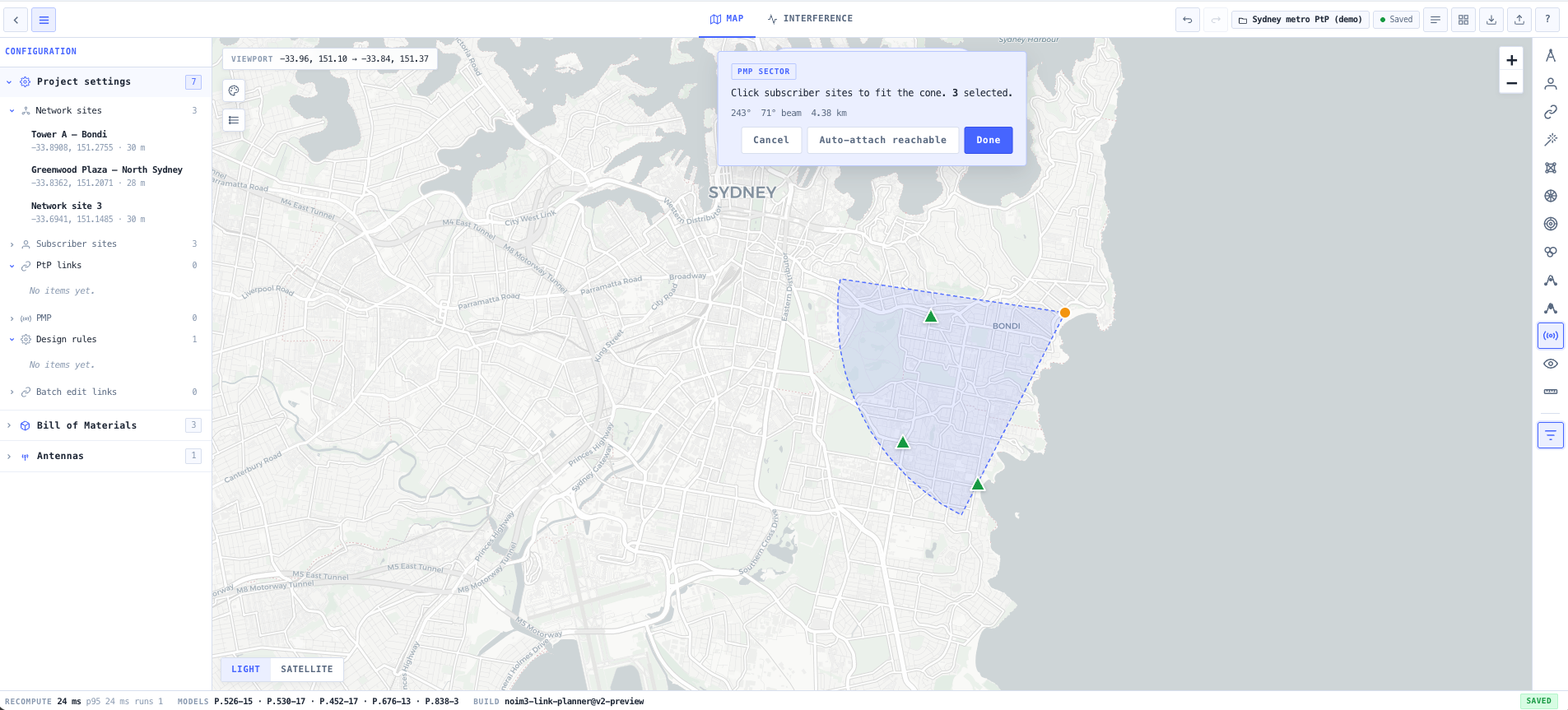
The same workstation plans point to multipoint access as well as point to point backhaul. You draw a sector from a base station over its subscribers, and every base to subscriber leg becomes a real link analysed through the identical engine, so per subscriber clearance, receive level, fade margin, availability, and modulation come from the actual terrain rather than a nominal range circle. Each sector carries its own editable radio configuration of frequency, channel width, polarisation, transmit power, and antenna gain, and changing any of them re-runs the affected legs. The sector is then sized for aggregate downlink throughput using an airtime fair model anchored to each subscriber real net rate, and a co-channel carrier to interference figure is reported for subscribers served by co-located sectors that share a channel, so you can stagger frequencies for clean reuse.