Fiber Optic Design

Fibre Optic Cable Selector

Pick the right outside-plant fibre cable from a real manufacturer catalogue, filtered on fibre count, installation method, armour, sheath, temperature and duct clearance, with aerial spans checked against the datasheet sag and tension table.

Overview

Choosing an outside-plant fibre cable is rarely about the fibre. The glass inside a 72 fibre loose-tube cable and a 72 fibre ADSS cable is the same G.652.D; what separates them is whether the cable can hold its own weight across a 450 m pole span, survive a termite-heavy trench, fit the sub-duct you already have in the ground, and meet the fire rating the building demands. Those are mechanical and environmental questions, and they are the ones this tool answers.

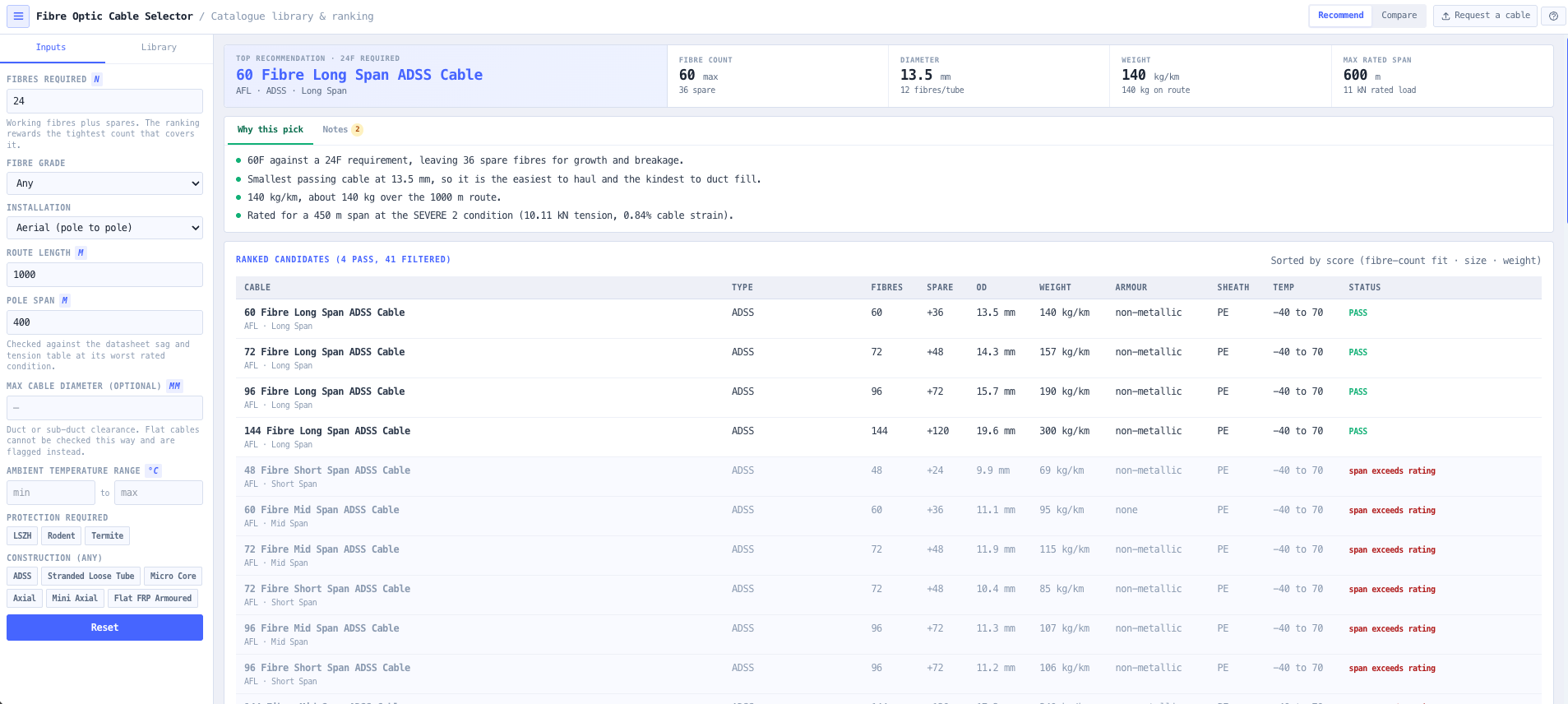
The selector reads a catalogue of real manufacturer cables and filters them against what you actually asked for: fibre count, fibre grade, installation method, LSZH, rodent and termite protection, ambient temperature range and maximum cable diameter. Anything that fails one of those constraints is shown with the reason it failed rather than quietly dropped, so you can see how close the near misses were and which constraint is doing the excluding.

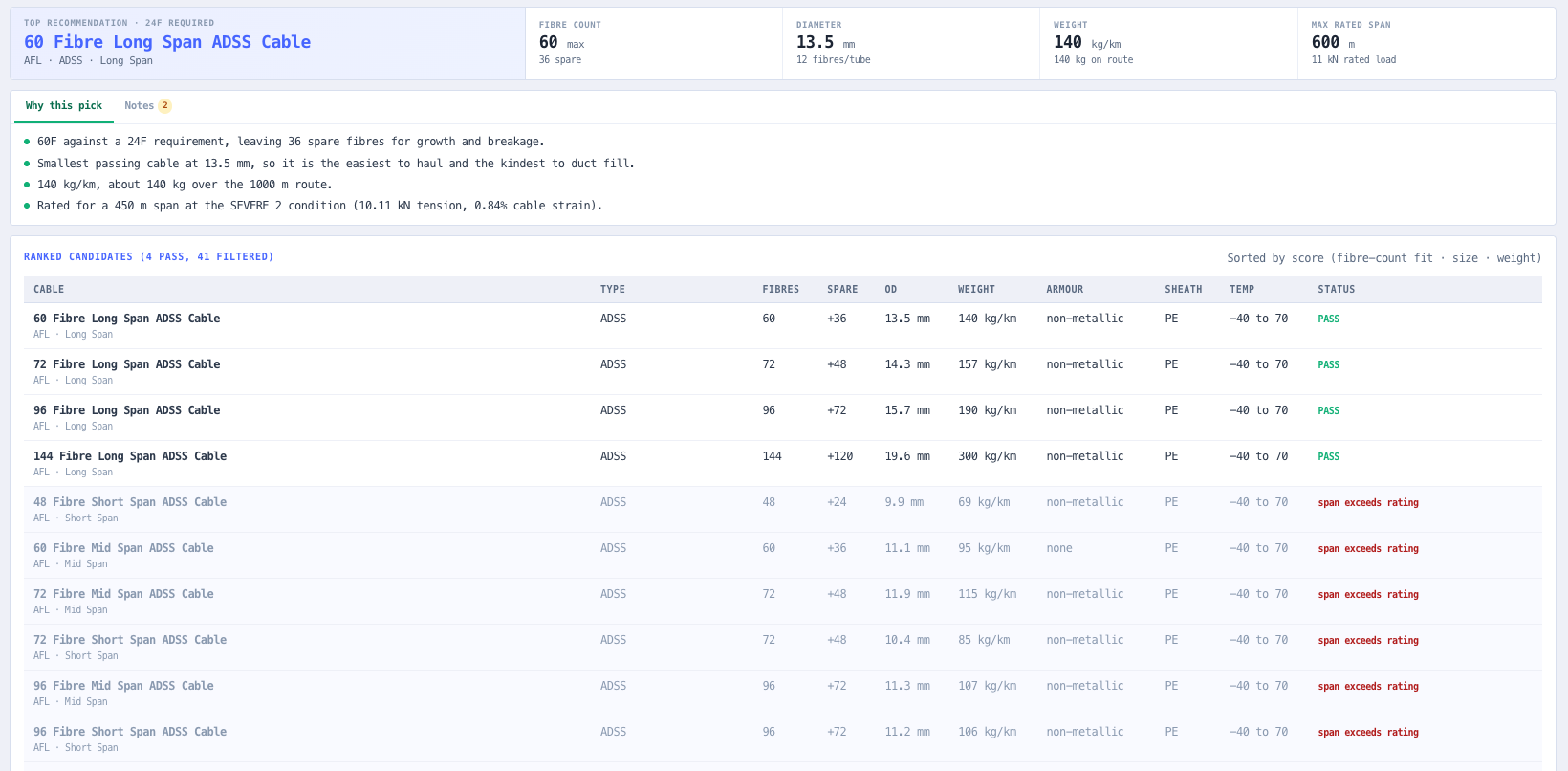
For aerial work the tool goes further. ADSS datasheets publish a sag and tension table covering an everyday stress condition and several severe wind and ice cases. The selector normalises those tables and checks your requested span against them, surfacing the sag, tension and cable strain at the worst condition that rates your span, and warning when you are inside ten percent of the longest span the sheet covers.

Capabilities

Ranked candidates with visible fail reasons

Every cable in the catalogue is evaluated, not just the passing ones. Failures are labelled in plain language, such as too few fibres, not self-supporting, span exceeds rating or too large for duct, so you can see exactly which constraint removed a cable and decide whether to relax it.

Aerial span check against the real sag and tension table

For ADSS cables the requested pole span is matched against the datasheet stringing examples at the worst rated condition. The tool reports span, sag, the vertical sag component under wind, tension and cable strain exactly as printed, and highlights the row it matched.

Fibre-count fit scoring

The commonest selection error is ordering a 144 fibre cable for a 24 fibre job. Scoring is weighted toward the tightest count that covers the requirement, then cable diameter and weight, so the recommendation is the one that does the job without over-buying.

Derived filters with verbatim provenance

Armour class, sheath class, rodent and termite protection are derived from datasheet prose that varies from sheet to sheet. The derived value drives the filter, and the original wording is shown beside it in the datasheet panel so you can always check what the manufacturer actually wrote.

Duct fit and route weight

Filter on maximum cable diameter for sub-duct clearance, and see estimated drum weight over your route length. Flat cables, which have no single nominal diameter, are flagged for manual checking rather than silently passed or failed.

Full datasheet panel

The physical characteristics table is reproduced verbatim, including bend radii, crush resistance, pulling tension and maximum cable breaking load, alongside part-number templates, applicable standards and the manufacturer application notes.

Standards & methodology

  • IEC 60793 optical fibres
  • IEC 60794 optical fibre cables
  • ITU-T G.652 and G.657 single-mode fibre
  • AS/CA S008 and AS 1049
  • AS/NZS 11801-1 and TIA-598-D

When to use this tool

  • Sizing a fibre backbone for a mine site or industrial campus
  • Choosing between short, mid and long span ADSS for a roadside pole route
  • Verifying a pole span against the manufacturer sag and tension table
  • Finding a cable that fits an existing sub-duct with limited clearance
  • Selecting a rodent-resistant cable for a direct-buried rural route
  • Selecting an LSZH cable for a building riser or equipment room
  • Checking whether a cable survives the ambient range at a desert or alpine site
  • Avoiding over-ordering fibre count on a small access build
  • Comparing loose-tube, micro-core and axial construction for a duct haul
  • Estimating drum weight before booking haulage and jointing crews
  • Building a cable schedule for a fibre tender response
  • Cross-checking a supplier recommendation against the published datasheet

Is this the right tool for you?

Reach for the Fibre Optic Cable Selector in any of the following situations.

  • A 450 m span between distribution poles needs a 96 fibre aerial cable. Filter to aerial, enter the span, and the tool eliminates short and mid span ADSS on rating and reports the tension and cable strain the long span cable sees at the severe wind case.
  • An existing 32 mm sub-duct already carries one cable and has limited clearance. Set the maximum diameter and the tool ranks the micro-core and axial constructions that fit, flagging flat cables it cannot check that way.
  • A direct-buried route crosses termite country. Tick termite protection and the catalogue drops to the cables whose datasheets state a termite-resistant nylon jacket, with the verbatim wording shown for each.
  • A building riser needs 24 fibres with a fire-safe sheath. Tick LSZH and set the installation to in building, and only the low-smoke zero-halogen cables remain.

Frequently asked questions

Does this tool calculate optical loss or a link budget?

No, and that is deliberate. The outside-plant datasheets behind this library publish mechanical and environmental data only; the manufacturer holds attenuation figures in a separate optical characteristics document. Producing a loss number here would mean inventing data rather than sourcing it. Use the PON Optical Budget and Connector and Splice Loss calculators for the loss maths, using the attenuation for your chosen fibre grade.

How does the aerial span check work?

ADSS datasheets publish stringing examples covering an everyday stress condition and several severe wind and ice cases, each with a span, sag, tension and cable strain. The tool normalises those tables, then finds the highest-tension condition that rates your requested span. If no condition covers it, the cable fails on span. If your span is within ten percent of the longest rated span, it passes with a warning to confirm with a manufacturer sag and tension calculation.

Why does the tool sometimes say the fibre grade is set by part number?

Several cables are ordered as a part-number template where a wildcard selects the fibre type, so one product covers single-mode and multimode variants. In that case the tool does not claim a fitted grade, it lists the grades the code legend makes available and reminds you to confirm the grade at order.

Where do the armour and sheath classifications come from?

They are derived from the datasheet wording, which varies considerably between sheets. The derived class drives the filters so that the catalogue is searchable, and the original manufacturer text is displayed beside it in the datasheet panel so nothing is hidden behind our interpretation.

Why is a cable with no diameter shown still passing my duct filter?

Flat cables have no single nominal diameter, so a diameter comparison is not meaningful for them. Rather than pass or fail them on a number that does not exist, the tool flags them so you can check the cross-section against the duct yourself.

Can I use a non-ADSS cable aerially?

Not without a separate support system. ADSS cable is built to carry its own weight between poles; loose-tube and micro-core cables are not self-supporting and would need lashing to a messenger wire or a catenary. Selecting an aerial installation therefore fails non-ADSS constructions.

How do I get a cable added to the library?

Use the Request a cable button in the tool. Submissions go to the catalogue maintainer with your notes and, if you attach one, the manufacturer datasheet. Accepted cables are added to the shared library for all users.