Cable Utilities

VSWR Calculator

Voltage Standing Wave Ratio, reflection coefficient, return loss, and mismatch loss in one workspace. Quantify how much transmit power actually reaches the antenna and where the rest is going.

Overview

Voltage Standing Wave Ratio is the single most useful diagnostic for any RF transmission line and antenna system. It tells you how well the load (typically the antenna) is matched to the transmission line. A VSWR of 1.0 means perfect matching and all forward power reaches the load. A VSWR of 2.0 means about 11 per cent of forward power is reflected back. A VSWR of 3.0 means 25 per cent of forward power is reflected. Above that, transmitter protection circuits start folding back the output, antenna efficiency drops sharply, and any high power transmitter risks damage from the standing wave on the feeder. Field technicians measure VSWR before and after every install for exactly this reason.

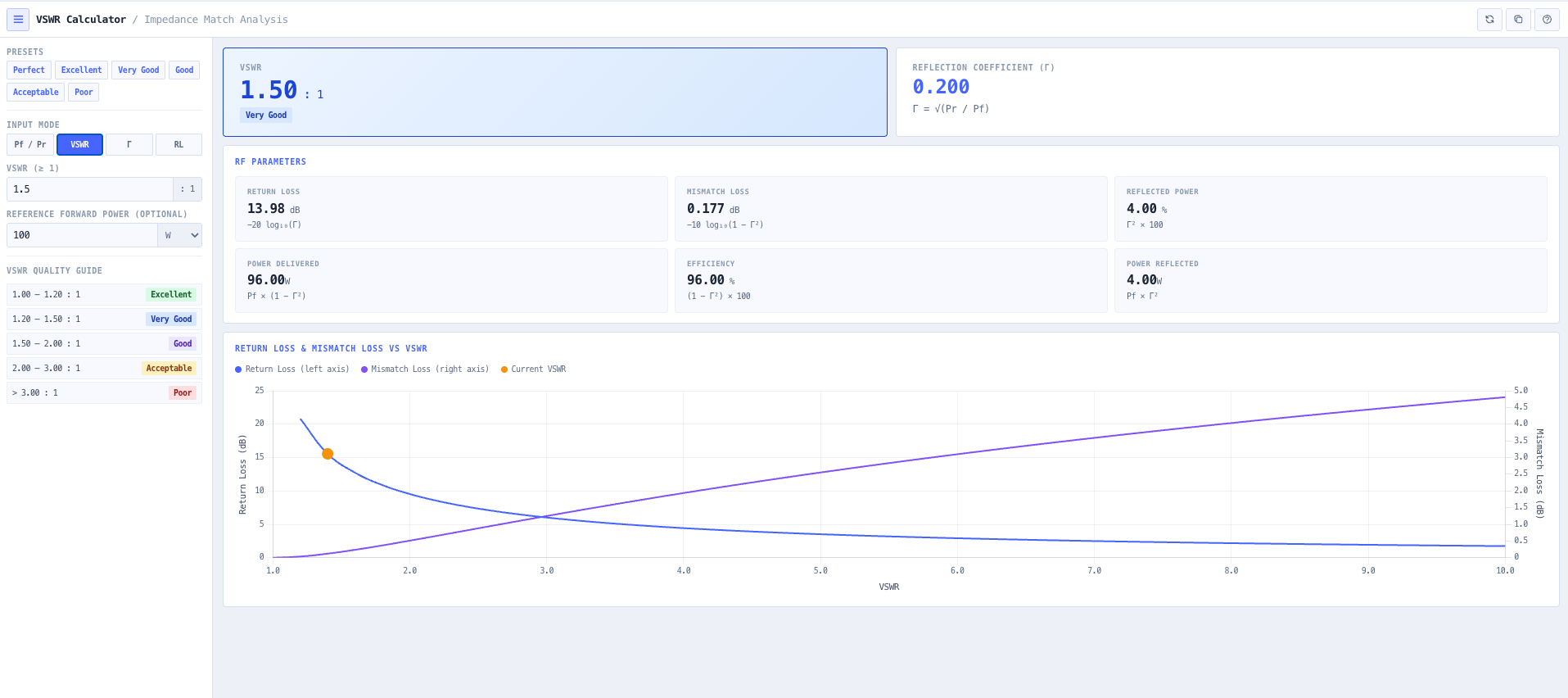
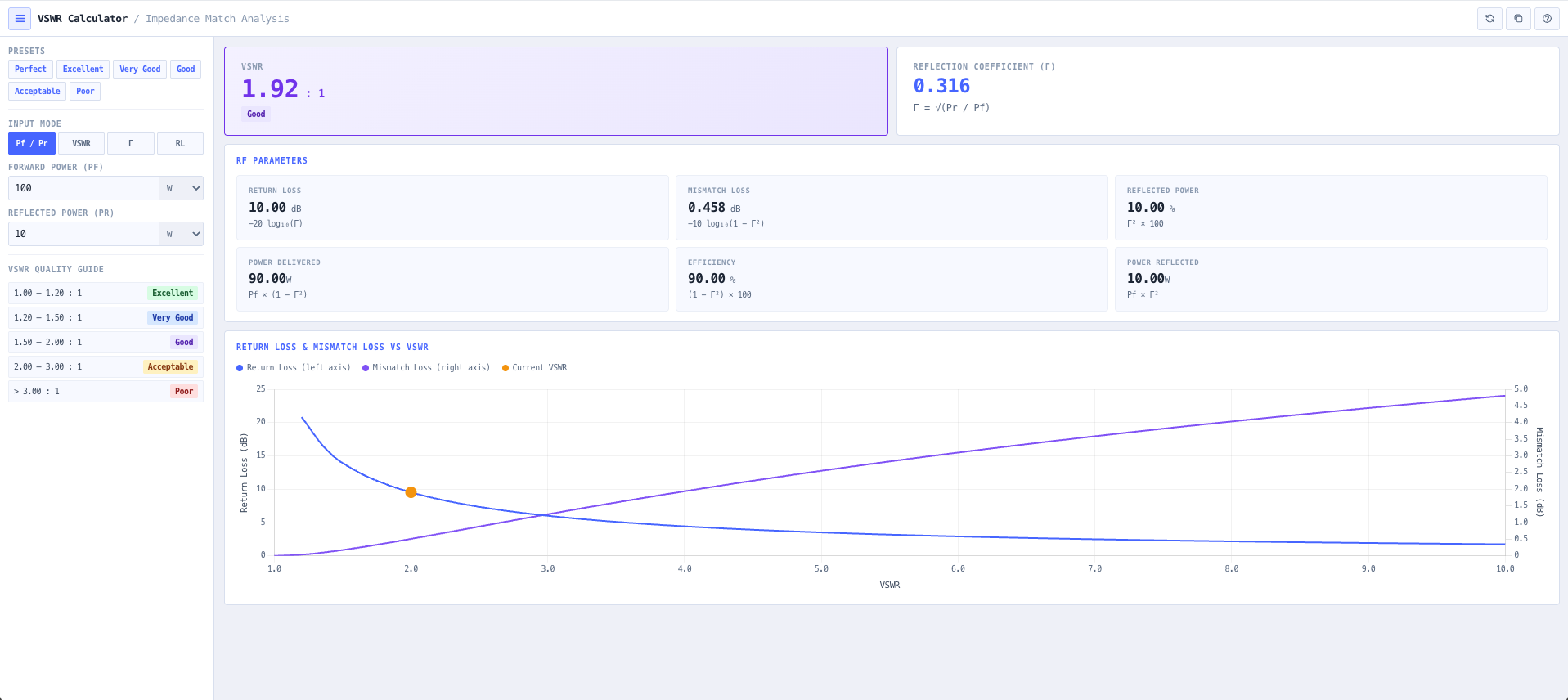
The noIM₃ VSWR Calculator turns those measurements into a complete picture in one workspace. Input forward and reflected power from a directional wattmeter, or input VSWR directly if that is what your test equipment reports, and the calculator returns reflection coefficient (Gamma) magnitude, return loss in dB, mismatch loss in dB, reflected power percentage, delivered power in watts, and overall efficiency. Quality presets classify the result against industry standard bands. Perfect (1.0 to 1.2 to 1), excellent (1.2 to 1.5 to 1), good (1.5 to 2.0 to 1), acceptable (2.0 to 3.0 to 1), and poor (greater than 3.0 to 1).

The relationships are straightforward but the conventions catch people out. VSWR equals (1 plus Gamma) divided by (1 minus Gamma). Return loss equals minus 20 log of Gamma. Mismatch loss equals minus 10 log of (1 minus Gamma squared). Reflection coefficient and VSWR are interchangeable but report different intuitions. The calculator surfaces all of them simultaneously so the analysis is a glance rather than a multi step conversion. Interactive charts of return loss and mismatch loss versus VSWR reinforce the intuition for anyone learning the relationships, and provide visuals for design reviews and troubleshooting reports.

Capabilities

VSWR from forward and reflected power

Calculates VSWR using the reflection coefficient formula. Gamma equals square root of reflected power over forward power. VSWR equals (1 plus Gamma) divided by (1 minus Gamma). Output presented in standard form such as 1.5 to 1 and categorised against industry quality bands so the result is immediately actionable.

Reflection coefficient and return loss

Returns the magnitude of the reflection coefficient (Gamma) and the return loss in dB. Return loss equals minus 20 log Gamma and is the form most spectrum analyser and network analyser instruments report directly. Both forms are surfaced together so cross referencing measurements between instruments is not a calculation step.

Mismatch loss

Mismatch loss equals minus 10 log of (1 minus Gamma squared) and represents the dB cost in delivered power against an ideal matched load. Output in dB and as a percentage of forward power, so the impact on link budget is visible. Often confused with return loss but it represents a different physical quantity (loss in delivered power versus reflection magnitude).

Power flow analysis

Displays total forward power, reflected power in watts and as a percentage of forward power, delivered power at the load, and overall efficiency. Useful for confirming that a transmitter is actually delivering its rated power into the antenna rather than dissipating it as heat in the feeder or reflecting it back into the protection circuits.

Quality presets

Industry standard VSWR quality bands. Perfect (1.0 to 1.2 to 1), excellent (1.2 to 1.5 to 1), good (1.5 to 2.0 to 1), acceptable (2.0 to 3.0 to 1), and poor (greater than 3.0 to 1). Facilitates quick decision making for installation acceptance, periodic checks, and troubleshooting.

Bidirectional input

Drive the calculator from forward and reflected power readings (typical of a directional wattmeter) or directly from VSWR (typical of a network analyser or VSWR meter). All output parameters update consistently regardless of which input form is used.

Return loss and mismatch loss visualisation

Interactive charts plot return loss and mismatch loss as functions of VSWR across the operating range. Useful for understanding how rapidly mismatch loss accelerates above a VSWR of 2 (less than 0.5 dB at VSWR 2, around 1.25 dB at VSWR 3, around 2.5 dB at VSWR 4), and for explaining the trade off to non specialist stakeholders.

Browser only computation

Runs entirely in your browser. No measurement data, antenna performance numbers, or installation details are submitted to a server. Useful for commercially confidential infrastructure work, safety critical installations, and environments where information security policy prohibits sending engineering data to third party services.

Standards & methodology

  • IEEE 145. Standard definitions of terms for antennas
  • IEEE 287. Precision coaxial connectors
  • Standard 50 ohm reference impedance for RF systems
  • ACMA radiocommunications licence conditions referencing antenna feed and radiated power

When to use this tool

  • Assessing transmission line matching for antenna and feeder installations
  • Evaluating reflected power and mismatch in cellular base station feeders
  • Troubleshooting high VSWR conditions on coaxial systems
  • Calculating delivered power efficiency for transmitters and amplifiers
  • Educational demonstration of reflection, VSWR, and return loss relationships
  • Quick system health check using directional wattmeter readings
  • Acceptance testing a new antenna installation against contractual VSWR limits
  • Periodic inspection of working installations against historical baselines
  • Validating that an antenna upgrade has not pushed VSWR outside acceptable bands
  • Documenting transmitter efficiency for engineering and customer reports
  • Investigating intermittent high VSWR alarms on cellular and broadcast sites
  • Sanity checking vendor antenna VSWR claims against measured forward and reflected power

Is this the right tool for you?

Reach for the VSWR Calculator in any of the following situations.

  • You are commissioning a new antenna and feeder installation and have measured forward and reflected power on a directional wattmeter, and need to convert that to VSWR, return loss, and mismatch loss for the acceptance report.
  • You are responsible for a cellular base station that is generating intermittent VSWR alarms and need to assess whether the measured VSWR is within acceptable bands or genuinely indicates a fault.
  • You are evaluating a candidate antenna against a contractual VSWR limit (for example better than 1.5 to 1) and need to confirm whether vendor claimed performance translates to acceptable mismatch loss for your link budget.
  • You are troubleshooting a transmitter that is folding back its output power and want to confirm whether VSWR at the antenna is the cause.
  • You are auditing a working installation against historical baseline VSWR readings and need to interpret a measured shift from 1.3 to 1 to 1.8 to 1 against what it actually means in delivered power.
  • You are calculating the delivered power for a link budget and need to quantify the dB cost of antenna VSWR mismatch on the transmit side of the budget.
  • You are designing a matching network for a complex impedance antenna and want to see how reflection coefficient and return loss change as you converge on a match.
  • You are documenting transmitter efficiency for an engineering report or customer deliverable and need delivered power versus forward power in a defensible form.
  • You are training new RF technicians and want a teaching tool that shows how VSWR, reflection coefficient, return loss, and mismatch loss are different views of the same underlying mismatch.
  • You are sanity checking a vendor antenna VSWR specification against the actual measured forward and reflected power on the bench before deploying.
  • You are responsible for a broadcast or high power transmitter installation where exceeding a VSWR limit triggers protection circuits, and you need to confirm operating margin against the limit.
  • You are evaluating whether to retune or replace an antenna based on a measured VSWR drift from the original commissioning value.
  • You are inspecting a tower top installation after a weather event and want to quantify whether a measured VSWR change indicates connector or feeder damage.
  • You are converting between VSWR and return loss because your test equipment reports one and your specification is written in the other.
  • You are operating under a security regime that prohibits sending measurement data to third party services and need a VSWR calculator that runs entirely in your browser.

Frequently asked questions

What formula does the calculator use?

VSWR equals (1 plus Gamma) divided by (1 minus Gamma), where Gamma is the magnitude of the reflection coefficient. Gamma equals square root of reflected power over forward power. Return loss equals minus 20 log Gamma. Mismatch loss equals minus 10 log of (1 minus Gamma squared). All four quantities are surfaced simultaneously so cross referencing between instruments and specifications is not a calculation step.

What is a good VSWR for an RF system?

Industry standard quality bands. Perfect (1.0 to 1.2 to 1) for laboratory work and precision instruments. Excellent (1.2 to 1.5 to 1) for high quality production antennas and matched cable runs. Good (1.5 to 2.0 to 1) for typical operational installations. Acceptable (2.0 to 3.0 to 1) for marginal installations or where the application is not transmit power critical. Poor (greater than 3.0 to 1) generally indicates a fault that needs attention. Most cellular and broadcast contracts specify better than 1.5 to 1 at the operating frequency.

What is the difference between return loss and mismatch loss?

They look similar but represent different things. Return loss in dB is minus 20 log Gamma and quantifies the magnitude of the reflection (it is positive for typical mismatches and large numbers indicate good match). Mismatch loss in dB is minus 10 log of (1 minus Gamma squared) and quantifies the dB cost in delivered power against an ideal matched load. Return loss is what a network analyser reports. Mismatch loss is what the link budget cares about.

How much power is actually lost at common VSWR values?

At VSWR 1.5 to 1, mismatch loss is about 0.18 dB, or about 4 per cent reflected power. At VSWR 2 to 1, mismatch loss is about 0.51 dB, or about 11 per cent reflected. At VSWR 3 to 1, mismatch loss is about 1.25 dB, or about 25 per cent reflected. The accelerating curve is the reason VSWR specifications cluster around 1.5 to 1 to 2 to 1 in practice rather than being arbitrarily tight.

Can I drive the calculator from VSWR directly?

Yes. If your test equipment reports VSWR rather than forward and reflected power, enter VSWR directly. The calculator computes reflection coefficient, return loss, mismatch loss, and the rest of the output set the same way. Useful for working from network analyser screens, antenna VSWR plots, and vendor datasheet specifications.

Why does my transmitter fold back its output above a certain VSWR?

Most modern transmitters include protection circuits that detect high reflected power and reduce output to protect the power amplifier from damage caused by the standing wave on the feeder. Typical fold back thresholds are around VSWR 2 to 1 to 3 to 1 depending on the radio. The calculator helps confirm whether a fold back event is genuinely due to a high VSWR or due to a different cause such as a measurement artefact or a faulty wattmeter.

How does this support cable loss and link budget work?

VSWR feeds directly into the cable loss calculation. The noIM₃ Cable Loss Calculator separates matched line attenuation from VSWR induced mismatch loss, so a measured antenna VSWR can be carried into the cable analysis without absorption into a single average loss number. From there, the EIRP, Link Budget, and Antenna Power Density tools all consume the result.

Does any data leave my browser?

No. The calculator runs entirely in your browser. No measurement data, antenna performance numbers, or installation details are submitted to a server. Useful for commercially confidential infrastructure work, safety critical installations, and environments where information security policy prohibits sending engineering data to third party services.