ITU aligned intermodulation engine
2nd, 3rd, and 5th order intermodulation products computed using industry standard mathematical models. Underground specific two signal (2F1 minus F2) and three signal (F1 plus F2 minus F3) 3rd order formulas are included to reflect confined environment RF behaviour. Results are categorised by proximity to carrier bandwidth to highlight critical and warning conditions.
Surface and underground modes
Switch between surface radio and underground environments to apply the appropriate analysis model and scoring logic. Underground mode evaluates 2nd and 3rd order products and omits 5th order, takes harmonics from every carrier rather than the transmit set, and drops the TX/RX role filter, because leaky feeder coupling brings transmit and receive into the same level range. A cross band products switch limits mixing to carriers of the same direction when a diplexed line amplifier keeps transmit and receive in separate gain stages.
Real time system scoring
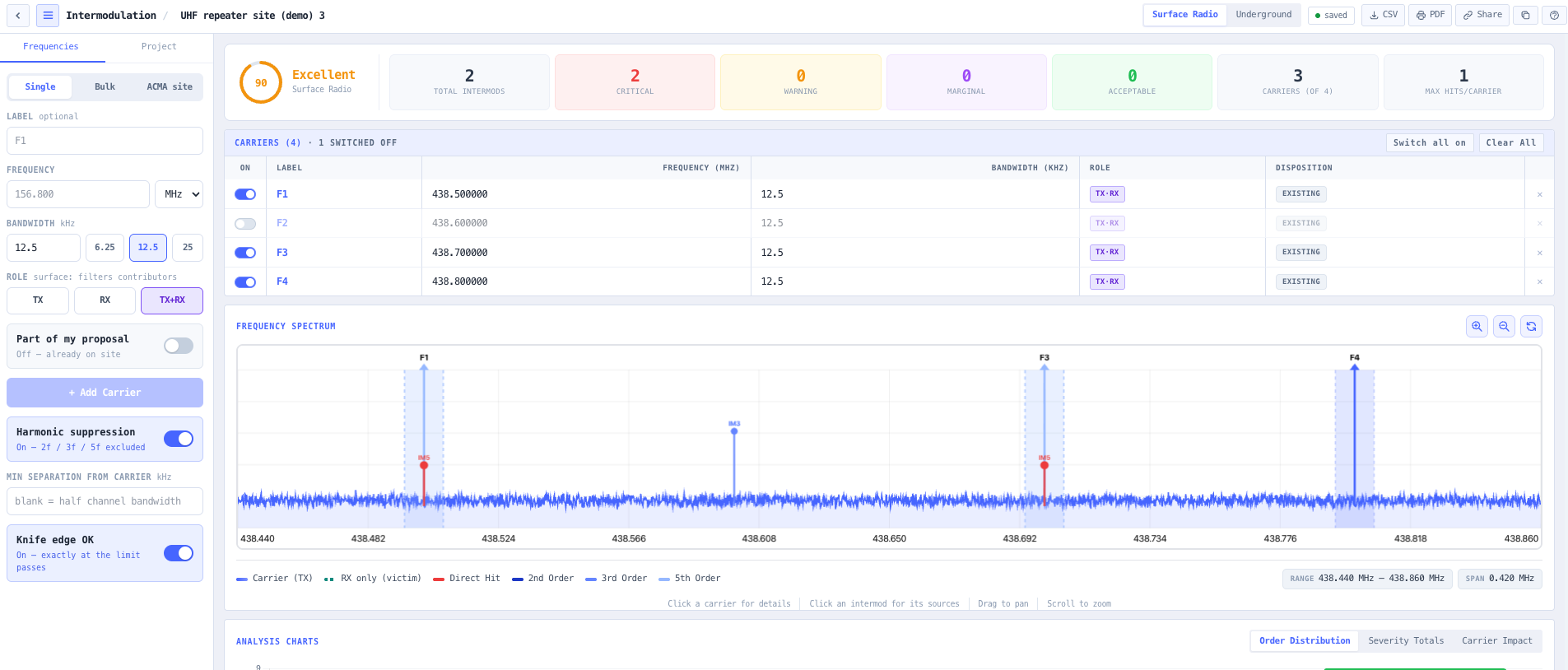
Every frequency plan is automatically scored from poor to excellent. Critical products, those inside a receiver’s passband, are uncapped because each one is a real finding. The warning, marginal and acceptable tiers grow with the cube of the carrier count, so they are capped at 15, 5 and 5 points: a plan with no product in any passband scores 75 or better whatever its size, instead of a large site with hundreds of adjacent channel products and nothing in band reading as zero. Maximum hits per carrier are surfaced, so the health read is immediate rather than buried in a long table.
Interactive spectrum visualisation
A built in spectrum viewer plots carrier frequencies alongside calculated 2nd, 3rd, and 5th order products. Zoom, pan, jump to the TX or RX band, and inspect individual spikes to analyse interference distribution across the band. Frequency span and distribution metrics provide a clear picture of overall spectrum efficiency.
Per carrier impact analysis
Detailed per carrier analysis shows how many intermodulation products affect each channel, identifying high risk frequencies within the system. Clean carriers are flagged. Heavily impacted channels are prioritised for reassignment during coordination exercises so remediation effort is targeted rather than scattered.
Switch a carrier off, not out
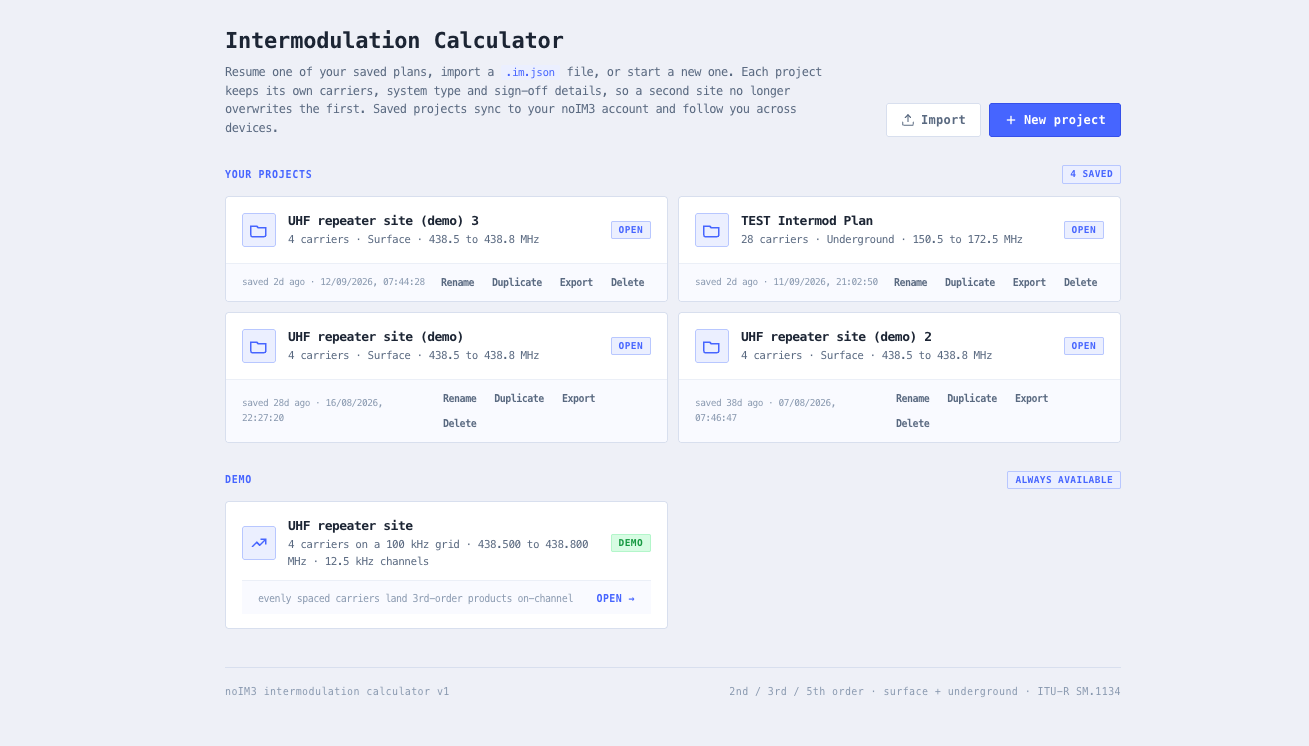
A switch on every row of the carrier table takes that carrier out of the analysis without deleting it. Use it to ask what the site looks like without a service: a licence that is not being renewed, a repeater coming out, or a candidate frequency you want to try against the incumbents. The carrier keeps its bandwidth, role, disposition and register details and is saved with the plan, and while it is off it makes no products and is assessed against none, so the score, every count, the spectrum and the proposal comparison describe the switched on carriers only. The title bar says how many are off, one click puts them all back, and the CSV and PDF name them so an exclusion never reads as an omission.
Flexible carrier entry
Add carriers one at a time with a label, value, unit, per carrier bandwidth and direction, or upload a whole plan from a CSV template. An exported plan can be edited and re-imported, so a frequency list maintained elsewhere stays the source of truth. Share copies a link that carries the whole plan, up to 40 carriers, so a colleague opens exactly what you see with nothing to upload.
ACMA site import
Search the ACMA register by site ID, site name, licence number or postcode and import the licensed services already on a shared tower as carriers, instead of transcribing a licence schedule by hand. Import everything on the site, or restrict it by band, frequency range, device type or licensee, with band edges taken from the RALI LM 08 coordination bands. The register device type sets the carrier role, so transmit records become intermod contributors and receive records become victims.
Proposal mode: what your change adds to a shared site
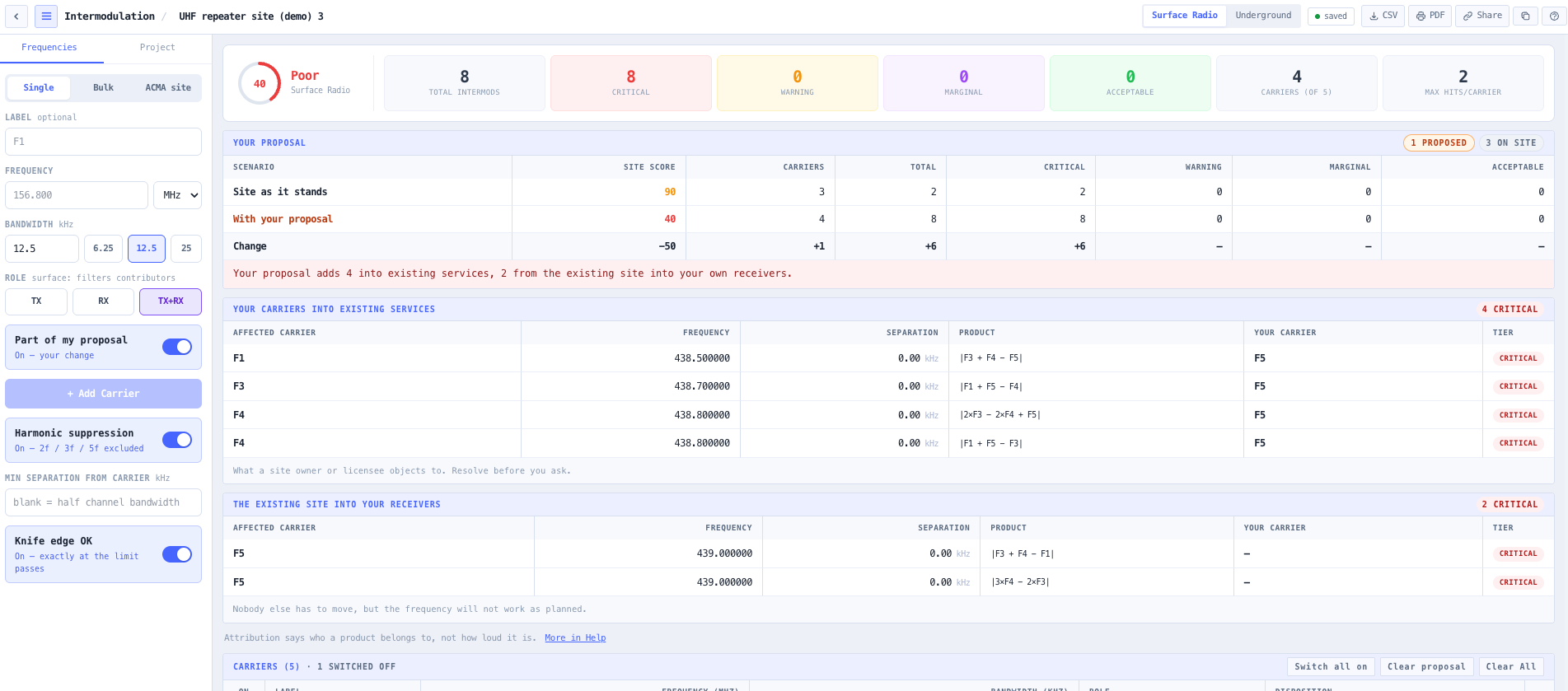
Mark which carriers are already on the tower and which are the change you are proposing, and every intermodulation product is attributed to a party. Products your proposal puts into a receiver already on site are separated from products the existing site puts into a receiver you are adding, because those are the same arithmetic and completely different conversations: one is a negotiation with a licensee who can refuse you, the other is a channel choice nobody else is involved in. Interference within your own plan is listed separately again, since both ends are yours to move. The site is scored before and after your change, the affected licensee is named on every product, and the whole attribution carries into the CSV export and the PDF report.
Every import is previewed and accounted for
Nothing is imported until you have seen it. The preview reports how many register records were selected and itemises every exclusion by cause, estimates the intermod product count before the analysis runs, and flags a carrier set whose span is too wide for the services to share hardware. Each imported carrier keeps its licence number, licensee, site and licensed EIRP, and that trail appears in the CSV export and the PDF report so a licensed service and a proposed one are never mistaken for each other.
Critical spacing detection
Each product is graded against the victim carrier’s own channel width rather than a fixed number: inside half that width is critical, then warning, marginal and acceptable zones at 12.5, 25 and 50 kHz beyond it. A single minimum separation can replace the half width for every carrier, which suits a signal that occupies less than its channel (a TETRA carrier occupies about 18 kHz of a 25 kHz channel) and lets you check a plan at the separation the Frequency Coordination Tool planned it to. A product exactly on the boundary is at the passband edge rather than inside it, so it passes unless you switch Knife edge OK off to refuse plans with zero margin. Critical hits are surfaced first, so the most damaging interactions are addressed before lower priority ones.
The analysis runs in your browser
Every product, tier and score is computed in your browser; nothing about your carriers is sent anywhere to run the analysis. Three things do talk to a server, and each sends only what it must: the optional ACMA site import sends your search and returns the public register records for that site, saving a project to your account stores the plan against your login so it follows you between devices, and Share puts the plan into the link you copy. Work on a plan without saving it to a project and it stays on this device.