Private Cellular

RSRP, RSRQ & SINR Calculator

RSRP, RSSI, RSRQ and RS-SINR to the exact 3GPP TS 36.214 definitions, with the measurement bandwidth and the cell load treated as part of the quantity rather than left out, and the TS 36.133 reporting ranges enforced.

Free forever on a Standard account. No credit card.

Overview

Two mistakes dominate LTE measurement work, and this tool exists to make both of them hard to repeat.

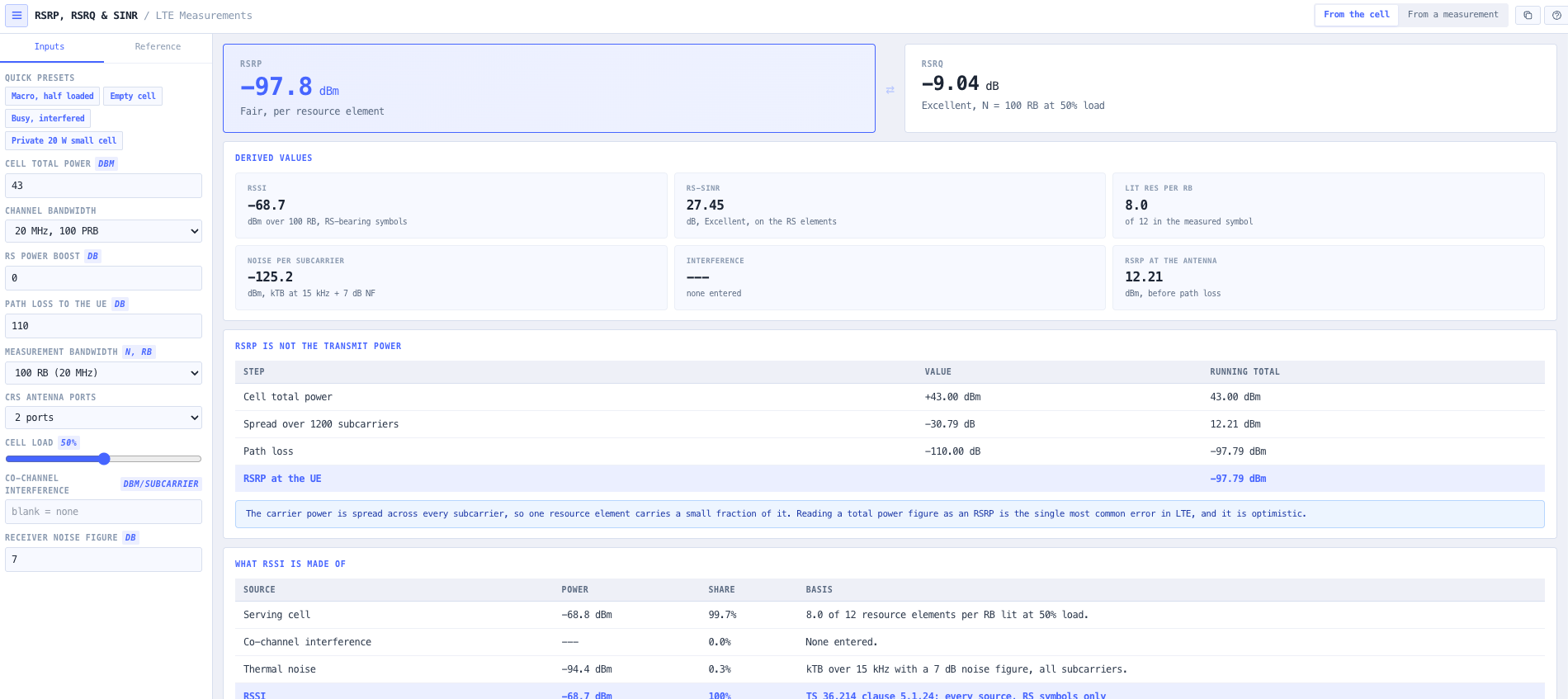
The first is reading RSRP as the cell transmit power. It is not. TS 36.214 clause 5.1.1 defines RSRP as the power of ONE resource element, so a 43 dBm carrier over 20 MHz has an RSRP near 12 dBm at the antenna, because the power is spread across 1200 subcarriers. That is 30.8 dB, in the optimistic direction, and it is the sort of error that survives a whole design review because the number still looks like a number. The derivation is shown line by line: total power, the spreading loss, any reference signal boost, the path loss, and the value a UE would report.

The second is quoting RSRQ without its measurement bandwidth or its cell load. Clause 5.1.3 defines RSRQ as N times RSRP over RSSI, where N is the number of resource blocks of the RSSI measurement bandwidth, and RSSI counts everything the receiver hears: the serving cell, co-channel neighbours, adjacent channel interference and thermal noise. Two cells with identical RSRP report different RSRQ if they are loaded differently, so an RSRQ quoted on its own cannot be compared with another one.

The load sweep makes that concrete. An empty single port cell lights 2 of the 12 resource elements in the measured symbol and reports about -3 dB. A fully loaded one lights all 12 and reports about -10.8 dB, with RSRP unchanged on every row. Those two figures are also the ends of the TS 36.133 reporting range, which is a useful check in itself: the specification stops reporting RSRQ above -3 dB, and an empty cell is exactly where that sits. RS-SINR is computed alongside and deliberately does not move with load, because it is measured on reference signal elements that are transmitted whether or not there is traffic. Watching RSRQ and RS-SINR disagree about how good a cell is, is the fastest way to understand what each one means.

Capabilities

The exact clause definitions, not approximations

RSRP, RSSI, RSRQ and RS-SINR are computed from TS 36.214 clauses 5.1.1, 5.1.3, 5.1.23 and 5.1.24, with the clause printed beside each result so it can be checked against the specification rather than believed.

The RSRP derivation shown line by line

Total cell power, the spreading loss across the subcarriers, the reference signal boost, the path loss, and the reported value. Seeing the 30.8 dB of spreading written out is what stops RSRP being confused with carrier power again.

RSSI itemised into what it is actually made of

Serving cell contribution, co-channel interference and thermal noise are shown separately rather than as one figure, because which of them dominates decides what to do about a poor RSRQ.

Cell load as a first class input

Load changes RSRQ without changing the radio at all. It is an input here rather than an assumption, and the sweep from empty to fully loaded is shown with RSRP held steady beside it so the independence is visible.

The same conditions across all six measurement bandwidths

Change the RSSI measurement bandwidth and the reported RSRQ changes with nothing about the radio changing. All six are shown at once, which is the clearest demonstration of why a bandwidth has to travel with the number.

TS 36.133 reporting ranges enforced

A value outside what the specification can report is flagged rather than printed. RSRP reports from -140 to -44 dBm and RSRQ from -19.5 to -3 dB, with the extended ranges handled, so a predicted value that a UE could never report is caught before it reaches a design.

RS-SINR computed alongside, and it does not move with load

Because it is measured on the reference signal elements, which are sent whether or not there is traffic. RSRQ and RS-SINR disagreeing about cell quality is the behaviour that teaches the difference between them.

Quality labels marked as convention, not as standard

Excellent, Good, Fair and Poor appear in no 3GPP document. They are shown because people expect them and labelled as industry convention, so nobody cites them back as though they were specified.

Standards & methodology

  • 3GPP TS 36.214 V17.0.0 clauses 5.1.1, 5.1.3, 5.1.23 and 5.1.24
  • 3GPP TS 36.133 V17.16.0, measurement reporting ranges
  • Release 17
  • The relationship between RSSI, cell load and interference is a MODEL and is labelled as one. TS 36.214 defines what RSSI is, not how to predict it.
  • Excellent, Good, Fair and Poor quality labels are industry convention and appear in no 3GPP document

When to use this tool

  • Reading a drive test or a UE diagnostic log correctly
  • Explaining why RSRQ degraded when coverage did not change
  • Converting a planned cell power into what a UE would actually report
  • Checking whether a predicted RSRP is even reportable
  • Teaching the difference between RSRQ and SINR
  • Settling whether a poor RSRQ is an interference problem or just a busy cell

Frequently asked questions

Why is RSRP so much lower than the cell transmit power?

Because RSRP is the power of one resource element, not the carrier. TS 36.214 clause 5.1.1 defines it as the linear average over the resource elements carrying cell specific reference signals. A 20 MHz carrier spreads its power across 1200 subcarriers, which is 30.8 dB, so a 43 dBm cell has an RSRP around 12 dBm at the antenna before any path loss. Reading the carrier power as RSRP overstates coverage by roughly that amount.

Why does RSRQ change when I change the measurement bandwidth?

Because the definition contains it. RSRQ is N times RSRP over RSSI, and N is the number of resource blocks of the RSSI measurement bandwidth. Change the bandwidth and both N and RSSI change. Nothing about the radio has moved, but the reported value has, which is why an RSRQ figure quoted without its bandwidth cannot be compared with another one.

Why does RSRQ fall as the cell loads when RSRP does not?

RSSI counts the traffic and RSRP does not. Reference signals are transmitted whether or not the cell is busy, so RSRP is a property of the cell and the path. RSSI rises with every occupied resource element, so RSRQ falls. An empty single port cell sits near -3 dB and a fully loaded one near -10.8 dB, with identical RSRP on both.

Why does RS-SINR behave differently from RSRQ?

Because it is measured on the reference signal elements, which are sent regardless of traffic. Loading a cell moves RSRQ and leaves RS-SINR alone. That divergence is genuinely useful: when RSRQ is poor and RS-SINR is fine, the cell is busy rather than interfered with, and those call for completely different responses.

What part of this is specified and what part is modelled?

The definitions and the reporting ranges are read straight from TS 36.214 and TS 36.133 and cited on the page. The relationship between RSSI, the cell load and the interference is a model: the specification says what RSSI is, not how to predict it. That distinction is stated on the result rather than buried, because it is the one part of the tool a reader is entitled to disagree with.

Are the Excellent and Good labels from 3GPP?

No, and they are marked as such. They are industry convention and appear in no 3GPP document. They are shown because people expect to see them, with the label attached so nobody quotes them back as if they carried a clause number.

What does the reporting range warning mean?

TS 36.133 defines the range a UE is able to report. RSRP runs from -140 to -44 dBm and RSRQ from -19.5 to -3 dB, with extended ranges below those. A predicted value outside the range is not a measurement anyone will ever see, so it is flagged rather than printed as though a device could return it.