A live, fully customisable space weather and HF propagation workspace built from over forty drag and drop widgets, powered by BOM SWS, NOAA SWPC, NASA DONKI, and the global ionosonde network.
Included in the 14-day Pro trial on every new account. No credit card.
Ionospheric Conditions Dashboard
4 inputs→12 outputs
Walkthrough
See it working
Ionospheric Conditions Dashboard1 / 2
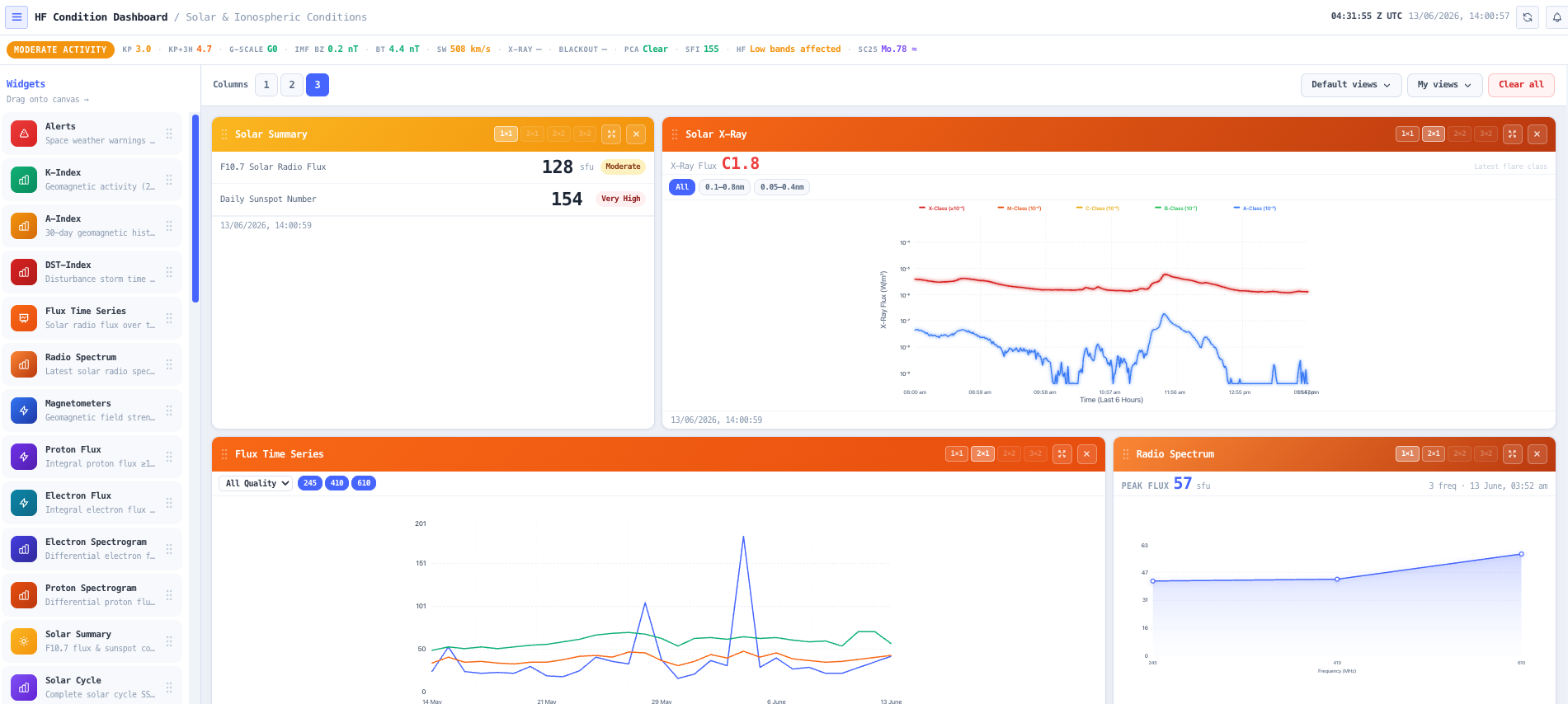
Empty canvas with the column grid selector and the widget palette.
Overview
What the Ionospheric Conditions Dashboard does
HF propagation is driven by an ionosphere that is in constant motion. Solar flares, coronal mass ejections, geomagnetic storms, sporadic E events, and the daily diurnal cycle all change which frequencies will work between any two points on the planet right now. Operators who do not check current conditions before transmitting waste time, miss critical traffic, and sometimes commit safety of life communications to a band that is already closed.
Read the full overview
The noIM₃ Ionospheric Conditions Dashboard consolidates everything an HF operator, emergency communications coordinator, or RF engineer needs to know about current space weather into a single configurable workspace. Rather than a fixed layout, the dashboard is a drag and drop canvas with over forty live widgets covering solar output, geomagnetic activity, ionospheric state, energetic particle flux, and derived HF propagation products. Every layout is persisted per user, so a DX operator, a maritime HF officer, an emergency communications volunteer, and a defence comms planner can each build a workspace that reflects their operational focus.
Data is sourced from authoritative feeds. The Australian Bureau of Meteorology Space Weather Services for the regional view, NOAA Space Weather Prediction Center for the global picture, NOAA DSCOVR for solar wind, GOES for X ray and EUV monitoring, NASA DONKI for CME and storm tracking, and the global ionosonde network for live foF2 and MUF(3000) readings. Automatic refresh, staleness detection (>15 min), a UTC clock, and a configurable alert engine that fires against user defined thresholds keep operators aware of data currency at all times.
Capabilities 8
Drag and drop widget canvas
A configurable one, two, or three column grid lets you compose your own dashboard from the widget palette. Every tile supports four size presets (1x1, 2x1, 2x2, 3x2), drag to reposition, overlap detection, fullscreen expansion, and per widget refresh. Layouts are persisted per user.
Conditions summary banner and alerts
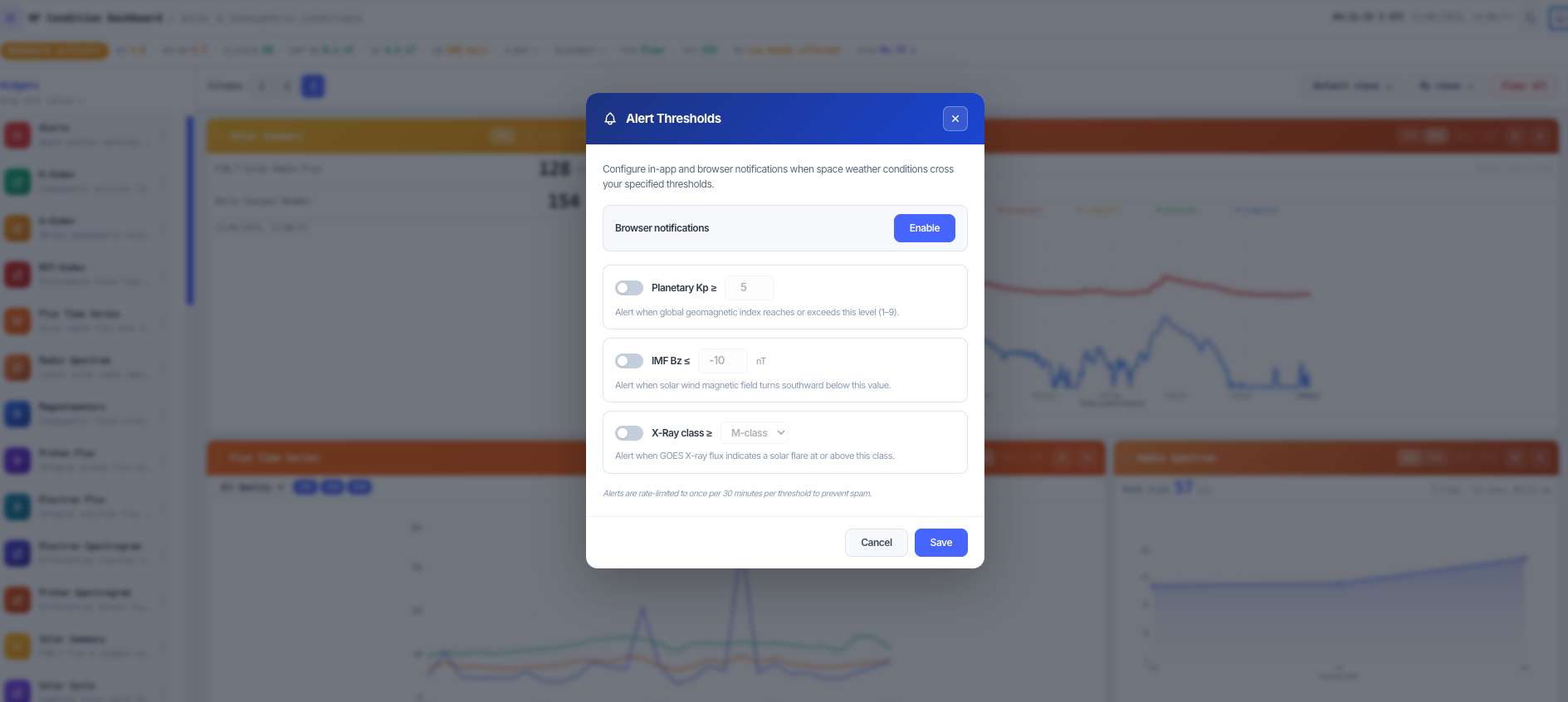
A top of page summary banner distils current solar, geomagnetic, and HF propagation state into an immediate go or no go read. User configurable alert thresholds (Kp, A index, X ray class, proton flux, Bz, solar wind speed) drive colour coded warnings and an integrated alerts panel that ingests NOAA SWPC watches, warnings, and advisories.
Solar activity suite
F10.7 solar radio flux observed against predicted, twenty year history, time series, and spectrum. Sunspot number, active regions with flare probabilities, GOES X ray flare monitoring, EUVS Lyman alpha and Mg II indices, and full solar cycle context. Together they give a complete picture of the solar drivers behind HF propagation.
Geomagnetic and space weather indices
K index over 24 hours, A index over 30 days, DST, planetary Kp seven day bar chart, Kp three day forecast with storm outlook, NOAA R, S, and G scales, magnetometer readings, and a geomagnetic activity map showing Kp driven auroral oval latitudes and affected HF path zones.
Ionospheric state and HF propagation
Live global foF2 ionospheric map (ITU model), ionosonde readings for foF2 and MUF(3000), HF band conditions from 160 m to 10 m derived from Kp and F10.7, D layer absorption and short wave fadeout impact, NVIS suitability with diurnal foF2 curve, sporadic E monitoring, band opening matrix (10 bands by 4 path types), and a point to point Path MUF planner.
Solar wind, CME, and particle environment
NOAA DSCOVR solar wind feed with IMF Bz, Bt, speed, and density. 24 hour Bz trend with storm onset annotations. Energetic proton (>=10 MeV) and electron (>=2 MeV) flux. Differential particle spectrograms for SEP events. NASA DONKI CME and storm tracker with predicted Kp arrival windows. NOAA OVATION aurora oval for polar path risk.
Operational planning tools
Grey line widget shows the day and night terminator with twilight enhancement band for DX planning. NOAA advisories surfaces plain text SWPC watches, warnings, alerts, and summaries. UTC clock, staleness badge, and background refresh indicator keep operators aware of data currency at all times.
Path MUF planner
Drop in transmit and receive coordinates and the dashboard returns MUF, LUF, OWF, and a suggested band list for the current ionosphere. Useful for a fast pre flight check on a specific circuit without leaving the situational awareness view.
Inputs and outputs
What goes in, what comes out
Inputs 4
Optional transmit and receive coordinates for the path MUF planner
User defined alert thresholds for Kp, A index, X ray flare class, proton flux, Bz, and solar wind speed
Layout configuration (column count, widget selection, size, and position)
Operational profile selection (DX, NVIS, polar, storm watch, long term)
Outputs 12
Live solar, geomagnetic, and ionospheric state across over forty widgets
Conditions summary banner with go or no go read
Colour coded alert state against user defined thresholds
NOAA SWPC watches, warnings, alerts, and summaries
Path MUF, LUF, and OWF for any user supplied transmit and receive coordinates
HF band condition matrix from 160 m to 10 m across day, night, short, and long path
Global foF2 map and ionosonde reading set
Aurora oval and geomagnetic activity map for polar path risk
Solar wind, IMF Bz, and storm onset trend with annotations
Particle flux and spectrogram data for SEP events
CME and geomagnetic storm arrival window predictions
Grey line terminator position with twilight enhancement band
Standards & methodology
ITU P.533. HF sky wave propagation prediction (used for derived MUF and band condition products)
ITU P.1239. CCIR ionospheric reference and global foF2 map
NOAA SWPC R, S, and G storm scales
BOM Space Weather Services regional warnings and alerts
NASA DONKI CME and geomagnetic storm catalogue
Use cases
When to use this tool
01HF link pre flight check before mission critical voice or data transmission
02Emergency communications and HF ALE network monitoring
03NVIS deployment planning for short to medium range tactical links
04DX and long haul HF path planning using grey line and MUF products
05Polar and high latitude path risk assessment during geomagnetic storms
06Real time monitoring of short wave fadeout during solar flares
07Long term HF system planning using solar cycle context and trends
08Situational awareness for defence, maritime, and aviation HF operators
09Resource sector and pastoral HF network monitoring
10Maritime HF watch operations and weather routing decisions
11Amateur radio contest and DXpedition condition tracking
12Training new HF operators on the link between space weather and band openings
BOM Space Weather Services for the Australian regional view, NOAA Space Weather Prediction Center for the global picture, NOAA DSCOVR for solar wind, GOES for X ray and EUV, NASA DONKI for CME and storm tracking, and the global ionosonde network for live foF2 and MUF(3000) readings. Each widget is annotated with its source and a staleness indicator fires if data is more than 15 minutes old.
How customisable is the layout?
Fully. The canvas supports a one, two, or three column grid, and every tile has four size presets (1x1, 2x1, 2x2, 3x2). You can drag tiles to reposition, expand any tile to fullscreen, and the layout is persisted per user so your workspace is restored on every visit.
Can I configure my own alerts?
Yes. Alert thresholds for Kp, A index, X ray flare class, proton flux, Bz, and solar wind speed are user configurable. When a threshold is crossed the summary banner changes colour and the alerts panel surfaces the event together with any related NOAA SWPC watch, warning, or advisory.
Does it include a propagation prediction for a specific path?
Yes. The path MUF planner widget takes transmit and receive coordinates and returns MUF, LUF, OWF, and a suggested band list against the current ionosphere. For a full ITU P.533 link prediction with link budget and reliability you would use the noIM₃ HF Link Planner, which integrates with this dashboard for a complete workflow.
How is HF band condition derived?
Band conditions across 160 m to 10 m are derived from current Kp and F10.7 against the diurnal cycle and seasonal context, then summarised into a band by path type matrix (day, night, short path, long path) so an operator can see at a glance which bands are likely to be open and to where.
Is the dashboard suitable for operations during geomagnetic storms?
Yes. The dashboard is built around storm awareness. Kp forecast, NOAA G scale, DSCOVR solar wind, IMF Bz with storm onset annotations, NASA DONKI CME tracker with predicted arrival windows, OVATION aurora oval, and proton flux are all first class widgets, with alerts wired to the indices that matter for your operations.
Can I use this for NVIS planning?
Yes. The NVIS suitability widget plots the diurnal foF2 curve at your location and indicates whether the operating frequency is supported by the current and forecast ionosphere for short to medium range tactical links.