RF Utilities

Noise Floor Calculator

Thermal noise, system noise figure cascade, and receiver sensitivity in one workspace. Compute noise floor in dBm against bandwidth, noise figure, and reference temperature with Friis cascade support up to twenty stages and presets for LTE, 5G NR, WiFi 6, GPS, TETRA, and satellite LNB.

Overview

The noise floor sets the absolute lower bound on what a receiver can detect. Below it, every signal disappears into thermal background. Above it, signals are recoverable subject to the required signal to noise ratio. The receiver sensitivity quoted on every datasheet is fundamentally a noise floor number plus a required SNR margin. Get the noise floor calculation wrong and the rest of the link budget rests on a sensitivity figure that is silently a few dB off, which translates directly into either over engineered antennas and transmit power, or coverage holes that nobody can explain.

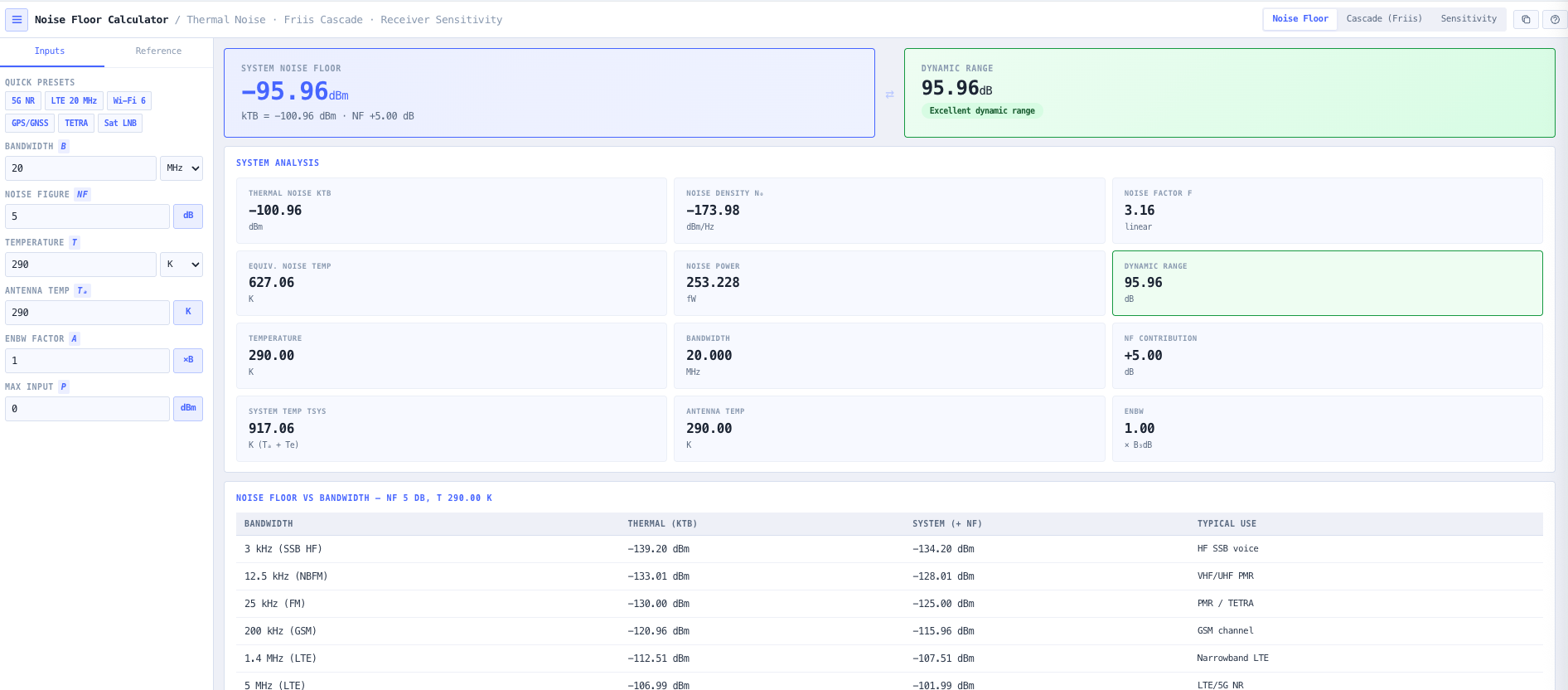
The noIM₃ Noise Floor Calculator computes the noise floor end to end in one workspace. The fundamental thermal noise relationship N equals kTB drives the calculation, where k is the Boltzmann constant, T is the reference temperature in Kelvin, and B is the bandwidth in Hz. At the IEEE standard reference temperature of 290 K, this reduces to the familiar minus 174 dBm per Hz spectral density, with a 10 log B correction for the actual bandwidth. Add the system noise figure on top and you have the noise floor in dBm at the receiver input. Output covers noise floor in dBm, thermal noise in fW, equivalent noise temperature in Kelvin, linear noise factor, dynamic range against the maximum input power, and noise floor expressed across multiple unit families.

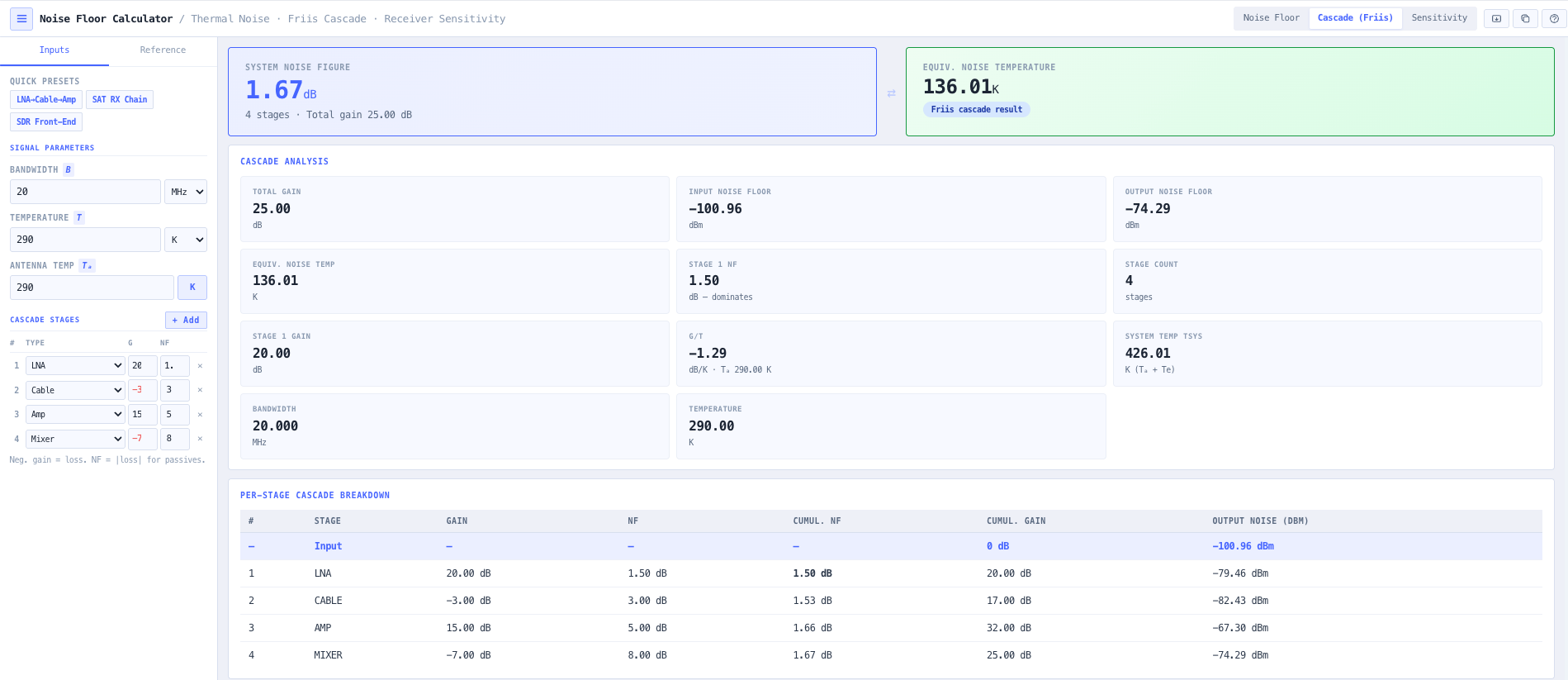
For multi stage receiver chains, the Friis cascade is supported up to twenty stages. Each stage accepts gain in dB and noise figure in dB or noise temperature in K. The system noise figure at the chain input is computed using F equals F1 plus (F2 minus 1) over G1 plus (F3 minus 1) over G1 G2 and so on. For satellite ground stations and radio astronomy, antenna noise temperature input and feeder loss handling produce a complete system noise temperature Tsys equals Ta plus T0 (F minus 1), and a G over T figure of merit (the receiver gain divided by system noise temperature) for direct comparison against published satellite ground station benchmarks. Built in presets cover LTE 20 MHz, 5G NR, WiFi 6, GPS and GNSS, TETRA, and satellite LNB configurations.

Capabilities

Thermal noise calculation

Computes thermal noise using N equals kTB with k as the Boltzmann constant, T as physical temperature in Kelvin, and B as bandwidth in Hz. Reference is the IEEE standard 290 K. Spectral density N0 in dBm per Hz is reported alongside total noise power for the configured bandwidth. The standard reference value of minus 174 dBm per Hz at 290 K is surfaced explicitly so cross checking is direct.

System noise floor with noise figure

Adds receiver noise figure contribution to thermal noise to compute overall noise floor. Noise floor in dBm equals minus 174 plus 10 log of bandwidth in Hz plus noise figure in dB. Output covers noise floor in dBm, thermal noise in fW (auto scaled to mW or microwatt as appropriate), equivalent noise temperature in K, and linear noise factor.

Friis cascade up to twenty stages

Multi stage receiver chains analysed using the Friis cascade formula. F equals F1 plus (F2 minus 1) over G1 plus (F3 minus 1) over G1 G2 and so on, supported up to twenty stages. Each stage accepts gain in dB and noise figure in dB or noise temperature in K. Identifies the dominant stage in the chain so design effort can target the actual bottleneck.

Antenna and sky temperature input

Antenna or sky noise temperature Ta in Kelvin can be configured directly or selected from common look angle scenarios for satellite work. System noise temperature Tsys equals Ta plus T0 (F minus 1) is computed and surfaced alongside the noise floor, supporting accurate satellite link budgets where antenna temperature varies with elevation.

G over T figure of merit

For satellite ground stations and radio astronomy work, the receiver gain G in dB divided by system noise temperature Tsys in K (expressed as G over T in dB per K) is computed and reported. G over T is the standard figure of merit for ground station capability and is the parameter operators benchmark against vendor and satellite operator specifications.

Equivalent noise bandwidth (ENBW) scaling

Real receivers have filters that are not perfect rectangles, so the equivalent noise bandwidth differs slightly from the 3 dB bandwidth used in datasheets. The calculator accepts an ENBW correction factor so the noise floor reflects the actual integrated noise across the receiver passband rather than only the rectangular approximation.

Dynamic range and minimum detectable signal

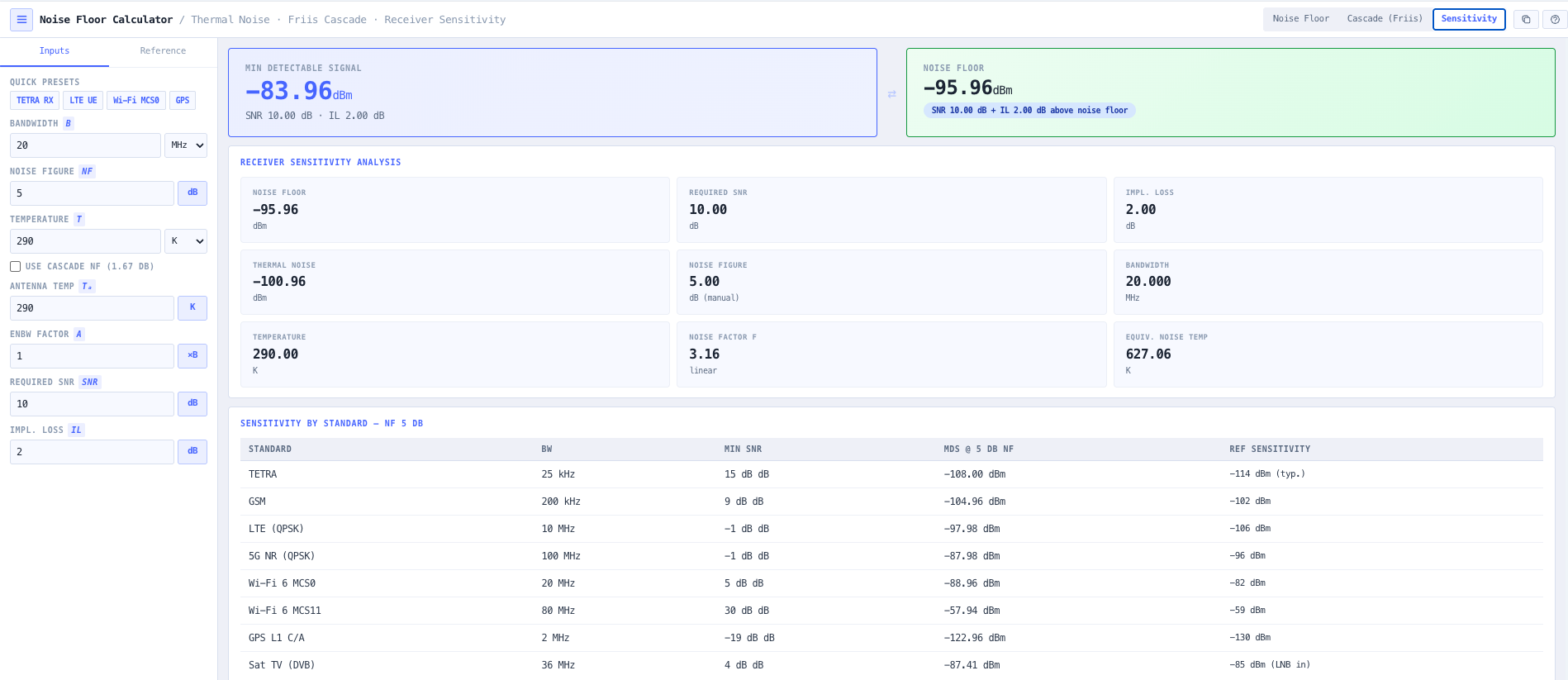
Computes system dynamic range from the maximum tolerable input power and the noise floor. Receiver minimum detectable signal (MDS) is reported as noise floor plus required SNR (typically 3 dB or 10 dB depending on application). Useful for sensitivity specification, intermodulation distortion analysis, and confirming the receiver has the dynamic range to handle both the smallest signal of interest and the largest interferer.

Band presets

Built in presets for LTE 20 MHz, 5G NR (numerologies 0 to 4), WiFi 6 (20, 40, 80, 160 MHz), GPS L1 and GNSS bands, TETRA narrowband, and satellite LNB configurations. Each preset populates bandwidth, noise figure, and reference temperature for the common configuration so a usable answer is one click away.

Visualisation

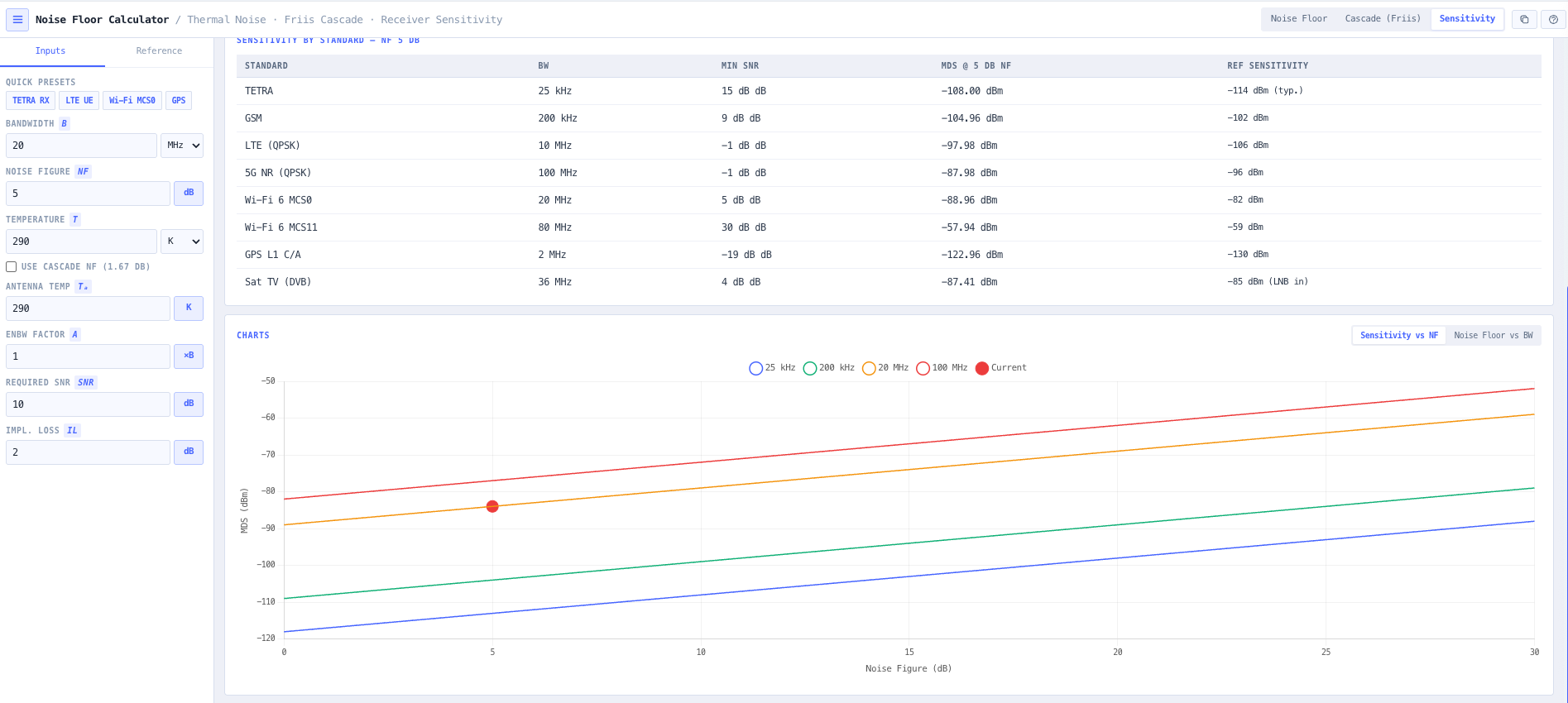
Interactive charts show noise floor versus bandwidth and noise floor versus physical temperature. Reinforces the intuition that a 10 fold bandwidth increase costs 10 dB of noise floor, and that thermal noise is roughly proportional to physical temperature in Kelvin (which is why cryogenic LNAs at 70 K rather than 290 K give about 6 dB of noise floor improvement).

Browser only computation

Runs entirely in your browser. No bandwidth, noise figure, or system data is submitted to a server. Useful for commercially confidential receiver design work, satellite ground segment, defence and intelligence installations, and environments where information security policy prohibits sending engineering data to third party services.
Standards & methodology

  • IEEE definition of Noise Figure with reference temperature 290 K
  • Friis cascade noise factor formula
  • ITU R P.372. Radio noise model and antenna noise temperature reference
  • Boltzmann constant 1.380649 e minus 23 J per K (CODATA exact value)
  • Industry G over T figure of merit conventions for satellite ground station benchmarks

When to use this tool

  • Computing receiver noise floor for cellular, WiFi, satellite, and microwave systems
  • Estimating receiver minimum detectable signal and sensitivity
  • Assessing low noise amplifier and receiver chain performance using Friis cascade
  • Designing LTE, 5G NR, WiFi 6, GPS, GNSS, TETRA, and satellite receiver systems
  • Teaching thermal noise, kTB, and the bandwidth and noise relationship
  • Quick assessment of system margin against the thermal noise floor
  • Computing G over T for satellite ground station benchmarking
  • Producing receiver sensitivity evidence for licence applications and acceptance testing
  • Diagnosing receiver desensitisation by separating thermal noise from external interference
  • Comparing two candidate receiver chains on a like for like noise floor basis
  • Validating vendor receiver sensitivity claims against the underlying physics
  • Sizing dynamic range against expected interferer levels in shared spectrum

Is this the right tool for you?

Reach for the Noise Floor Calculator in any of the following situations.

  • You are designing an LTE, 5G NR, or WiFi 6 receiver chain and need to compute the noise floor in dBm at the receiver input against the operating bandwidth and noise figure.
  • You are responsible for a satellite ground station and need to compute system noise temperature including antenna noise and the cascaded LNA and downconverter contributions, plus the resulting G over T figure of merit.
  • You are evaluating the sensitivity claim on a vendor receiver datasheet and want to confirm the noise floor calculation against the underlying thermal noise plus noise figure relationship.
  • You are diagnosing a working receiver that is underperforming and want to confirm whether the measured noise floor matches the theoretical thermal limit or is sitting above it due to external interference.
  • You are sizing a multi stage receiver chain and need to use the Friis cascade to confirm the system noise figure is dominated by the front end LNA rather than later stages.
  • You are designing a GPS or GNSS receiver and need to compute the noise floor at the L1 bandwidth (typically 2 MHz) against a 1.5 to 3 dB front end noise figure.
  • You are responsible for a TETRA narrowband receiver and need to compute the noise floor at the standard 25 kHz channel bandwidth.
  • You are designing or auditing a satellite LNB chain and need to compute the system noise temperature alongside the gain to derive G over T for benchmarking.
  • You are evaluating whether an antenna upgrade or LNA change will measurably improve the noise floor in the receiver chain.
  • You are training new RF engineers and want a teaching tool that exposes thermal noise (kTB), the role of bandwidth and noise figure, and the cascaded receiver chain side by side.
  • You are responsible for a radio astronomy receiver where the absolute noise floor against bandwidth determines integration time for a given source detection threshold.
  • You are sizing the dynamic range of a receiver in shared or congested spectrum, where both a small signal of interest and a large interferer must be handled simultaneously.
  • You are comparing two candidate receivers on a like for like basis (same bandwidth, same antenna, different noise figure) and need a defensible noise floor calculation for both.
  • You are producing receiver sensitivity evidence for a licence application or contractual acceptance test and need a traceable noise floor calculation.
  • You are operating under a security regime that prohibits sending receiver design data to third party services and need a noise floor calculator that runs entirely in your browser.

Frequently asked questions

What formula does the calculator use?

Thermal noise follows N equals kTB. At the IEEE reference temperature of 290 K, this reduces to a spectral density of minus 174 dBm per Hz, with a 10 log of bandwidth in Hz correction. System noise floor in dBm equals minus 174 plus 10 log B plus noise figure in dB. For cascaded chains the Friis formula is used. F equals F1 plus (F2 minus 1) over G1 plus (F3 minus 1) over G1 G2 and so on, with up to twenty stages supported.

Why is the reference temperature 290 K?

Following IEEE convention, 290 K is the standard reference temperature used by every published noise figure datasheet, every test instrument, and every commercial receiver specification. It is roughly equivalent to 16.85 degrees Celsius and represents typical operating temperature. The calculator allows the reference to be adjusted for unusual environments (cryogenic systems, tropical or arctic deployments) but 290 K is correct for almost all engineering work.

How is the noise floor different from the noise figure?

Noise figure is a property of the receiver. It is how much extra noise the receiver adds above the thermal floor. Noise floor is the actual noise power at the receiver input, equal to thermal noise plus noise figure. Noise figure is dimensionless (in dB). Noise floor is an absolute power (in dBm). Both are needed for a complete sensitivity calculation. Use the noIM₃ Noise Figure Calculator for noise figure analysis specifically. Use the Noise Floor Calculator for the absolute noise power result.

What is G over T and when do I need it?

G over T is the standard figure of merit for satellite ground stations and radio astronomy receivers. It is the receiver gain G in dB divided by the system noise temperature Tsys in K, expressed as G over T in dB per K. Higher G over T means a more sensitive receiver. Satellite operators specify required minimum G over T values for ground stations to receive their satellites, and ground station vendors benchmark against published G over T claims. The calculator surfaces G over T directly so the comparison is straightforward.

How does ENBW correction work?

Equivalent Noise Bandwidth (ENBW) is the bandwidth of an ideal rectangular filter that would pass the same total integrated noise as the actual filter. For real filters, ENBW is slightly larger than the 3 dB bandwidth (typically 1.05 to 1.15 times for common filter shapes). The calculator accepts an ENBW correction factor so the noise floor reflects the actual integrated noise across the receiver passband rather than only the rectangular approximation. Useful for precision sensitivity work.

How does the cascade analysis identify the dominant stage?

For each stage in the cascade, the contribution to the total noise factor is computed and reported as a fraction of the total. The stage with the largest contribution is the dominant stage and the one to focus design effort on. The design rule is that the front end LNA dominates as long as its gain is high enough (typically 15 to 25 dB) to suppress the noise contribution of subsequent stages.

How does this relate to the Link Budget Calculator?

Noise floor is one of the inputs to the link budget. Receiver sensitivity equals noise floor plus required SNR plus implementation loss. The noIM₃ Link Budget Calculator consumes the noise floor and noise figure values and computes the carrier to noise ratio against the received power. Use the Noise Floor Calculator to compute the noise floor and the cascaded system noise figure, then carry that into the link budget for the full operational analysis.

Does any data leave my browser?

No. The calculator runs entirely in your browser. No bandwidth, noise figure, or system data is submitted to a server. Useful for commercially confidential receiver design work, satellite ground segment, defence and intelligence installations, and environments where information security policy prohibits sending engineering data to third party services.