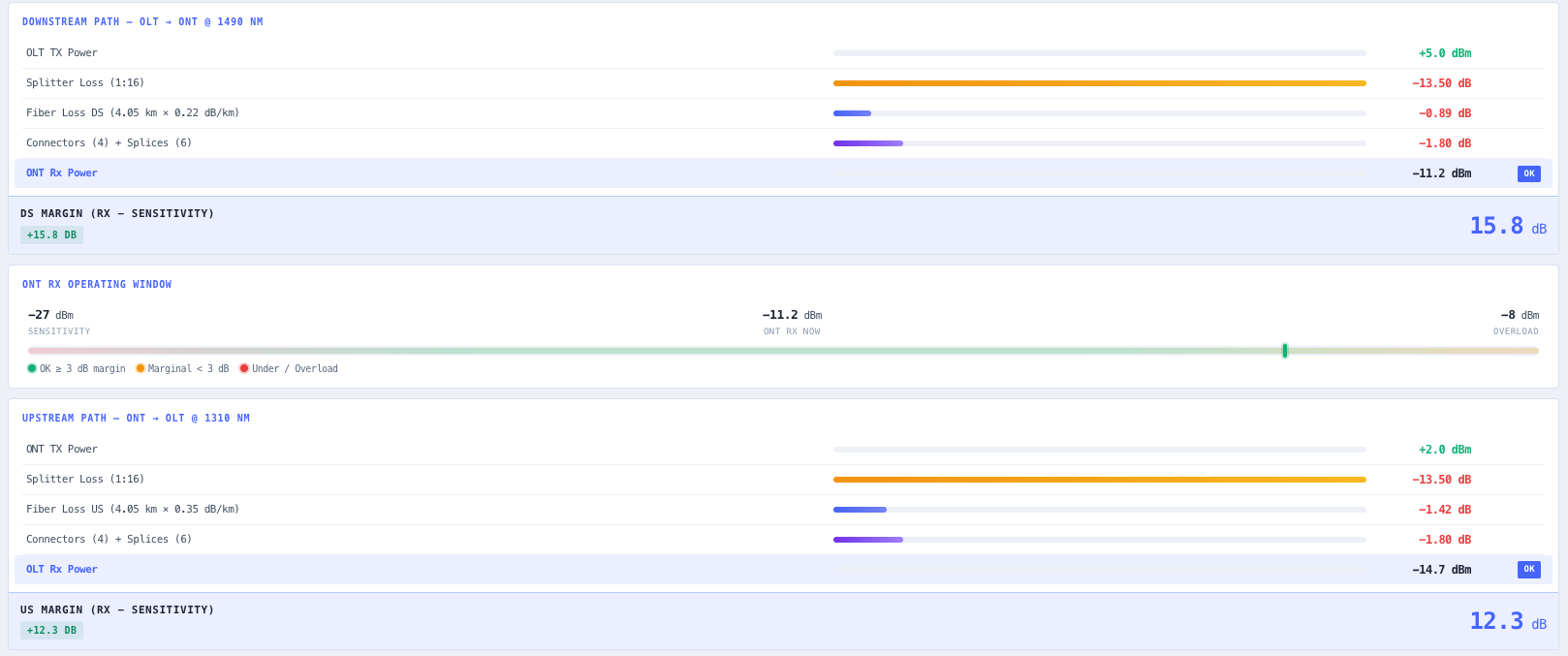
Downstream and upstream loss waterfalls
Both directions are presented as constraint-waterfall sections. Every loss contributor (splitter, fiber, connectors, splices, optional FEC coding gain) is one row with a bar scaled to the largest single loss in the path and a numeric loss value in dB. The receive row (ONT Rx for downstream, OLT Rx for upstream) is highlighted as the binding result and tagged OK, UNDER (below sensitivity), or OVERLOAD (above the overload threshold). The footer reports the margin (Rx minus sensitivity) with a coloured badge: green at 3 dB or more, amber for marginal, red for negative.
ITU-T budget classes and G.671 splitter loss
Budget class selection is scoped to the active PON standard. GPON exposes Classes A, B, B+, C, and C+ (20, 25, 28, 30, 32 dB), while XG-PON, XGS-PON, and NG-PON2 expose N1, N2, E1, and E2 (29, 31, 33, 35 dB). PLC splitter loss is a lookup against typical G.671 values that include about 1 to 1.5 dB excess loss above the ideal 10·log₁₀(N): 1:4 ≈ 7 dB, 1:8 ≈ 10.5 dB, 1:16 ≈ 13.5 dB, 1:32 ≈ 17 dB, 1:64 ≈ 20.3 dB, 1:128 ≈ 23.6 dB. Unknown ratios fall back to the theoretical formula plus a 1.5 dB excess-loss reserve.
Wavelength-aware fiber attenuation per standard
Each PON standard carries its own downstream and upstream wavelengths (GPON 1490/1310 nm, XG-PON and XGS-PON 1577/1270 nm, NG-PON2 1596/1270 nm). Default downstream and upstream attenuation is seeded from these wavelengths when the standard is selected, and can be overridden when the cable spec or measured OTDR data is known. The total fiber span (feeder plus distribution plus drop) is multiplied by the relevant per-direction attenuation to give the fiber loss components of each waterfall.
FEC coding gain (off, conservative, nominal)
Forward Error Correction adds a coding gain to the downstream link only, since the FEC overhead consumes upstream headroom rather than producing it. Three modes are exposed: Off (0 dB), Conservative (+1 dB, recommended for budgeting), and Nominal (+2 dB, vendor and implementation specific). The conservative default avoids over-committing budget the specific transceiver may not deliver.
System design margin decomposition
Rather than collapsing system reserve into a single number, the panel exposes the three components separately so the design rationale is auditable. Aging margin reserves dB for transceiver and fiber ageing over the deployment life (typically 0.5 dB), repair margin reserves for splice repairs at fault locations (typically 0.5 dB), and temperature margin reserves for outdoor cabinet thermal swing (typically 0.3 dB). The sum is subtracted from the ITU-T class budget to give the effective budget shown in the headline pair.
ONT Rx operating window
A dedicated operating window strip plots the current ONT Rx between the sensitivity and overload thresholds on a colour-banded bar. The pointer colour matches the operating state: green for 3 dB or more margin, amber for marginal, red for under (below sensitivity) or overload (above the overload threshold). This is the diagnostic view to use when an ONT is reporting an RSSI alarm in the field or when a short-fiber drop near the OLT risks driving the ONT into compression.
Max reach against TDMA and DBA cycle limits
Maximum optical reach is computed from the effective budget after splitter, passive, and FEC accounting, divided by the downstream attenuation. The result is reported alongside the standard typical reach (around 20 km) and the standard maximum (around 40 km, requiring extended-ranging configuration). When the optical math allows further than the TDMA and DBA cycle limits permit, a warning surfaces explicitly: the optical link could carry the signal, but the protocol layer cannot bound ranging at that distance without explicit reconfiguration.
Splitter ratio feasibility ranking
Every standard splitter from 1:4 to 1:128 is evaluated against the current fiber plant and passives in a feasibility table. Each row reports the splitter loss, total path loss, margin against the available budget, and a feasibility badge. The selected splitter is highlighted. The table makes the cost and capacity trade visible directly: a smaller splitter has more headroom for longer spans, while a bigger splitter serves more ONTs from each PON port but reduces optical reach.
Live two-way sync with the PON Split Ratio Planner
The PON standard and the splitter ratio are shared state with the PON Split Ratio Planner via a dedicated local-storage key. Change either of them here and the Planner picks them up, and the same in reverse. A cross-tab storage listener surfaces a sync-offer banner when the sister tool changes shared state in another window, with a single click to accept the new values. The Planner button in the top bar opens the sister tool with the current state pre-loaded.