

Shannon-Hartley capacity
Enter a channel bandwidth and SNR and read the theoretical maximum error-free data rate, C = n·B·log₂(1 + SNR), in bps, Mbps or Gbps, along with the spectral efficiency in bits per second per Hz.
RF Utilities
Shannon-Hartley channel capacity for systems integrators. Work out the maximum data rate a channel can carry, solve for the SNR or bandwidth a target rate needs, and compare a realistic throughput against the theoretical limit, with MIMO scaling.
Free to use, no sign-up needed.
Walkthrough
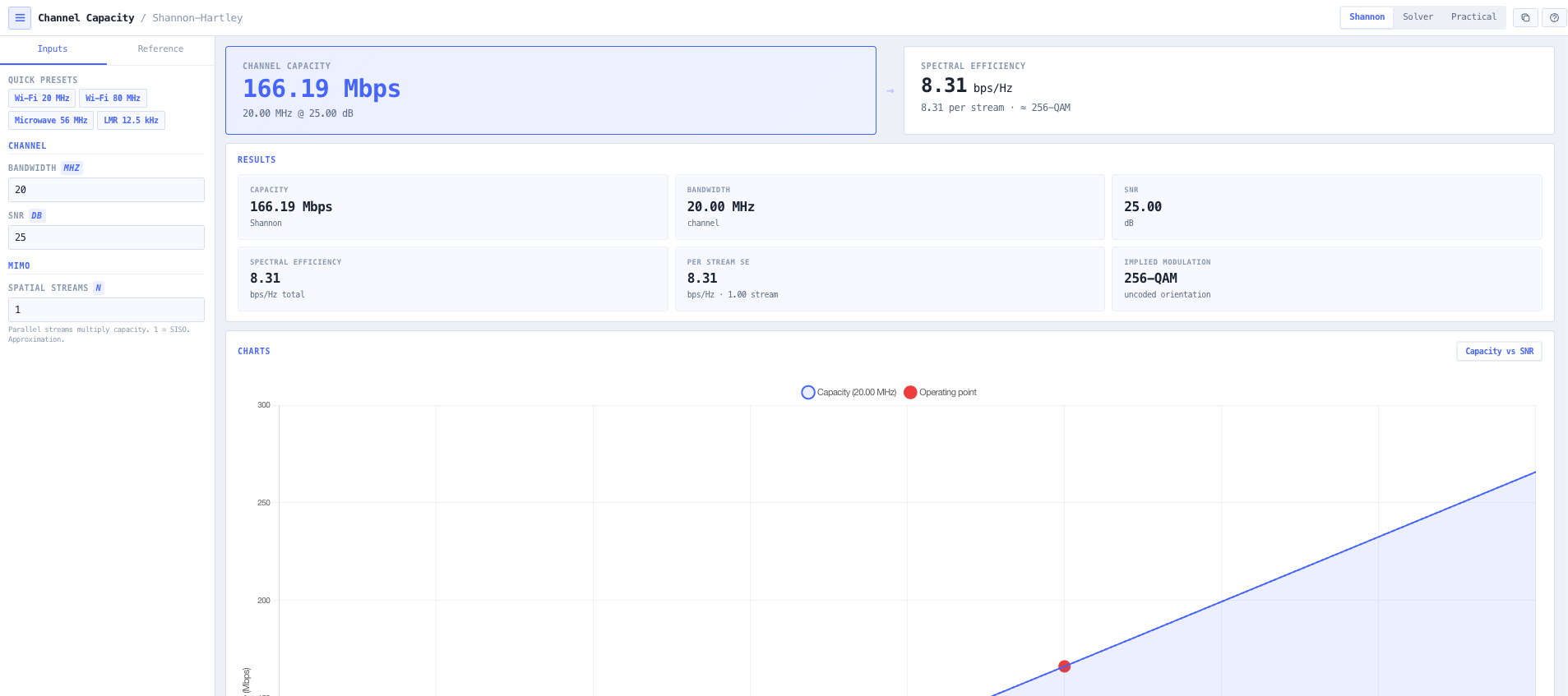
Shannon mode with the channel capacity, the spectral efficiency and the implied modulation.
Overview
Every digital radio link has a ceiling. The Shannon-Hartley theorem sets it: a channel of bandwidth B carrying a signal at a signal-to-noise ratio SNR can move at most B times the base-two logarithm of one plus the SNR bits per second, error free. No modulation, coding or clever engineering beats it. For a systems integrator sizing a microwave hop, a Wi-Fi cell, a satellite carrier or a private LTE link, that ceiling is the first sanity check on every throughput number a vendor quotes and every bandwidth or SNR a design assumes.
The noIM3 Channel Capacity Calculator puts that ceiling and the questions around it in one place. Enter a bandwidth and an SNR and read the capacity and the spectral efficiency in bits per second per Hz. Turn the problem around and ask what SNR a target rate needs in a given bandwidth, or how much bandwidth it needs at a given SNR. Then apply a realistic efficiency or an SNR gap to see what a real system will actually deliver against the theoretical bound, because production links reach only a fraction of Shannon.
It is scoped for the integrator, not the modem designer. It stays in the capacity and limit lane, with spatial-stream scaling for MIMO links and an implied modulation order for orientation, and it does not try to reproduce modulation formats, bit-error-rate curves or per-standard modulation and coding scheme tables. For that depth, the Modulation and Throughput tool is the right place. This one answers the fast questions: how much can this channel carry, what do I need to hit a rate, and is a claim physically possible.
Enter a channel bandwidth and SNR and read the theoretical maximum error-free data rate, C = n·B·log₂(1 + SNR), in bps, Mbps or Gbps, along with the spectral efficiency in bits per second per Hz.
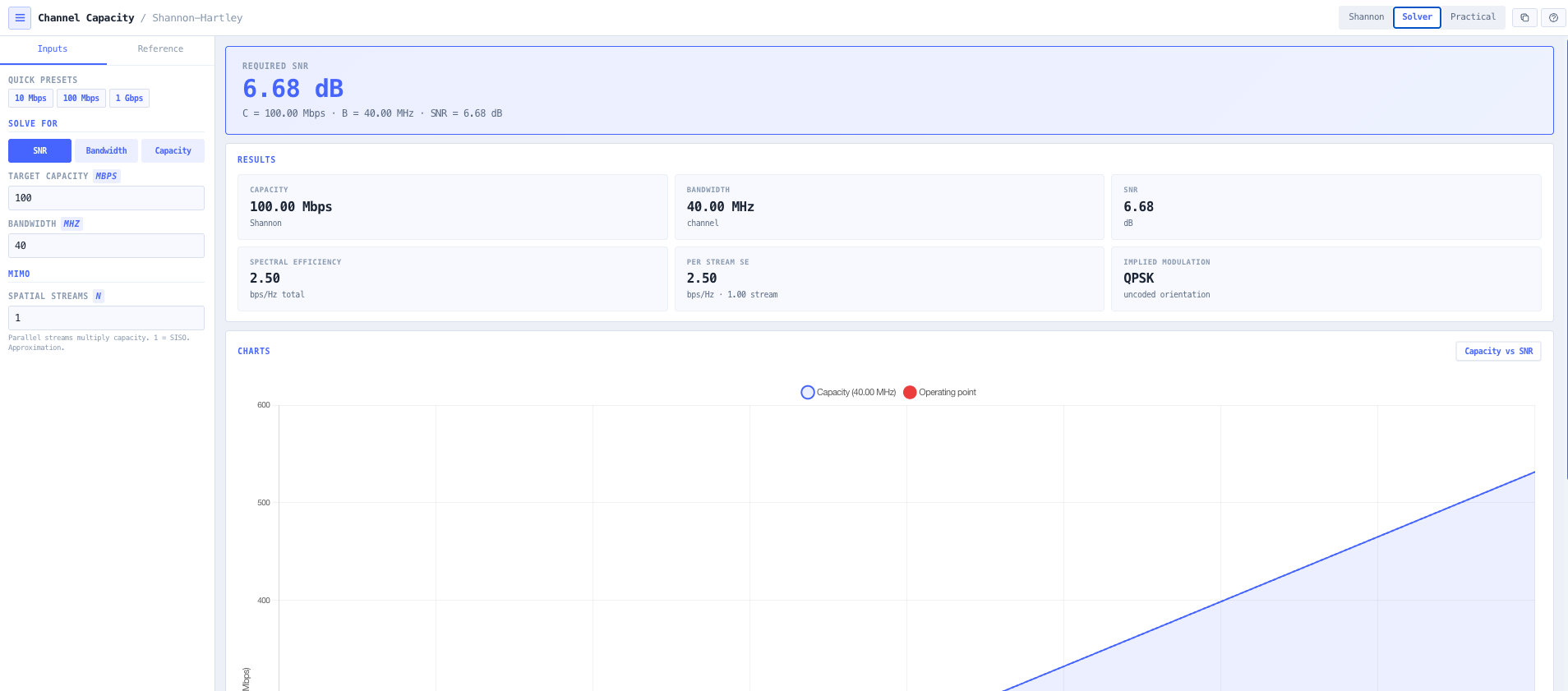
Enter any two of capacity, bandwidth and SNR and the tool solves the third. It answers the two questions a design keeps asking: what SNR do I need for a target rate in this bandwidth, and how much bandwidth does that rate need at the SNR I have.
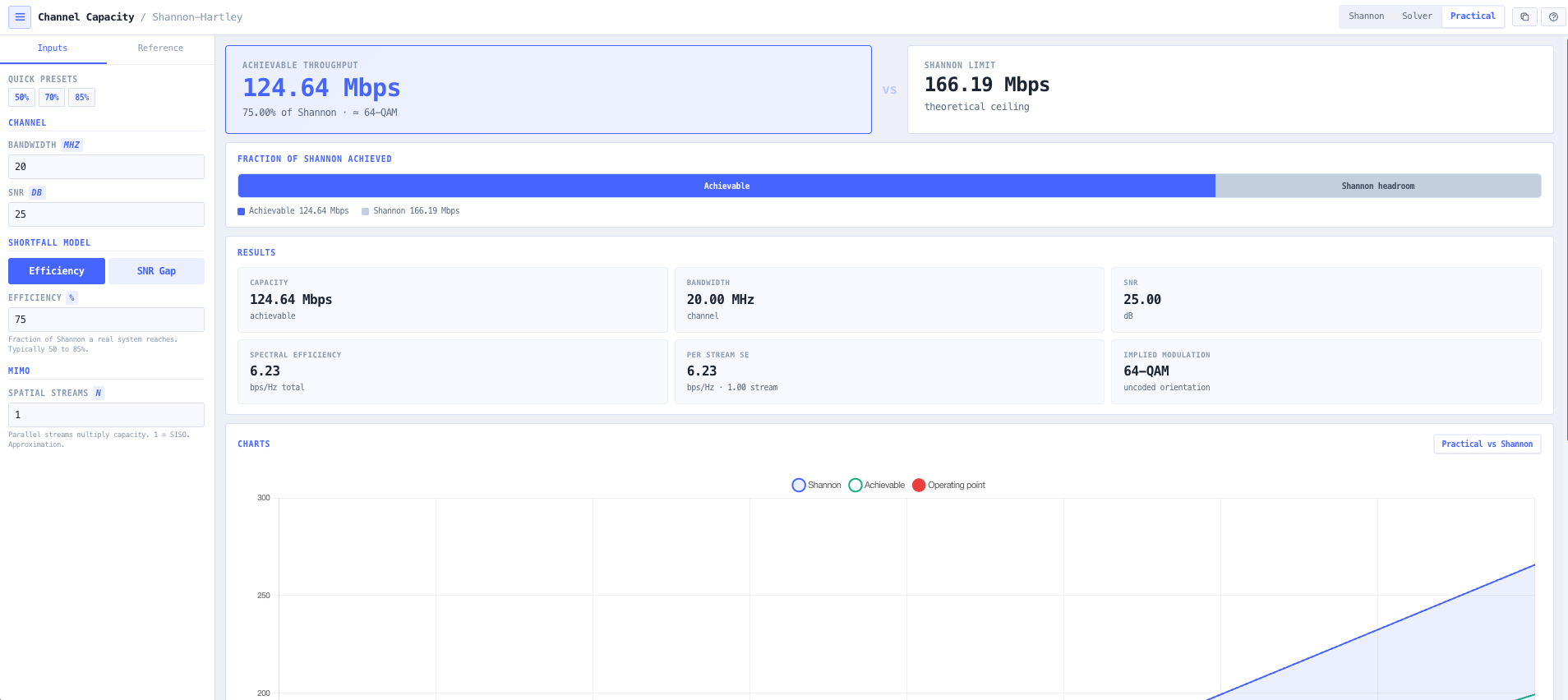
Real systems fall short of Shannon. Apply an efficiency percentage, or an SNR gap in dB that bundles coding, modulation and the target error rate into an equivalent penalty, and see the achievable rate, the fraction of Shannon it reaches, and the effective spectral efficiency. It is the sanity check on a vendor throughput claim.
Spatial multiplexing multiplies capacity by the number of parallel streams. Set the stream count for a MIMO link and every mode scales with it, with the spectral efficiency reported both in total and per stream. A simple parallel-stream approximation, clearly labelled.
The per-stream spectral efficiency is mapped to the highest standard constellation it can support, from BPSK through to 4096-QAM, as a quick orientation. It is an uncoded mapping for context, not a modulation and coding scheme recommendation.
Every mode plots capacity against SNR at the current bandwidth with the operating point marked, and the practical mode overlays the achievable curve against the Shannon bound, so the headroom and the shape of the trade are visible at a glance.
Runs entirely in your browser. No link parameters are submitted to a server. Useful for commercially confidential work or any environment where information security policy prohibits sending engineering data to third party services.
Inputs and outputs
Inputs 6
Outputs 7
Use cases
Channel capacity is the maximum rate at which information can be sent over a channel with an arbitrarily low error rate. The Shannon-Hartley theorem gives it as the bandwidth times the base-two logarithm of one plus the signal-to-noise ratio, C = B·log₂(1 + SNR). It is a theoretical ceiling that no modulation or coding scheme can exceed, so it is the first check on any throughput figure.
Multiply the bandwidth in Hz by the base-two logarithm of one plus the linear SNR. For example, a 20 MHz channel at 25 dB SNR (a linear ratio of about 316) gives 20 million times log₂(317), which is about 166 Mbps. The tool does this directly and reports the result in bps, Mbps or Gbps, along with the spectral efficiency.
Rearrange Shannon. The spectral efficiency you need is the capacity divided by the bandwidth, and the SNR required is two raised to that spectral efficiency, minus one. For 100 Mbps in 40 MHz the spectral efficiency is 2.5 bits per second per Hz, so the SNR required is about 4.7 as a ratio, or 6.7 dB. The Solver mode returns this for any two of capacity, bandwidth and SNR.
Shannon assumes an ideal code of unbounded length and complexity and a perfectly Gaussian channel. Real systems use finite, practical modulation and coding at a target bit-error rate, and lose to implementation impairments. They typically reach 50 to 85 percent of Shannon, or sit a few dB back from it in SNR terms. The Practical mode lets you apply either an efficiency percentage or an SNR gap to get a realistic figure.
Spatial multiplexing sends independent data streams over the same bandwidth using multiple antennas. In the simple model of n parallel streams of equal SNR, capacity is multiplied by n, so a two-stream link roughly doubles capacity and a four-stream link roughly quadruples it. Real MIMO gains depend on the channel richness and antenna correlation, so the tool treats the stream count as an approximation.
This tool stays in the capacity and theoretical-limit lane: the Shannon rate, the SNR or bandwidth a rate needs, and how far a real link falls short. The Modulation and Throughput calculator goes deeper into specific modulation formats, bit-error-rate curves and per-standard modulation and coding scheme throughput tables. Use this one for the fast capacity questions and that one when you need the modem-level detail.
No. The calculator runs entirely in your browser. No link parameters are submitted to a server, which suits commercially confidential work and any environment where information security policy prohibits sending engineering data to third party services.