Automated frequency pair generation
Scans every valid TX and RX combination inside the configured ranges and split, then filters for guard band compliance and existing channel collisions before scoring.
Find clean, interference free TX and RX frequency pairs with full intermodulation analysis for surface and underground radio systems.
Included in the 14-day Pro trial on every new account. No credit card.
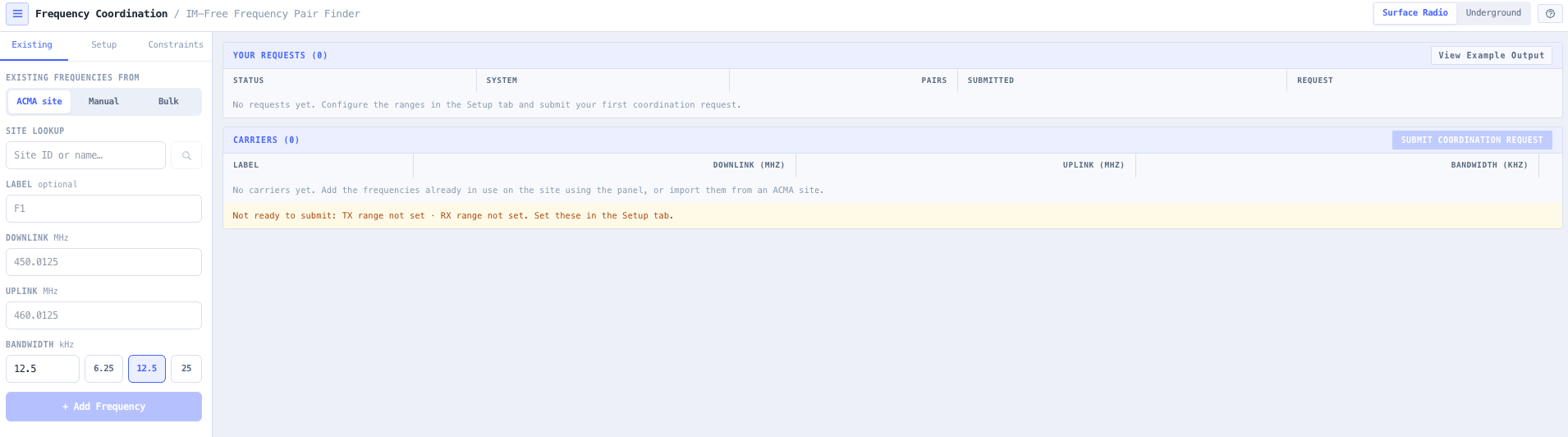
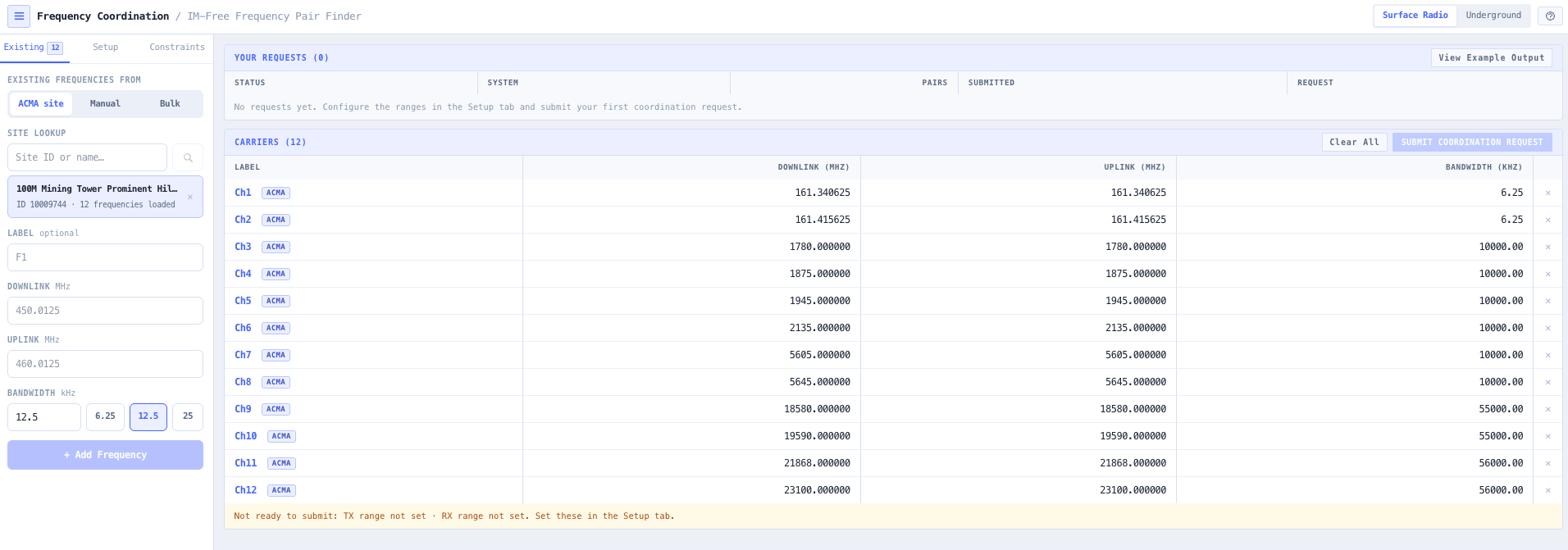
Frequency coordination is the engineering process of selecting transmit and receive frequency pairs that will not generate harmful intermodulation products in the band of interest. Done badly, it produces in band spurs that mask weak signals, drive trunked systems into hunting, and trigger persistent intermittent interference that is notoriously difficult to diagnose once the network is in service.
The noIM₃ Frequency Coordination Tool runs an exhaustive search across user defined TX and RX frequency ranges, applies split, guard band, and exclusion zone constraints, then scores every candidate pair against ITU standard intermodulation models, to 5th order on the surface and to 3rd order underground, where 5th order is omitted. Results are ranked so the cleanest, lowest risk pairs surface first, making the tool suitable for both greenfield deployments and incremental channel expansion within a working network.
Surface mode evaluates the full product set: 2nd order, 3rd order two signal and three signal, and 5th order two signal and three signal, plus harmonics of the transmit carriers. Underground mode evaluates 2nd and 3rd order and omits 5th order, because the 5th order three signal family is effectively un-plannable and the two signal product sits below the noise floor once typical leaky feeder coupling loss and cascade amplifier IM rejection are taken into account. Underground mode also drops the TX/RX role filter, so every carrier both radiates harmonics and counts as a potential victim, which is how leaky feeder systems in mines, tunnels, and metro networks behave. Underground adds one further choice: whether to combine a downlink carrier with an uplink one. A diplexed line amplifier filters each direction into its own gain stage, so the two never meet at the same active non-linearity and a mixed band product can only form as passive intermodulation on the cable. Restricting the enumeration to each band on its own removes those products; including them is available for a site where cable PIM is the concern.
Scans every valid TX and RX combination inside the configured ranges and split, then filters for guard band compliance and existing channel collisions before scoring.
2nd, 3rd, and 5th order product analysis on every candidate. Surface mode reports the full set, two signal and three signal. Underground mode reports 2nd and 3rd order and omits 5th order for leaky feeder environments.
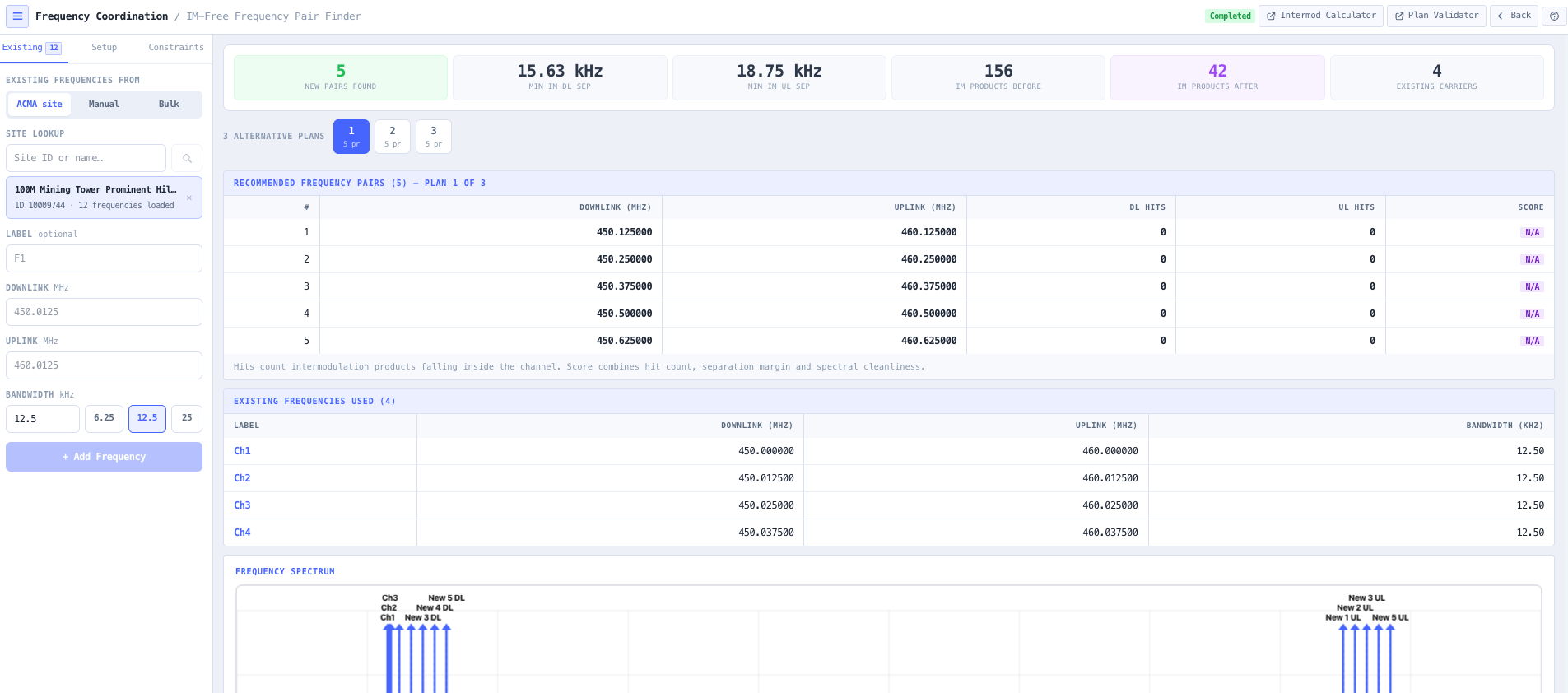
Each pair receives a composite score combining intermodulation hit count, minimum separation, and spectral cleanliness, so the cleanest options surface at the top of the list.
Enforces engineering and licensing constraints. Guard bands, exclusion ranges, and protection of incumbent channels are applied at search time, not as an afterthought filter.
Carriers and intermodulation products overlaid on the band, so you can validate coordination outcomes visually before committing to a channel plan.
Pin specific TX or RX frequencies (for example fixed dispatch channels) and let the tool coordinate the remainder of the plan around them.
Frequency coordination is the process of choosing TX and RX frequency pairs that do not generate harmful intermodulation products inside the band of interest. Without it, a system will produce in band spurs that mask weak signals and cause intermittent interference that is very difficult to diagnose once the network is in service.
Surface mode evaluates 2nd order, 3rd order two signal and three signal, and 5th order two signal and three signal, plus harmonics of the transmit carriers. Underground mode evaluates 2nd and 3rd order and omits 5th order. The product types follow the definitions in ITU-R SM.1446. Note that SM.1446 defines and measures intermodulation products rather than predicting their level: this tool computes frequency arithmetic and channel spacing, and models no isolation, filtering, or predicted product level.
Each candidate pair is scored on a composite of intermodulation hit count weighted by order, minimum separation between carriers and intermodulation products, and spectral cleanliness across the working band. Higher scores indicate cleaner, lower risk pairs and surface first in the ranked output.
Yes. The constraint engine enforces user defined existing channels, guard bands, and exclusion ranges (for example licensed incumbents or broadcast bands) at search time. Pairs that would violate any constraint are eliminated before scoring rather than filtered after the fact.
Yes. You can pin specific TX or RX frequencies, for example fixed dispatch or repeater channels that cannot move, and the tool will coordinate the remaining channels around them.
Yes. Underground mode evaluates 2nd and 3rd order products and omits 5th order: the 5th order three signal family is effectively un-plannable, and the two signal product sits below the noise floor once typical leaky feeder coupling loss and cascade amplifier IM rejection are taken into account. It also drops the TX/RX role filter that surface mode applies, because leaky feeder coupling makes the distinction between a radiating carrier and a listening one moot in tunnels and stopes. Separately, underground lets you choose whether downlink and uplink carriers are combined with each other: a diplexed line amplifier keeps the two directions in separate gain stages, so mixed band products can only arise as passive intermodulation on the cable rather than in the amplifier.
Yes. The coordination output is structured to support ACMA licence applications and Australian spectrum management workflows, with traceable input parameters, ranked candidate output, and exportable spectrum diagrams suitable for inclusion in engineering submissions.
Included in the 14-day Pro trial on every new account. No credit card.