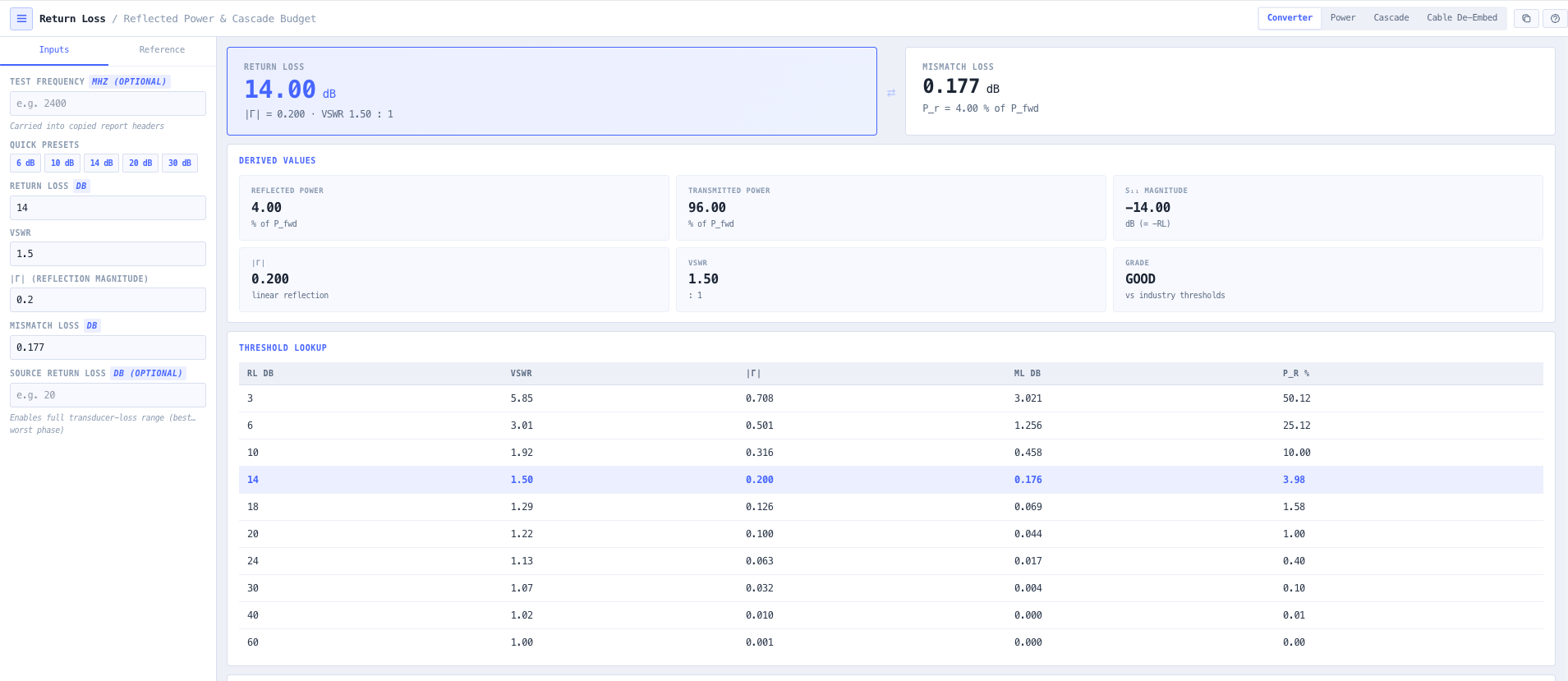
Return loss is the everyday metric of RF installation and commissioning. Antenna analysers, vector network analysers, and field test sets all report it directly, and contractual specifications, vendor datasheets, and licence conditions are routinely written in dB of return loss. The relationship to reflected power is direct but not obvious without a calculator. A 14 dB return loss leaves about 4 per cent of forward power reflected. A 20 dB return loss leaves 1 per cent. A 10 dB return loss leaves 10 per cent. For high power transmitters, that fraction matters in absolute watts (a 1 kilowatt transmitter feeding a 14 dB return loss antenna has 40 watts of reflected power circulating in the feed system, which is enough to damage circulators, duplexers, and arrestors that were not sized for it).
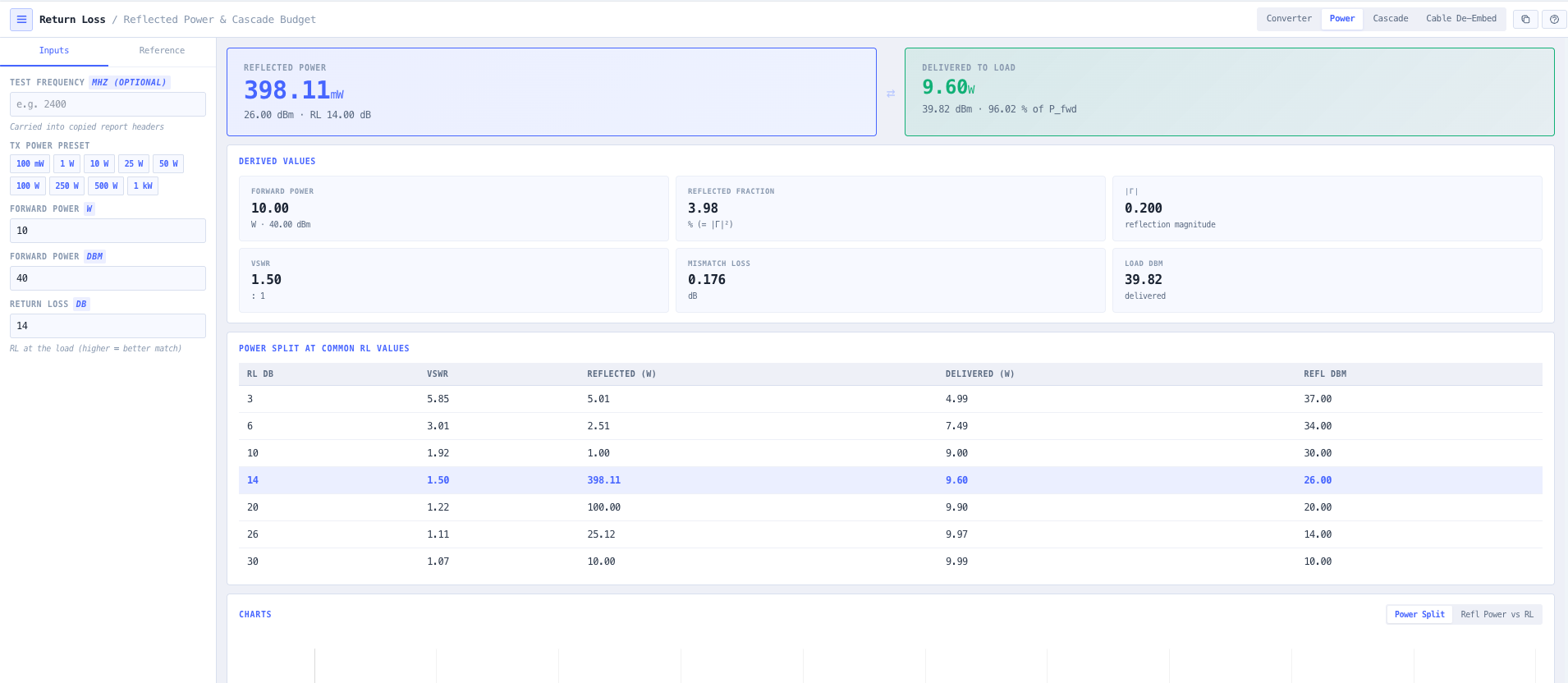
The noIM₃ Return Loss Calculator handles every adjacent quantity in one workspace. Bidirectional conversion between return loss, VSWR, magnitude Gamma, and mismatch loss with reflected and transmitted power percentages, all updating simultaneously so a number from any source translates instantly to every other form. Forward power input in watts or dBm (converted live between the two) returns reflected power and the power delivered to the load in both watts and dBm, auto-scaled to milliwatts, microwatts, or kilowatts for readability. Useful for high power transmitter safety analysis and for protecting downstream components from circulating reflected energy.
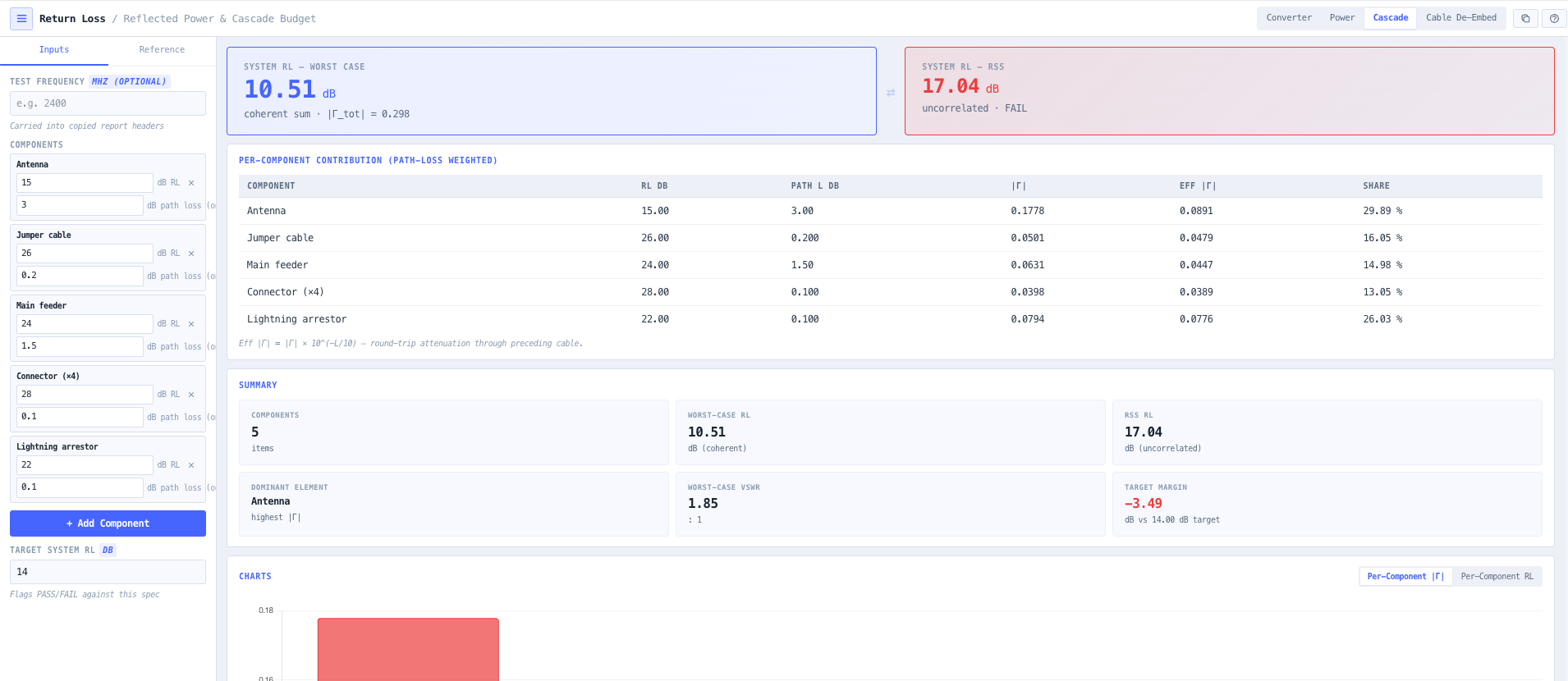
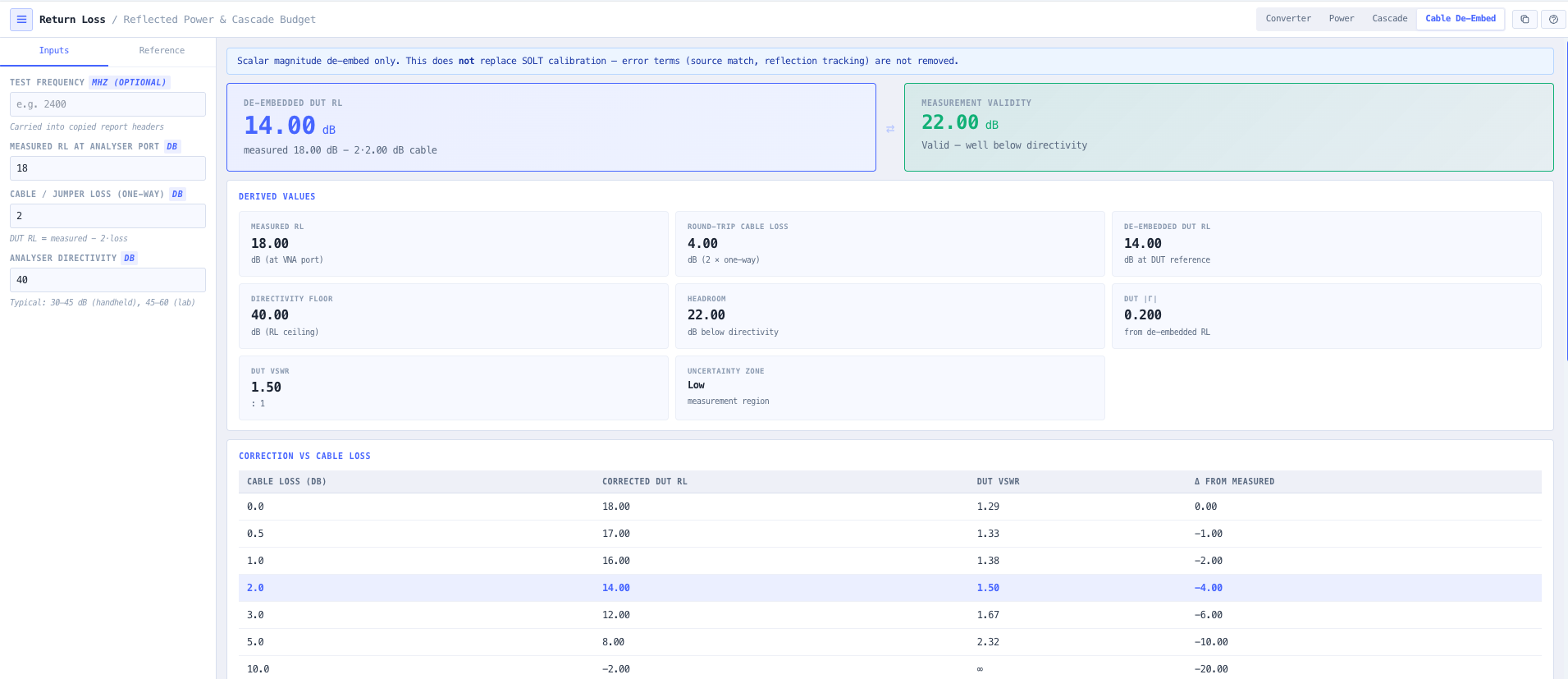
Beyond conversion, the calculator covers the cascade and measurement workflows engineers actually need. Cascade return loss budget rolls up the contributions of a free-text named component list (antenna, jumper cable, main feeder, connectors, lightning arrestor), each weighted by the round-trip loss of the feeder run in front of it so a reflection behind a lossy feeder counts for less, and reports both worst case coherent (all reflections in phase) and root sum of squares (uncorrelated) system return loss, with a per component bar chart that identifies which element dominates the system mismatch. Vector network analyser correction handles the case where the analyser is at the bottom of a tower or behind a long jumper run. True DUT return loss equals measured return loss minus 2 times cable loss in dB. Directivity floor warning fires when the DUT return loss approaches the analyser directivity, flagging the measurement noise limited region where readings are not trustworthy.