ACIR from both ratios, per TR 36.942 clause 5.2
The transmitter leakage and the receiver selectivity combined the way the specification combines them, with the result bounded above by the smaller of the two and never able to exceed it.
Adjacent channel interference ratio combining BOTH the transmitter ACLR and the receiver ACS per 3GPP TR 36.942, receiver desensitisation from the interference to noise ratio, the exact isolation shortfall, and the Australian limits from RALI MS 47, the Fixed Licence Determination 2025 and the Schedule 2 boundary criterion.
Free forever on a Standard account. No credit card.
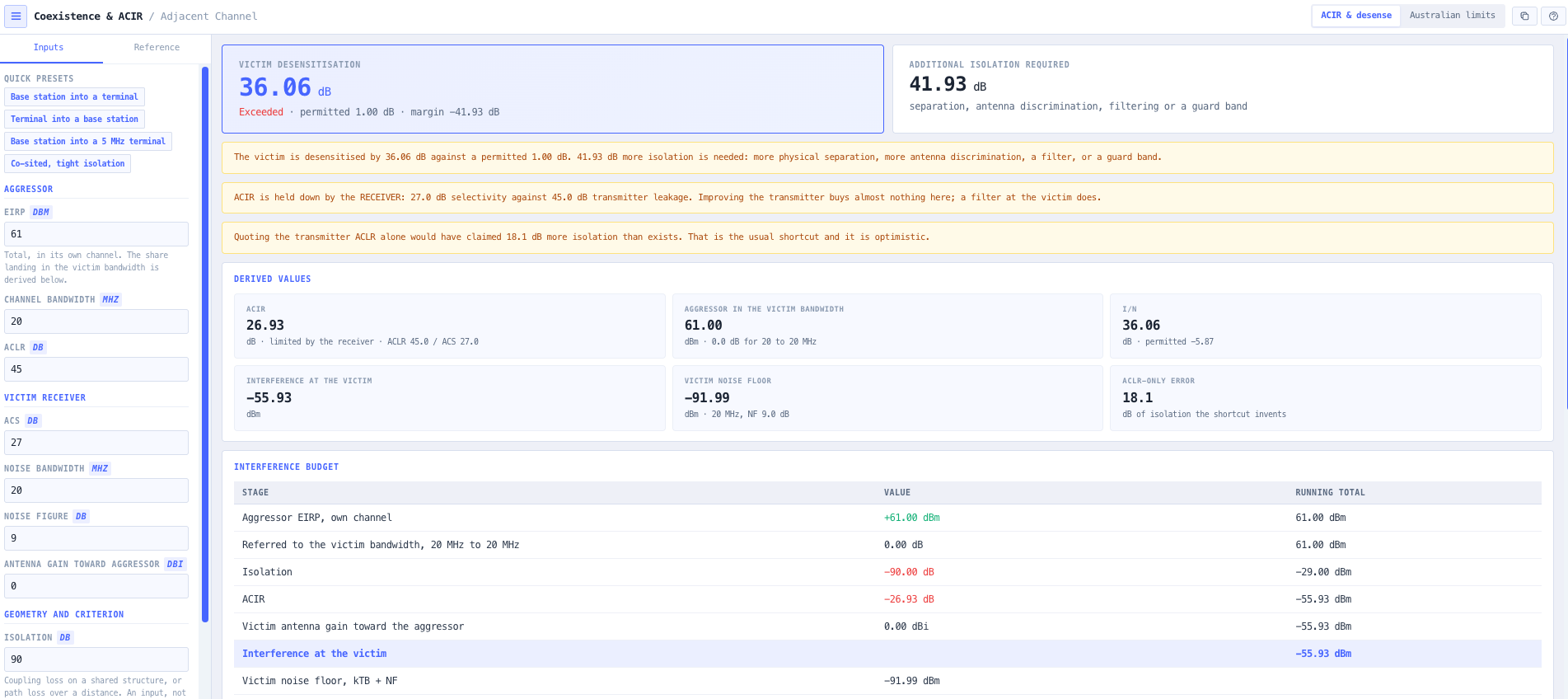
The shortcut this tool exists to stop is quoting the transmitter ACLR as the achievable isolation. TR 36.942 clause 5.2 is explicit: one over ACIR equals one over ACLR plus one over ACS. The receiver selectivity is half the answer, and ACIR is bounded above by the smaller of the two ratios. A base station with 45 dB ACLR beside a terminal with 27 dB ACS at 20 MHz achieves 26.9 dB, not 45. Quoting the 45 is out by 18 dB, in the optimistic direction, and it is the single most common error in coexistence work.
The output that matters in a coordination study is not the interference power, which means nothing on its own, but what it does to the victim receiver noise floor. Desensitisation is 10 log10 of one plus the interference to noise ratio, which puts a 1 dB criterion at an I/N of minus 5.87 dB and a 3 dB criterion at 0 dB. Coordination criteria are written in those terms, so that is what the tool reports, alongside the exact additional isolation needed when a criterion is exceeded.
It also names which side of the pair is limiting, which is the part that decides where the money goes. Where the receiver selectivity is the constraint, improving the transmitter buys almost nothing and a filter at the victim buys a great deal. Where the transmitter is the constraint the reverse holds. Getting that backwards is expensive, and an analysis that only ever looks at ACLR cannot tell the difference at all.
The aggressor power is first referred to the victim bandwidth, because a narrow receiver collects only its share of the adjacent channel: charging a 12.5 kHz receiver the whole 20 MHz leakage is 32 dB pessimistic. Two Australian instruments set emission limits that do not depend on the ACIR result, and both are implemented. RALI MS 47 clause 4.9.2.3 protects radio altimeters in 4200 to 4400 MHz, directly above the 3.4 GHz band, with figures from minus 48 to minus 21 dBm per MHz depending on whether the transmitter uses an active antenna system, whether it is indoors, and whether it sits inside a runway inner zone; it is a registration recommendation for AWL transmitters above 3700 MHz sited in a runway restriction zone. The Radiocommunications Licence Conditions (Fixed Licence) Determination 2025 section 36 sets the point to multipoint emission mask as a function of offset from the licensed band edge, and Schedule 2 of the 3.4 GHz spectrum licence guidelines sets the boundary criterion. An analysis that clears the desensitisation criterion and breaches one of these has not cleared the licence.
The transmitter leakage and the receiver selectivity combined the way the specification combines them, with the result bounded above by the smaller of the two and never able to exceed it.
ACLR is a ratio over an adjacent channel of the same width, so a narrow receiver collects only its share of the leakage. The tool asks for the aggressor EIRP and channel bandwidth, refers the power to the victim bandwidth with the same helper the Network Planner uses, and prints the referral as a budget stage. A 12.5 kHz victim charged the whole 20 MHz channel would be 32 dB pessimistic.
Where the receiver holds ACIR down, cleaning up the transmitter buys almost nothing and a filter at the victim buys a great deal. Where the transmitter holds it down, the reverse. The tool says which, because getting it backwards is expensive.
The difference between the ACLR and the true ACIR is reported directly, so an analysis that took the shortcut can be audited against one that did not. The error is always optimistic and is largest exactly where the two ratios are close.
Reported as 10 log10 of one plus I/N rather than as a bare interference power. A 1 dB criterion is an I/N of minus 5.87 dB and a 3 dB criterion is 0 dB, and those are the numbers coordination is written in.
When a criterion is exceeded, the shortfall in dB. That is the actionable number: it converts directly into separation, antenna discrimination, filtering or a guard band.
Minus 108 dBm per 5 MHz, not exceeded more than 5% of any hour, scaled logarithmically to the victim bandwidth and checked against this design. A continuous pass is conclusive; a fail is not settled without a duty cycle the calculation does not have, and the page says which it is.
Clause 4.9.2.3 across active and non active antenna systems, indoor and outdoor, inner zone and outside it: a registration recommendation for AWL transmitters above 3700 MHz sited in a runway restriction zone, independent of any ACIR result. The licensing intake already asks applicants for the figure.
Section 36 Tables 3 and 4, as a function of offset from the licensed band edge, for both AAS and non-AAS transmitters. An analysis that clears ACIR and breaches this has not cleared the licence.
The instruments measure them differently and the two are not interchangeable. Conflating them silently converts a compliant design into a non-compliant one, or the reverse, with no visible sign.
The page states what is assumed rather than measured: interference as additive noise, leakage spread evenly across the aggressor channel, isolation as an input. When a criterion is exceeded, the shortfall links to the Antenna Separation Calculator, the RF Filter & Combining Designer and the Co-Site Designer, which turn a number of dB into a separation or a filter.
Because it assumes a perfect receiver. TR 36.942 clause 5.2 combines the transmitter leakage with the receiver selectivity, and the combination is bounded above by the smaller of the two. A 45 dB ACLR transmitter beside a 27 dB ACS receiver achieves 26.9 dB. Quoting the 45 overstates the isolation by 18 dB, and the error is largest exactly where the two ratios are close, which is the case that matters most.
Because an interference power means nothing without the noise floor it is landing on. Desensitisation is 10 log10 of one plus I/N, and coordination criteria are written in those terms: 1 dB of desense is an I/N of minus 5.87 dB, 3 dB is 0 dB. Reporting the quantity the criterion is expressed in removes a conversion step where errors get introduced.
The tool names which ratio is holding ACIR down. If the receiver selectivity is the constraint, improving the transmitter buys almost nothing and a filter at the victim buys a great deal. If the transmitter is the constraint, the reverse. An analysis that only looks at ACLR has no way of telling the two apart, which is how money gets spent at the wrong end of a link.
RALI MS 47 clause 4.9.2.3 protects radio altimeters in 4200 to 4400 MHz, which sit directly above the 3.4 GHz band, with figures from minus 48 to minus 21 dBm per MHz depending on the antenna system, indoor or outdoor, and the runway inner zone; it applies to AWL transmitters above 3700 MHz sited in a runway restriction zone, where a transmitter exceeding it should not be registered. The Fixed Licence Determination 2025 section 36 sets the point to multipoint emission mask, and Schedule 2 of F2025L01050 the spectrum licence boundary criterion. None depends on ACIR: a design can clear every desensitisation criterion and still fail them.
Because ACLR is defined over an adjacent channel of the same width as the carrier. A receiver narrower than that collects only the fraction of the leakage that lands in its own bandwidth, so the power is scaled by the bandwidth ratio before ACIR is applied, and the scaling is printed as its own line in the budget. Charging a 12.5 kHz receiver the full 20 MHz leakage is 32 dB pessimistic, and that error survives review because it produces a scary number nobody questions. A victim wider than the aggressor collects all of it and no more, so the correction never goes the other way.
No. ACLR and ACS are defined at the first and second adjacent channel, and a UHF receiver is tens of MHz from any LTE carrier. Out there the aggressor is governed by its absolute out-of-band and spurious limit and the victim by its blocking performance, not by a ratio to the carrier. Applying ACIR anyway is the single most common error in a co-siting study. That case belongs in the Co-Site Designer, which classifies the regime before it calculates.
No, and that is deliberate. Isolation on a shared structure is antenna coupling loss and over a distance it is path loss, and the two are measured and modelled quite differently. It is an input here rather than something guessed at. The 3D Antenna Separation tool computes coupling loss properly for the co-sited case.
It reports the exact additional isolation required, in dB, rather than just failing. That is the number that converts into a decision: more physical separation, more antenna discrimination, a filter, or a guard band. A pass or fail without the shortfall leaves the engineer to work out the magnitude of the problem separately.
They share the engine. The Network Planner runs it across every service on a structure at once and classifies which mechanism governs each victim before calculating, since ACLR and ACS are only defined at the first and second adjacent channel. This tool is the single pair case, for when you want to work one interaction in detail.
Free forever on a Standard account. No credit card.