Electrical System Design

Generator Sizing Calculator

Size a standby or prime diesel generator for a comms hut, rack, shelter, or container DC plant from a real equipment schedule, with motor starting, altitude and temperature derating, and diesel fuel and autonomy estimation.

Free forever on a Standard account. No credit card.

Overview

Sizing a generator for a communications site is not the same problem as sizing one for a workshop or a house. The load is dominated by switch-mode rectifier plant, UPS, and air-conditioning rather than resistive heating, the power factor is high but the current is non-linear, the largest air-conditioner compressor usually governs the transient rather than the steady load, and the site is often at altitude, hot, or remote enough that fuel autonomy and derating decide the design. A set chosen on connected kW alone is routinely the wrong size, oversized and wet-stacking at light load, or undersized and collapsing when the compressor starts.

The noIM₃ Generator Sizing Calculator is built for exactly that work. It starts from a load schedule you build line by line, rectifier plant, UPS, HVAC, lighting, chargers and auxiliary loads, each carrying a typical power factor and a non-linear compatibility allowance that captures the extra alternator capacity a double-conversion UPS or unfiltered rectifier demands. From that it resolves running kW, apparent kVA and the effective power factor of the combined load, and recommends a standard commercial frame rated at the 0.8 PF reference point with spare capacity for growth, checking the resulting load factor against the ISO 8528-1 duty class so a prime set is not loaded past its recommended average.

Beyond the steady load the tool covers the three things that actually move the answer on a comms site. A starting mode sizes the set for the largest motor or block load using start-method inrush factors checked against the ISO 8528-5 transient voltage-dip classes, and shows side by side how much smaller a set a soft starter or VSD permits. A derating mode reduces available output for site altitude and ambient temperature and returns the required ISO-reference nameplate rating. A fuel mode estimates diesel burn in litres per hour, the runtime on a given tank, and the tank size needed for an NFPA 110 autonomy target. Everything runs in the browser, copies to the clipboard for the design file, and is labelled as planning-grade guidance to confirm against the chosen set datasheet.

Capabilities

Equipment-schedule load build-up

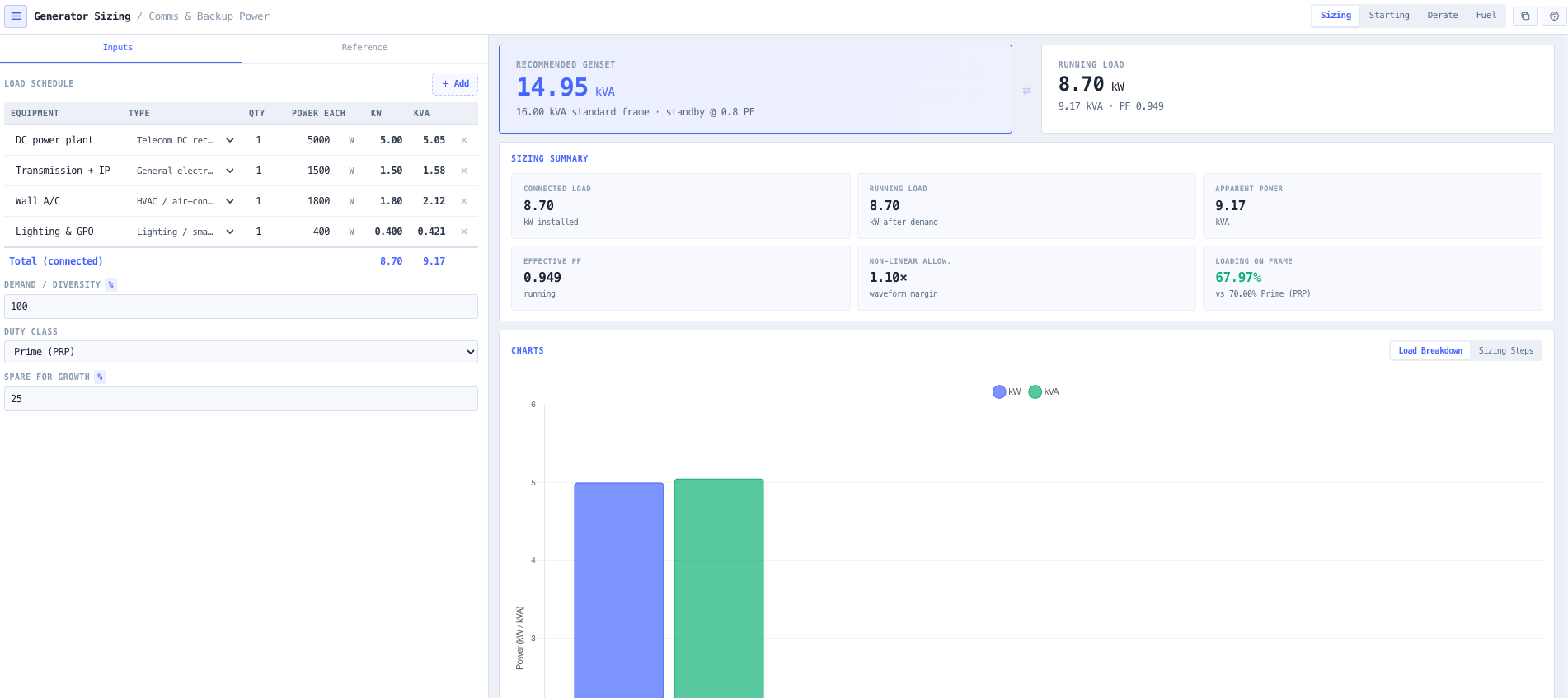
Build the connected load from a schedule of equipment rather than a single blanket figure. Each line carries a name, a load category, a quantity and watts each. The category sets a typical power factor and a non-linear compatibility multiplier, so a power-factor-corrected rectifier shelf and a double-conversion UPS are treated differently. The tool resolves connected and running kW, apparent kVA, and the effective power factor live as you edit, with a demand / diversity factor applied to the running load.

Non-linear and UPS compatibility allowance

Communications loads are largely switch-mode, and the alternator has to supply their non-linear current. The category multipliers capture this directly. A PFC rectifier shelf carries a small margin, while an unfiltered double-conversion UPS pushes the recommended frame up, reflecting the standard practice of oversizing a set feeding a double-conversion UPS unless it is filtered or 12-pulse.

Standard frame selection at the 0.8 PF rating point

A generator is bought in discrete commercial frames and its kVA is quoted at 0.8 PF, so its kW ceiling is 0.8 times the kVA. The tool sizes against both the alternator (kVA) and the engine (kW), applies the non-linear allowance and a growth margin, rounds up to the next standard frame, and reports the load factor the running load places on that frame against the selected ISO 8528-1 duty class (standby, prime, or continuous).

Motor and step-load starting (ISO 8528-5)

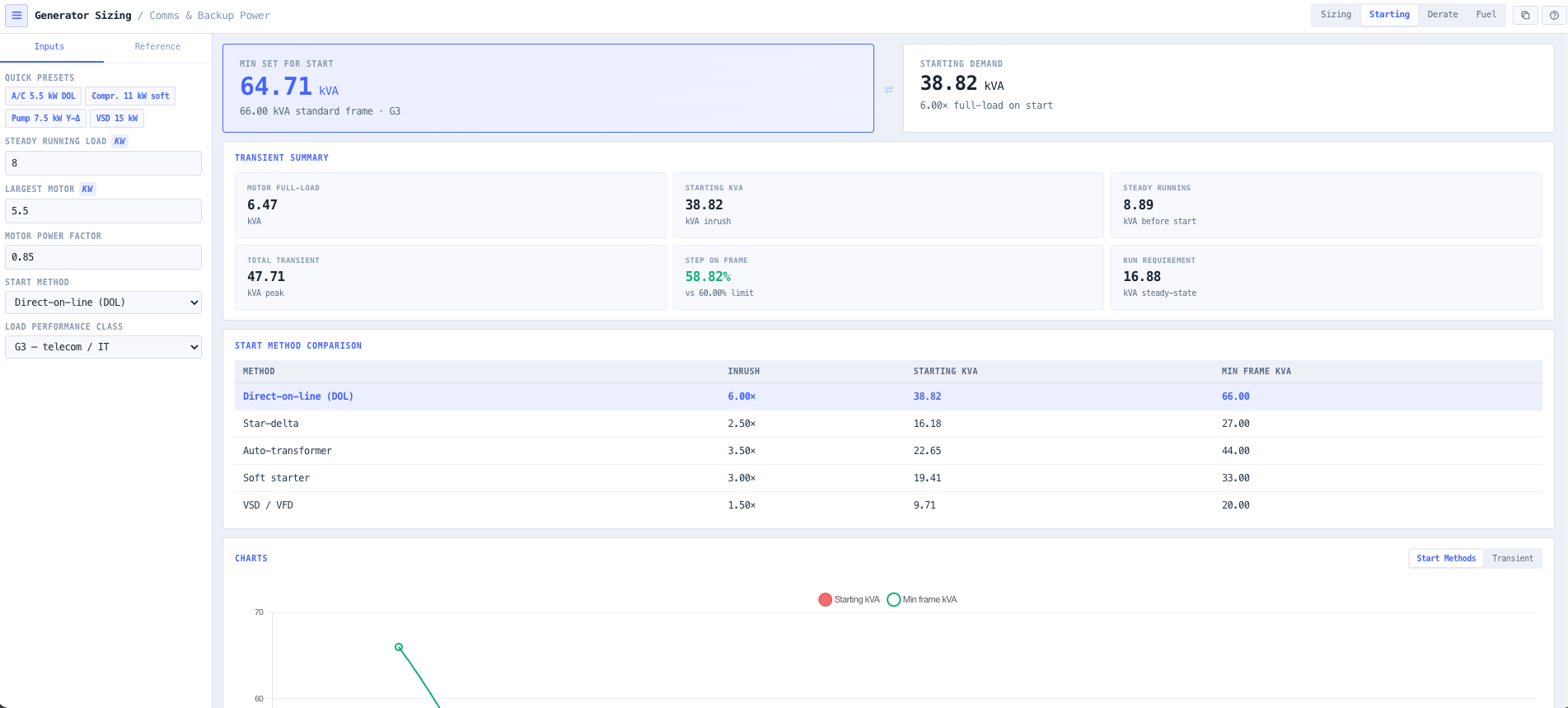
The largest motor usually governs the transient. Starting kVA is the motor full-load kVA times the start-method inrush factor, direct-on-line, star-delta, auto-transformer, soft starter, or VSD, and the minimum set is sized so the step sits within the ISO 8528-5 transient voltage-dip class chosen for the load, from general-purpose loads to critical telecom and UPS loads that demand a tight transient.

Start-method comparison

Reduced-voltage and electronic starters cut inrush sharply, and the difference often decides the set size. A side-by-side table reports the starting kVA and minimum frame for each start method against the same load and transient class, making the case for a soft starter or VSD where a smaller, cheaper set is the goal.

Altitude and temperature derating

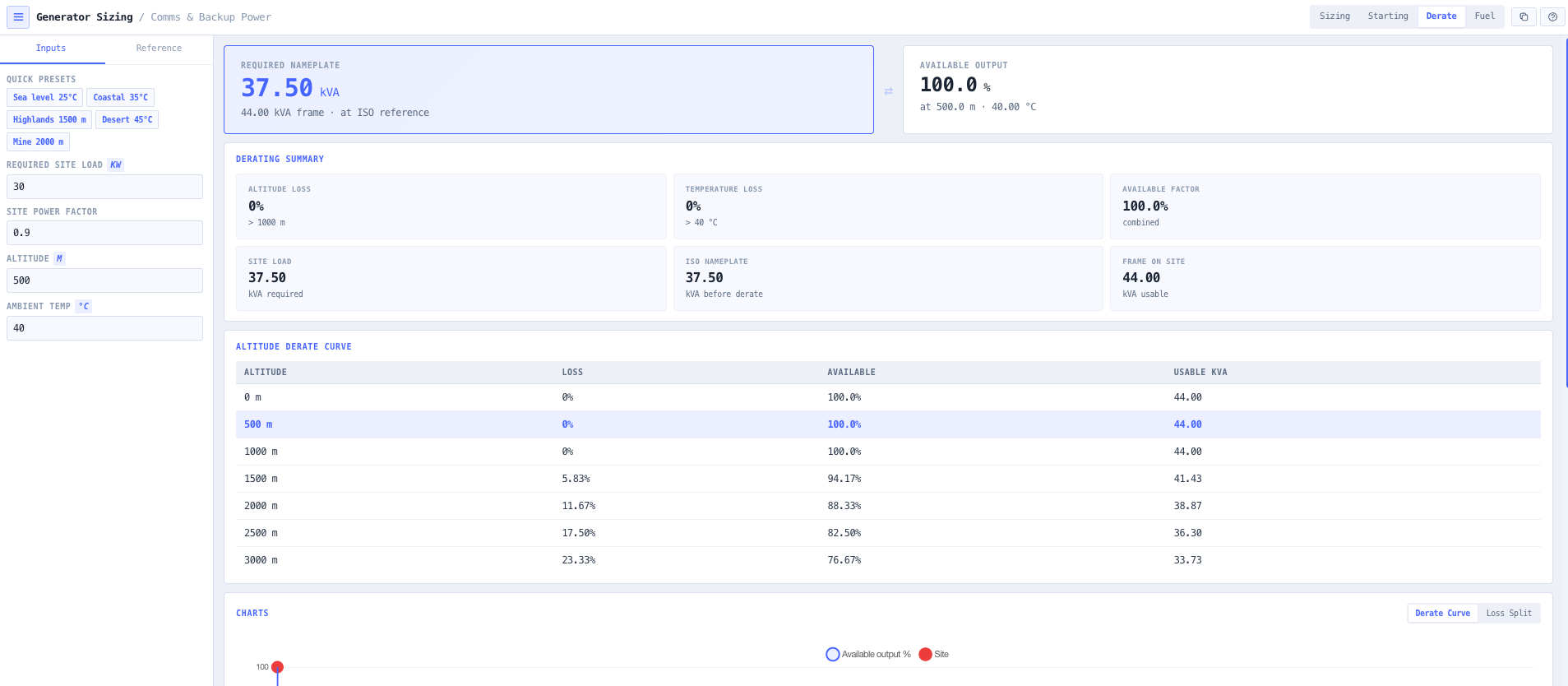
Air density falls with altitude and rising ambient temperature, and the engine loses output. The derating mode applies a representative altitude and temperature derate, returns the combined available output fraction, and computes the required ISO-reference nameplate rating so the set still delivers the site load, with a curve showing how the usable output of a frame falls across the elevation range.

Diesel fuel burn and NFPA 110 autonomy

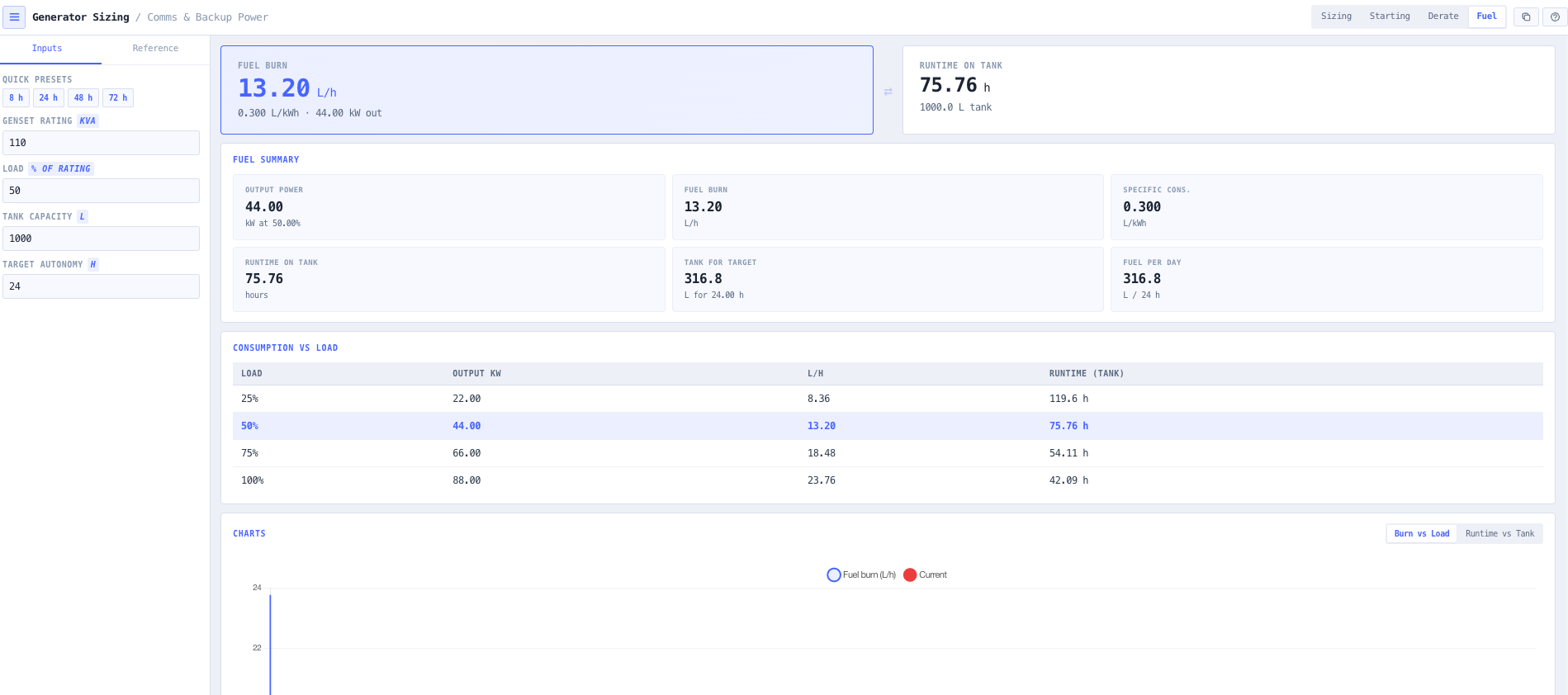
Estimate diesel burn in litres per hour using load-dependent specific consumption, the runtime on a given tank, and the tank capacity needed for a target autonomy against the NFPA 110 classes, with a consumption-versus-load table for 25, 50, 75 and 100 percent loading so part-load fuel penalties are visible.

Browser-only computation

Runs entirely in your browser. No load schedule, site condition, or fuel figure is submitted to a server. Useful for commercially confidential work and for security-restricted communications sites where information security policy prohibits sending design data to third party services.

Standards & methodology

  • ISO 8528-1 generating set rating definitions (ESP / PRP / COP)
  • ISO 8528-5 transient response and voltage-dip performance classes (G1 to G4)
  • ISO 3046 engine power and derating reference conditions
  • NFPA 110 standard for emergency and standby power systems (fuel autonomy classes)

When to use this tool

  • Sizing a standby generator for a comms hut, equipment shelter, or roadside cabinet
  • Sizing a set for a single rack or a small group of racks on a temporary or remote site
  • Sizing a prime generator for a container DC plant or off-grid communications node
  • Checking whether an existing generator can carry an added HVAC or motor load
  • Comparing start methods to justify a smaller, cheaper set
  • Derating a generator selection for a highland, desert, or high-temperature mine site
  • Estimating diesel fuel burn and refuelling intervals for a remote communications site
  • Sizing a day tank or bulk tank for an NFPA 110 autonomy target
  • Producing a first-pass sizing note for a tender or design review
  • Validating a vendor-proposed generator against the actual connected load and starting demand
  • Allowing for double-conversion UPS non-linear loading when sizing a backup set
  • Sanity-checking a generator size before requesting formal manufacturer sizing output

Is this the right tool for you?

Reach for the Generator Sizing Calculator in any of the following situations.

  • You are sizing a standby diesel generator for a regional comms hut with a DC rectifier plant, a small transmission rack, and a wall air-conditioner, and need a defensible kVA before going to a supplier.
  • You have a single equipment rack on a temporary site and need to know whether a small portable set will carry it with headroom for the air-conditioner.
  • You are designing a container DC plant for an off-grid node and need both the running size and the fuel and tank sizing for a 72-hour autonomy.
  • An existing generator is in place and the client wants to add an air-conditioner; you need to check the starting demand against the set before committing.
  • The air-conditioner compressor is tripping the generator on start, and you want to see whether a soft starter or VSD lets you keep the existing set.
  • The site is at 1800 m on a highland ridge and you need to know how much the altitude derate eats into the available output of the frame you were going to specify.
  • The site routinely sees 45 °C ambient and you need the ISO-reference nameplate rating that still delivers the load once temperature derating is applied.
  • You are feeding a double-conversion UPS and need to allow for the non-linear loading so the generator does not see excessive voltage distortion.
  • You need to estimate weekly diesel consumption and refuelling logistics for a remote communications site running on prime power.
  • You are sizing the day tank for an NFPA 110 standby installation and need the tank capacity for the required run time at the expected load.
  • You are writing a first-pass sizing note for a tender and want a clear connected-load build-up, recommended frame, and fuel figure to attach.
  • You are reviewing a vendor-proposed generator and want to confirm it matches the actual connected load, starting demand, and site derating before approval.
  • You are working on a security-restricted site and need a sizing tool that runs entirely in the browser and sends nothing to a server.
  • You are comparing a prime versus standby duty rating for a set that will run for extended periods and need to check the load factor against the duty class.

Frequently asked questions

How big a generator do I need for a comms hut?

It depends on the connected load, the power factor, the largest motor start, and the site conditions, which is exactly what the tool resolves. Build the load schedule for the hut (rectifier plant, transmission, air-conditioning, lighting), apply a demand factor, and the tool recommends a standard frame in kVA rated at 0.8 PF with growth headroom. As a rough orientation a small hut with a few kW of DC load and a wall air-conditioner often lands on a set in the 8 to 20 kVA range, but the air-conditioner start and site derating can move that, so size it properly rather than guessing.

Why is the generator rated in kVA, not kW?

A generator has two limits, the engine (kW) and the alternator (kVA), and they are related by the rating power factor, conventionally 0.8 lagging. So a 100 kVA standby set delivers about 80 kW. The tool sizes against both limits at once, taking the larger of the load kVA and the load kW referred to the 0.8 PF point, so the recommendation satisfies the alternator and the engine together.

Why do I need to oversize for a UPS?

A double-conversion UPS without input filtering draws non-linear current with significant harmonic content, which distorts the generator voltage and forces the alternator to be larger than the UPS kW alone would suggest. Common practice is to oversize the set feeding an unfiltered double-conversion UPS, often by 1.25 to 2 times, unless the UPS is filtered or 12-pulse. The tool captures this with a per-category non-linear multiplier so the recommended frame already allows for it.

How does motor starting affect the size?

Starting a motor draws inrush current well above its running current, around six times full-load for a direct-on-line start, which the generator has to supply as a transient without the voltage dipping more than the connected loads tolerate. The starting mode multiplies the motor full-load kVA by the start-method inrush factor and sizes the set so the step sits within the ISO 8528-5 transient voltage-dip class for the load. On many comms sites the largest air-conditioner start, not the steady load, sets the minimum generator size.

How much output does altitude and temperature cost?

Both reduce available output because the engine has less dense air to work with. As a planning guide output falls a few percent per few hundred metres above about 1000 m, and a couple of percent per five degrees above about 40 °C, though the exact derate depends on the engine and its aspiration. The derating mode applies a representative derate and returns the ISO-reference nameplate rating that still delivers the load on site. Always confirm against the manufacturer derate curves for the chosen set.

How is fuel consumption estimated?

Fuel burn is the electrical output in kW multiplied by a load-dependent specific fuel consumption in litres per kWh, around 0.27 L/kWh near full load for a modern diesel and higher at part load. From that the tool gives the burn in litres per hour, the runtime on a given tank, and the tank capacity needed for a target autonomy against the NFPA 110 classes. It is a planning estimate, the real figure comes from the engine fuel map, but it is accurate enough to size tanks and plan refuelling.

Does any data leave my browser?

No. The calculator runs entirely in your browser. No load schedule, site condition, or fuel figure is submitted to a server, which suits commercially confidential work and security-restricted communications sites.