Both directions, uplink and downlink
Channel number to frequency and frequency to channel number, on either link, using the formula and offsets from TS 36.101 clause 5.7.3 and Table 5.7.3-1.
EARFCN to frequency and back for every E-UTRA band from 3GPP TS 36.101, every band edge cross checked against the operating band table, off raster frequencies and out of range channel numbers refused rather than rounded, and an Australian licensing overlay where a band with no held source reads not assessed rather than available.
Free forever on a Standard account. No credit card.
There are a great many EARFCN converters and they all do the same arithmetic. This one adds the two things they do not.
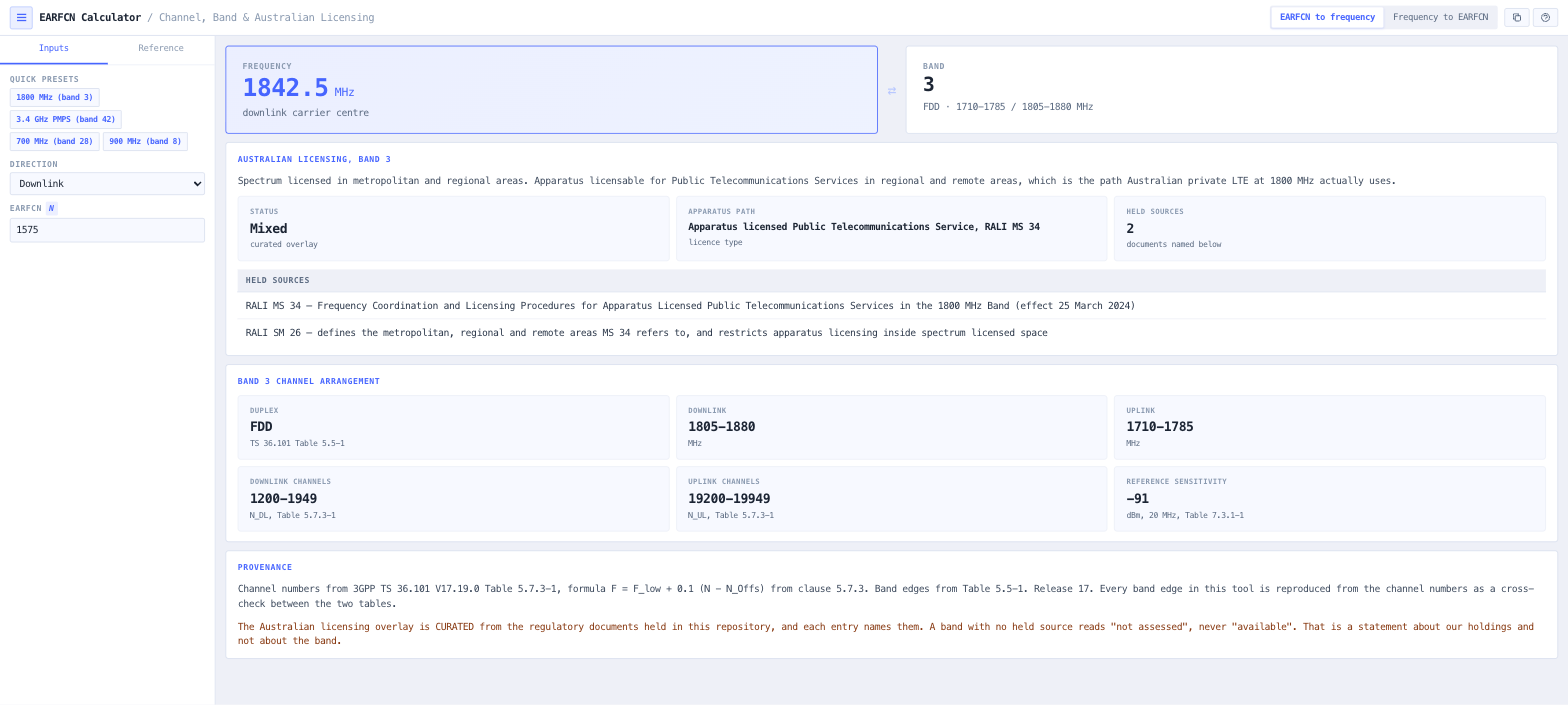
First, correctness under pressure. The channel table and the operating band table are separate pages of TS 36.101 and are extracted independently here, and the build refuses to emit unless every band edge reproduces from the channel numbers. All 126 of them do. A channel number outside the defined range returns nothing rather than extrapolating the formula, because the answer would land in another band or in none. A frequency off the 100 kHz raster returns nothing rather than snapping to the nearest channel, because a carrier cannot sit between channel numbers and rounding hides an input error instead of reporting it. And because bands overlap, the tool lists every band that contains a frequency rather than implying that a frequency identifies a band.
Second, the Australian overlay, which is the part no other converter has. Band 3 is spectrum licensed in metropolitan and regional areas and apparatus licensable for Public Telecommunications Services in regional and remote areas under RALI MS 34, which is the path Australian private LTE at 1800 MHz actually uses. Band 42 carries two apparatus paths beside the spectrum licences: a point to multipoint system licence under RALI MS 50, and an area wide licence under RALI MS 47, conditioned by the Fixed Licence Determination 2025 and the 3.4 GHz Advisory Guidelines.
And the rule that makes the overlay worth trusting: a band with no held source reads NOT ASSESSED, never available. Most E-UTRA bands read not assessed here and say so plainly, because an availability claim that cannot be sourced is worse than a gap. A gap prompts a question. A wrong claim prompts an application.
Channel number to frequency and frequency to channel number, on either link, using the formula and offsets from TS 36.101 clause 5.7.3 and Table 5.7.3-1.
The channel table and the operating band table are separate pages of the specification and are extracted independently. The build will not emit unless all 126 band edges reproduce from the channel numbers, so a transcription error in either table is caught rather than shipped.
The formula will happily produce a frequency for a channel number outside the defined range. That frequency belongs to a different band or to none, so nothing is returned instead of a confident wrong answer.
A carrier cannot sit between channel numbers. Snapping to the nearest one hides an input error, so a frequency off the 100 kHz raster returns nothing and says why.
A frequency does not identify a band. Reporting the first match implies a uniqueness that does not exist, so all containing bands are listed.
Each licensing statement names the RALI, determination or guideline it comes from. The overlay is curated from held documents rather than from recollection of how a band is usually used.
Never available. Most E-UTRA bands read not assessed here, and that is the honest output. A gap prompts a question; an unsourced availability claim prompts an application.
Band edges, duplex mode, channel number ranges and reference sensitivity shown with the result, so the answer arrives with the context needed to use it.
Because the formula keeps working past the end of the band and produces a frequency that belongs to a different band, or to no band at all. There is nothing in the output to distinguish that from a valid answer. Returning nothing, with the reason, is the only result that cannot be misread.
Because a carrier cannot sit between channel numbers, so an off raster input is an error in the input rather than a precision question. Rounding it silently produces a plausible channel number and destroys the evidence that something was wrong upstream.
Because E-UTRA bands overlap, and a frequency genuinely does not identify a band. Reporting the first match implies a uniqueness the specification does not provide. Listing all of them is the accurate answer, and which one applies is a licensing and equipment question rather than an arithmetic one.
That no held document has been read which establishes a licensing position for that band. It is not a statement that the band is unavailable, and it is deliberately not a statement that it is available. Most E-UTRA bands read not assessed. A gap prompts a question, whereas an unsourced availability claim prompts an application, which is the expensive failure.
From documents actually held and read: RALI MS 34, MS 41, MS 47, MS 50 and SM 26, the Radiocommunications Licence Conditions (Fixed Licence) Determination 2025, and the 3.4 GHz Advisory Guidelines 2025. Every claim names its source on the page, so it can be checked rather than trusted.
The channel number table and the operating band table are separate pages of TS 36.101 and are extracted independently. Every band edge is then reproduced from the channel numbers and compared against the operating band table, and the build refuses to emit unless all 126 agree. A single source transcribed once has nothing to check it against.
The conversion is not, and works for every E-UTRA band worldwide. The licensing overlay is Australian, because that is where the held regulatory documents apply. Outside Australia the conversion, band identification and band context are all still correct and the overlay simply does not apply.
Free forever on a Standard account. No credit card.