Leaky Feeder Design

Leaky Feeder Cable Selector

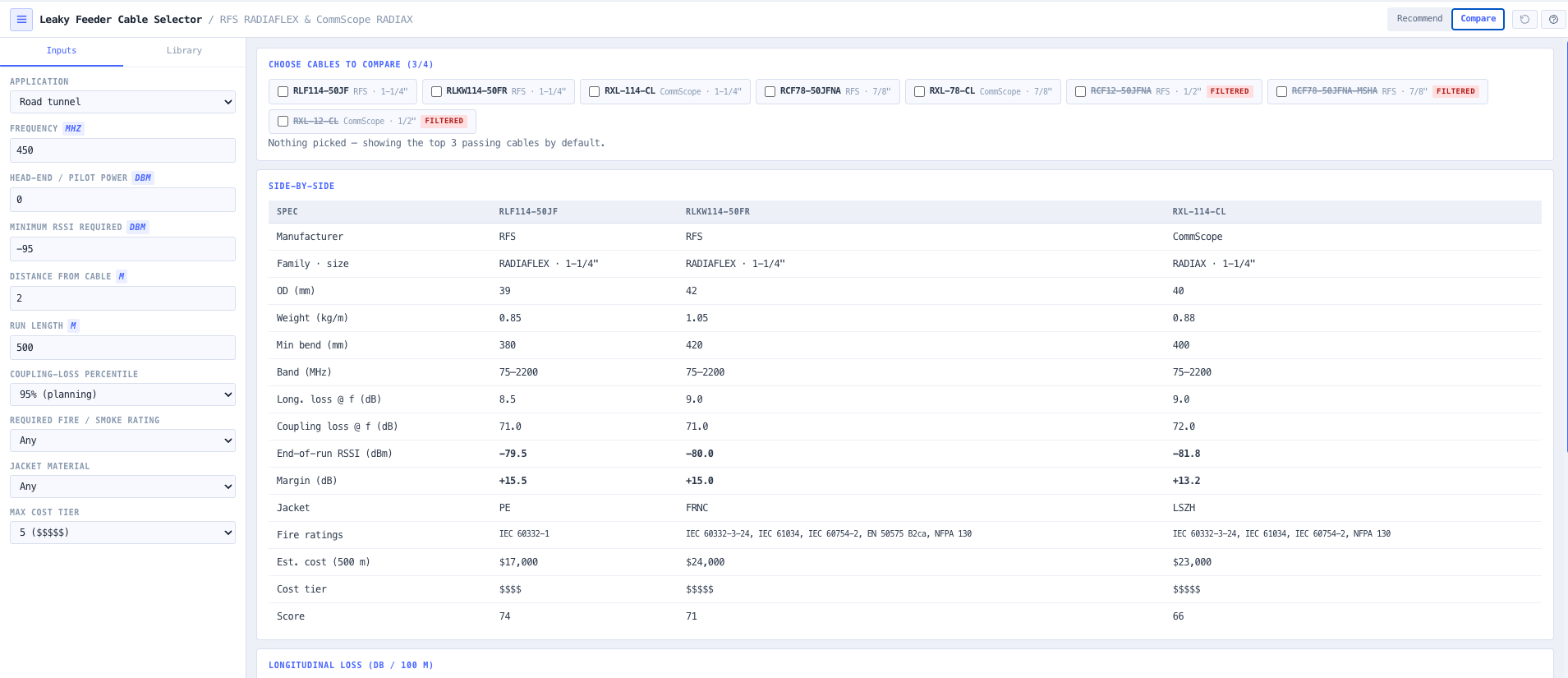
Pick the right radiating cable for any tunnel, mine, or in-building DAS run. Enter frequency, run length, head-end power, minimum RSSI, and listener distance. Get a ranked list of RFS RADIAFLEX and CommScope RADIAX cables with end-of-run margin, longitudinal loss, coupling loss, and fire / smoke compliance at a glance.

Overview

Radiating cable (leaky feeder, LCX) is its own product class. Unlike regular coax it is engineered to leak a controlled fraction of the signal sideways out of slots along its length, so it can deliver radio coverage through tunnels, deep mines, ships, lift shafts, and in-building dead zones where free-space antennas cannot reach. RFS RADIAFLEX (RCF, RLF, RLKW families) and CommScope RADIAX (RXL family) are the dominant Western product lines, with sizes from 1/2 inch up to 1-5/8 inch and frequency coverage from VHF land mobile through LTE / 5G mid-band. Each variant trades longitudinal loss, coupling loss, mechanical robustness, weight, bend radius, jacket material, and fire / smoke compliance differently. Choosing between them on every project is slow, and getting it wrong costs coverage budget, fire-code compliance, or money.

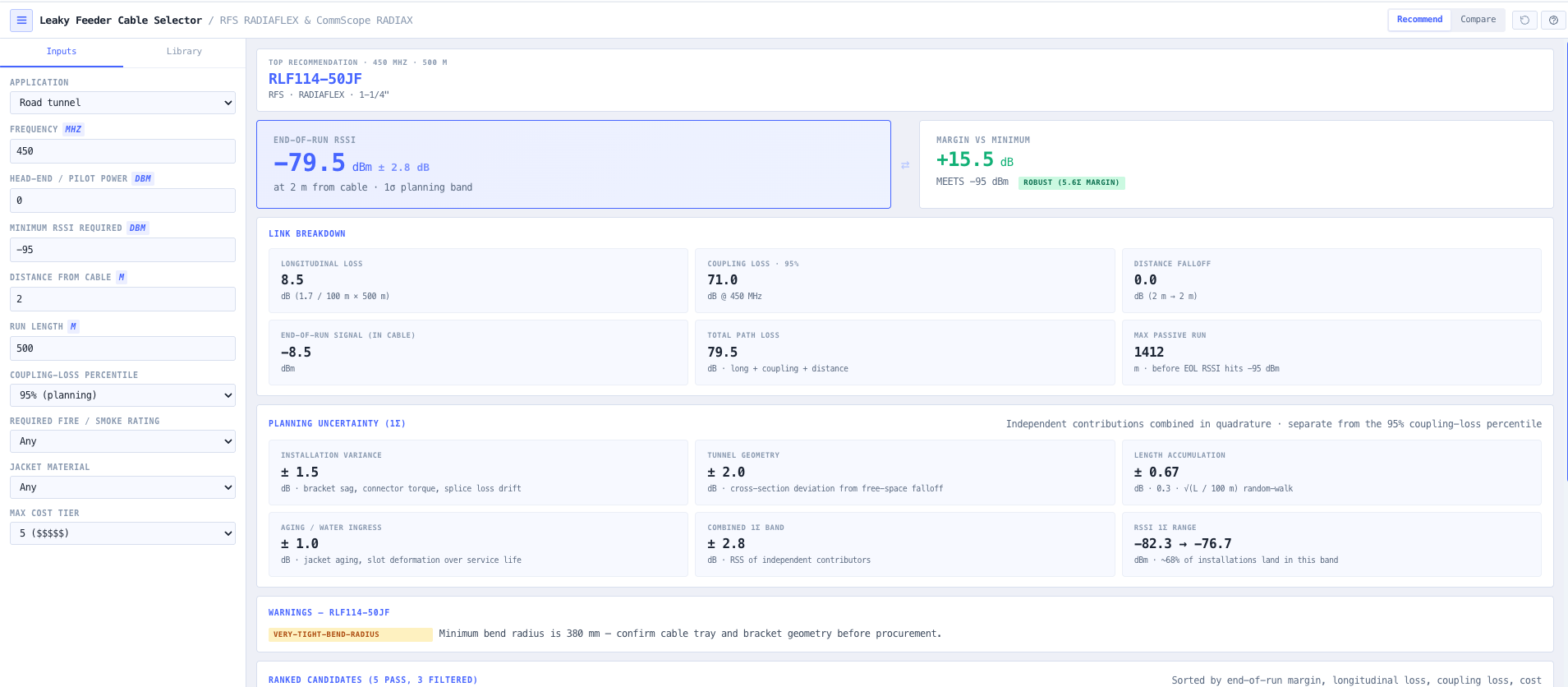
The noIM₃ Leaky Feeder Cable Selector is a precision picker for that decision. Enter the operating frequency, the total run length, the head-end power into the LCX, the minimum receive level required at the handset, and the radial distance from the cable at which RSSI must be evaluated. Pick the application (road tunnel, rail tunnel, mining, in-building DAS, industrial, broadcast confined-space). Apply the fire / smoke ratings your jurisdiction requires (NFPA 130 for rail in the US, EN 50575 Cca or B2ca for European building cables, MSHA for US mining, AS 1668 for Australian building). Set a containment-limited outer-diameter ceiling. Set a cost tier ceiling. The tool interpolates each cable's datasheet longitudinal attenuation curve on a log-log axis at the chosen frequency, multiplies by length to get total run loss, interpolates the chosen 50% or 95% coupling-loss curve at the same frequency, adds a 20 log₁₀ inverse-distance falloff from the manufacturer reference distance out to the user-specified distance, and produces a single end-of-run RSSI number with margin against the supplied minimum.

The library is curated from published manufacturer datasheets. RFS RADIAFLEX RCF12-50JFNA, RCF78-50JFNA, the MSHA-flagged RCF78 mining variant, RLF114-50JF, and the rail-tunnel RLKW114-50FR (NFPA 130 + EN 50575 B2ca). CommScope RADIAX RXL-12-CL, RXL-78-CL, and RXL-114-CL. Each entry carries the full longitudinal loss curve, 50% and 95% coupling-loss curves, manufacturer reference distance, jacket material, fire / smoke ratings, declared applications, physical specs, and a cost tier. The single-link model produces planning-grade end-of-run margins suitable for passive runs up to a few hundred metres. For amplified Becker / Smart Com chains across multiple kilometres, the dedicated Amplifier Spacing Calculator is the right destination — and the cable choice from this selector flows directly into it.
Capabilities

Curated radiating-cable library

RFS RADIAFLEX RCF12-50JFNA (1/2"), RCF78-50JFNA (7/8"), RCF78-50JFNA-MSHA (mining), RLF114-50JF (1-1/4" PE), RLKW114-50FR (1-1/4" rail-tunnel). CommScope RADIAX RXL-12-CL (1/2"), RXL-78-CL (7/8"), RXL-114-CL (1-1/4"). Each cable carries longitudinal loss vs frequency, 50% and 95% coupling loss vs frequency at the manufacturer reference distance, jacket material, fire / smoke ratings, declared applications, OD, weight, bend radius, tensile load, temperature range, connectors, and a cost tier.

Datasheet-faithful interpolation

Longitudinal attenuation and coupling loss are interpolated on a log10-log10 axis between datasheet points. This matches the underlying skin-effect-plus-dielectric physics of cable loss and the near-log-linear behaviour of slotted-cable coupling across the rated band, and produces values within a few percent of the published curves.

End-of-run RSSI model

End-of-run RSSI = head-end power − longitudinal loss × length − coupling loss @ frequency − 20 log₁₀(distance / reference distance). The result is compared against the supplied minimum receive level (handset sensitivity + margin) to produce a single MEETS / BELOW indicator and a dB margin per cable. The model is a planning estimate suitable for a single passive run.

50% vs 95% coupling-loss selection

Manufacturers publish both. 50% is the median coupling loss across sample windows along the cable, 95% is the value exceeded by 95% of windows. Use 95% for a margin-bounded planning design; use 50% to characterise typical performance. The selector's coupling-loss picker is one click.

Fire / smoke compliance filtering

Tick every fire / smoke rating your jurisdiction requires (IEC 60332-3 bundled-cable flame, IEC 61034 low-smoke density, IEC 60754-2 halogen-free, EN 50575 Cca or B2ca Euroclass, NFPA 130 rail transit, AS 1668 building, MSHA US mining). Cables that fail every requirement are filtered out with a clear failure reason.

Application-aware ranking

Road tunnel, rail tunnel (metro / mainline), underground mining, in-building DAS, industrial / process plant, and broadcast confined-space are first-class application filters. Manufacturer-declared applications scope the candidate set before scoring.

Cost tier and run cost estimate

Each cable carries an indicative cost-per-metre and a 1-to-5 cost tier. The tool multiplies cost-per-metre by run length to surface a $ figure per candidate alongside the technical performance, making the engineering / commercial trade-off visible in one view.

Browser only computation

Selection and ranking run entirely in your browser. No project details, frequencies, run lengths, or fire-code constraints leave your machine. Useful when the network plan is operationally sensitive or covered by an information-security regime.

Standards & methodology

  • IEC 60332-1 single-cable vertical flame test
  • IEC 60332-3-24 bundled-cable flame propagation Category C
  • IEC 61034 measurement of smoke density
  • IEC 60754-2 acidity and conductivity of halogen-free gases
  • EN 50575 Cca and B2ca Euroclass building-cable fire performance
  • NFPA 130 standard for fixed guideway transit and passenger rail systems
  • AS 1668 use of ventilation and air-conditioning in buildings
  • 30 CFR Part 18 (MSHA) for permissible electric equipment in underground coal mines
  • Manufacturer datasheets: RFS RADIAFLEX RCF / RLF / RLKW; CommScope RADIAX RXL

When to use this tool

  • Choosing the right LCX size for a long road-tunnel coverage run at 450 MHz LMR
  • Comparing RFS RADIAFLEX RCF78 against CommScope RADIAX RXL-78 at 900 MHz cellular
  • Selecting an NFPA 130 + EN 50575 B2ca compliant LCX for a metro rail tunnel
  • Selecting an MSHA-flagged LCX for an underground hard-rock or coal mine
  • Picking an LSZH or FRNC radiating cable for an indoor DAS installation in a public-safety code zone
  • Sizing the cable choice before sizing the Becker Smart Com 150 amplifier chain in the Amplifier Spacing Calculator
  • Comparing 1/2" against 7/8" against 1-1/4" LCX on loss, weight, bend radius, and cost for a tunnel cable tray
  • Validating that an existing installed LCX still meets RSSI margin at a planned frequency change
  • Producing a procurement estimate with a per-metre cost and a 1-to-5 cost tier
  • Comparing 50% vs 95% coupling-loss assumptions on the same cable to size the planning margin
  • Teaching the relationship between longitudinal loss, coupling loss, listener distance, and end-of-run RSSI on a single page
  • Producing the cable-selection appendix for engineering reports and tender submissions

Is this the right tool for you?

Reach for the Leaky Feeder Cable Selector in any of the following situations.

  • You are designing a 600 m road-tunnel coverage system at 450 MHz LMR with 0 dBm head end and need a passive run with at least 6 dB margin at 2 m from the cable.
  • You are scoping a rail-tunnel project and need an LCX that satisfies both NFPA 130 and EN 50575 B2ca for the European mainline section before committing the cable order.
  • You are designing an underground hard-rock mine leaky feeder backbone and need an MSHA-compliant 7/8" cable with FRNC jacket on the Becker Smart Com 150 family.
  • You are commissioning an in-building DAS for a public-safety responder system and need an LSZH or FRNC LCX that meets the local fire-code requirement.
  • You are comparing RFS RADIAFLEX RCF78-50JFNA against CommScope RADIAX RXL-78-CL for a 900 MHz cellular tunnel deployment and want a side-by-side loss / coupling / cost comparison.
  • You are deciding whether 1/2" or 7/8" LCX wins for a 250 m short-tunnel pedestrian crossing at 800 MHz, balancing OD, weight, bend radius, and cost.
  • You are auditing an inherited installed network at a planned new operating frequency to see whether the existing cable still delivers the required end-of-run RSSI at 2 m.
  • You are producing the cable-selection appendix for a tender submission and need the top three candidates side-by-side with longitudinal loss, coupling loss, fire ratings, and per-metre cost.
  • You are sizing the planning margin on a critical coverage path and want to see the end-of-run RSSI shift between the 50% median coupling-loss assumption and the 95% planning value.
  • You are upstream of the Amplifier Spacing Calculator and need to lock the cable choice before sizing the Becker Smart Com 150 amplifier chain across multiple kilometres.

Frequently asked questions

What does the recommendation optimise for?

It optimises for end-of-run RSSI margin first, low longitudinal loss second, low coupling loss third, and low cost fourth. The exact weighting is designed so that a cable cannot win by being cheap if it fails the RSSI margin, and cannot win by being low-loss if its coupling is so high that the listener never sees a usable signal at the chosen distance.

What is coupling loss and why are there 50% and 95% values?

Coupling loss is the difference between the signal level inside the radiating cable and the signal level radiated outside it at a reference distance (typically 2 m for RFS, 6 ft / 1.83 m for some CommScope datasheets). Because the slot geometry is periodic and the surrounding environment varies, the radiated level is not constant along the cable — it has a statistical distribution. The 50% value is the median across 100 m sample windows; the 95% value is the level exceeded by 95% of windows. Use 95% for a margin-bounded planning design, and 50% if you are characterising typical performance.

How accurate is the end-of-run RSSI prediction?

It is a planning-grade single-link estimate. Real coupling loss varies with frequency, slot geometry, tunnel cross-section, cable orientation, near-field versus far-field effects, and reflections from adjacent surfaces. The calculator uses a single log-log interpolated coupling-loss value plus a 20 log₁₀ inverse-distance falloff from the manufacturer reference distance. The number is good enough for sizing decisions and tender estimates; for site-specific coverage prediction with terrain and structure loss the dedicated Leaky Feeder 3D Coverage tool is the right destination, and for amplified Becker chains the Amplifier Spacing Calculator is the right destination.

Why log-log interpolation?

Cable longitudinal attenuation is dominated by skin-effect (∝ √f) and dielectric loss (∝ f). On a log-log axis the combined curve is close to a straight line in segments. Slotted-cable coupling loss is similarly near-log-linear across the rated band. Linear interpolation in log space produces much better accuracy than linear interpolation in linear space, especially across decade-wide frequency steps.

Which fire / smoke ratings should I filter on?

It depends on the jurisdiction and the application. Rail transit in the US typically requires NFPA 130. European building cables typically require EN 50575 Cca or stricter B2ca for higher-risk spaces. Halogen-free smoke behaviour for indoor public-safety spaces requires IEC 60754-2 plus IEC 61034. Bundled-cable flame performance requires IEC 60332-3-24. US underground coal and hard-rock mining requires MSHA permissibility. The selector lets you tick the union of every standard your project must satisfy and filters out anything that does not carry all of them.

Why are RFS RADIAFLEX and CommScope RADIAX so similar?

Both are slotted-coax radiating cables with comparable internal construction (solid copper outer with engineered slot patterns, foam dielectric, copper inner). Sizes overlap directly (1/2", 7/8", 1-1/4"). Longitudinal loss differs by a few percent at most. Coupling loss differs by a few dB depending on slot pattern. The biggest practical differences are jacket material (FRNC vs LSZH), fire-rating coverage, declared applications, geographic availability, and price. The selector ranks them side-by-side so the trade-off is visible.

Does any of my project data leave the browser?

No. Selection and ranking run entirely in your browser. Operating frequency, run length, head-end power, minimum RSSI, listener distance, fire-rating filter, and every other input stay on your machine and are remembered between sessions through browser local storage.

How does this relate to the Amplifier Spacing Calculator and the 3D Coverage tool?

This selector decides which cable to lay. The Amplifier Spacing Calculator decides where to put the Becker / Smart Com line amplifiers along that cable and produces the end-to-end signal trace for an amplified chain. The Leaky Feeder 3D Coverage tool predicts coverage in three dimensions with terrain, tunnel cross-section, and structure loss for site-specific validation. Use them in that order on a typical project.