Microwave Link Planning

Two Ray Ground Reflection Model

Coherent direct and ground reflected ray propagation with multipath ripple, crossover distance, and the d to the fourth far field roll off. Built for low antenna terrestrial VHF, UHF, land mobile, tactical, cellular backhaul, and open terrain WLAN coverage analysis.

Overview

Free space path loss assumes a single direct ray between transmitter and receiver. Real terrestrial links almost never see only the direct ray. The earth itself reflects a second ray that arrives at the receive antenna out of phase with the direct ray, and the two rays sum coherently. The result depends on antenna heights, frequency, distance, and the electrical properties of the ground. Close in, the two rays alternately reinforce and cancel as distance changes, producing a characteristic ripple pattern with deep nulls at specific separations. Beyond a critical crossover distance, the geometry stabilises and the path loss settles into a smooth d to the fourth power roll off, which is much steeper than the d squared free space law and is the actual physical reason long range terrestrial coverage is harder than free space estimates suggest.

The noIM₃ Two Ray Ground Reflection Model computes both regimes accurately in one workspace. The coherent sum form Prx proportional to (lambda over 4 pi d) squared times magnitude of (1 plus Gamma times exp of j delta phi times d direct over d reflected) squared captures the full multipath ripple near the crossover. The asymptotic far field plane earth loss form PL equals 40 log d minus 20 log ht minus 20 log hr minus Gt minus Gr applies beyond crossover and is frequency independent, which is why land mobile and cellular macro coverage rules of thumb are written in terms of antenna heights rather than frequency.

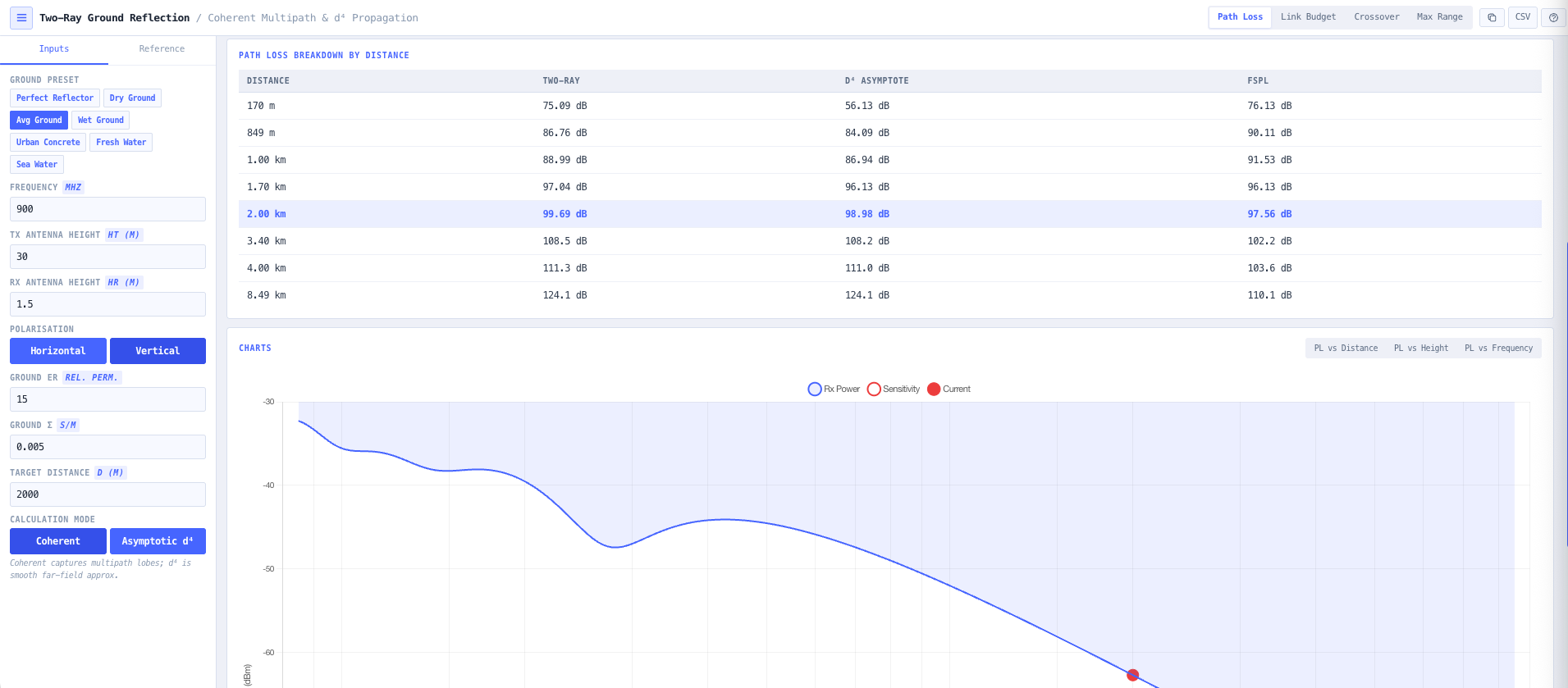
The crossover distance dc equals 4 pi ht hr divided by lambda separates the two regimes. For typical land mobile geometries (transmit antenna at 30 m, receive antenna at 1.5 m, frequency 800 MHz), dc is around 1.5 km. Inside that distance the multipath ripple matters and the model can predict deep coverage nulls that move with antenna height. Beyond it, the d to the fourth law applies and coverage scales with the product of antenna heights. The Fresnel reflection coefficient Gamma at the grazing angle is computed for horizontal and vertical polarisation using user defined ground permittivity (epsilon r) and conductivity (sigma), with built in presets for dry ground, wet ground, fresh water, sea water, urban concrete, and perfect reflector. Sea water in particular acts close to a perfect reflector at low grazing angles, which is why over water links can suffer extreme multipath nulls and why naval and coastal communications systems use specific antenna height combinations to manage them.

Capabilities

Coherent two ray sum

Implements the full electric field superposition Prx proportional to (lambda over 4 pi) squared times magnitude of (exp of (minus j 2 pi d direct over lambda) plus Gamma times exp of (minus j 2 pi d reflected over lambda)) squared, where d direct is the direct ray path length, d reflected is the ground reflected ray path length, and Gamma is the Fresnel reflection coefficient. Captures the full multipath ripple near the crossover distance with all the constructive and destructive interference detail intact.

Asymptotic d to the fourth power law

Far field plane earth loss approximation PL equals 40 log d minus 20 log ht minus 20 log hr minus Gt minus Gr applies beyond the crossover distance. Frequency independent. The reason coverage rules of thumb for land mobile and cellular macro are written in terms of antenna heights rather than frequency once the link is far enough out for the geometry to stabilise.

Crossover (break) distance

Computes the critical distance dc equals 4 pi ht hr divided by lambda separating the near region (free space dominated with multipath interference lobes) from the far region (monotonic d to the fourth roll off). Identifies which propagation regime the link is operating in and which model is appropriate.

Fresnel reflection coefficient

Calculates the Fresnel reflection coefficient Gamma at the grazing angle for horizontal (TE) and vertical (TM) polarisation using user defined ground permittivity epsilon r and conductivity sigma. Built in presets for dry ground (epsilon r equals 4, sigma equals 0.001), wet ground (15, 0.005), fresh water (80, 0.01), sea water (81, 5), urban concrete (4 to 6), and perfect reflector (Gamma equals minus 1).

Polarisation handling

Horizontal and vertical polarisation handled separately because the Fresnel coefficients differ. Horizontal polarisation has Gamma close to minus 1 at low grazing angles and produces strong multipath ripple. Vertical polarisation passes through a Brewster angle minimum and behaves differently. Critical for accurate prediction over water and at low grazing angles where the polarisation choice changes the multipath structure significantly.

Multipath ripple visualisation

Received power versus distance plot shows the characteristic multipath ripple before crossover and the smooth d to the fourth roll off beyond. Useful for identifying multipath null locations along a path and for choosing antenna heights that move the nulls away from the operating distance.

Link budget integration

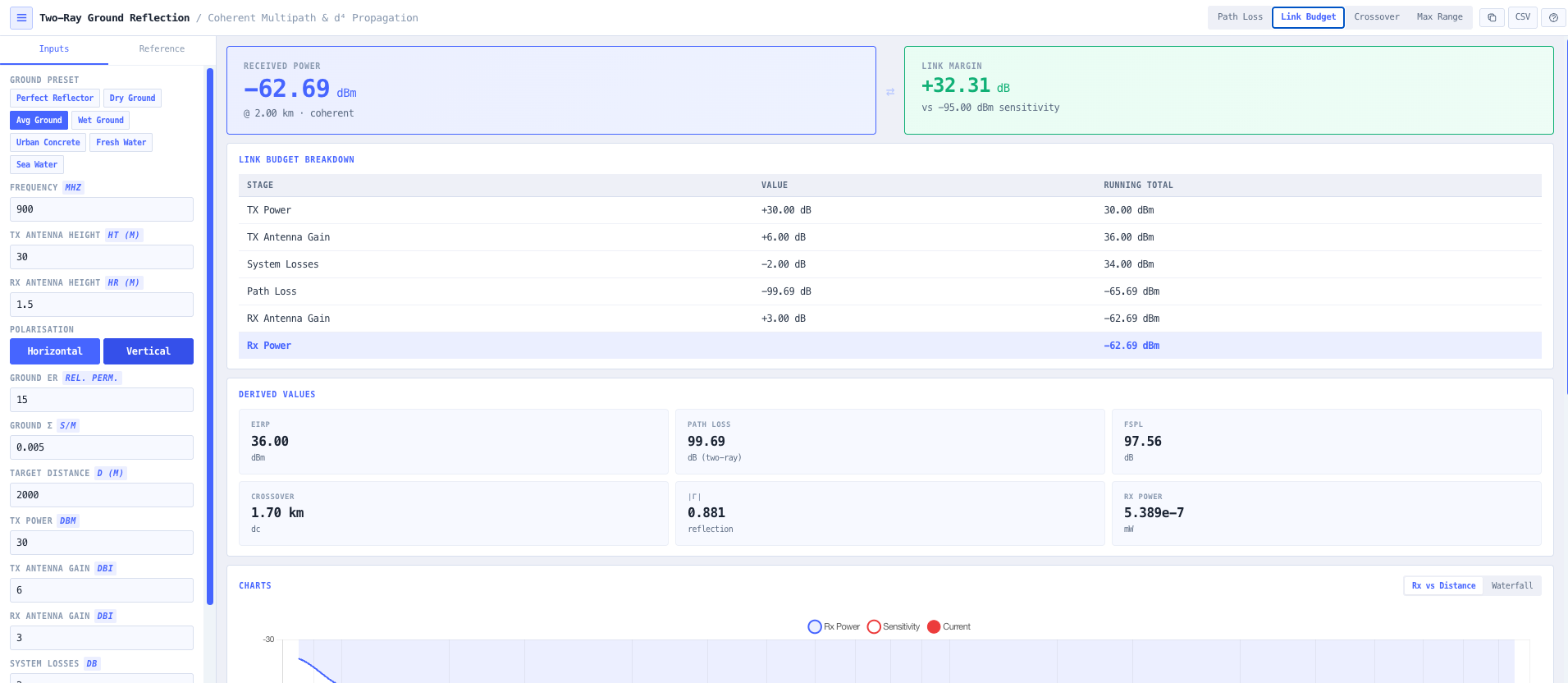
Applies the two ray model to a full link. Transmit power, transmit antenna gain, transmit feeder loss, two ray path loss, receive antenna gain, receive feeder loss combined into received power in dBm and link margin against a configured receiver sensitivity. EIRP also surfaced for licence compliance.

Antenna height sensitivity

Plot of received power versus antenna height for the configured frequency, distance, and polarisation. Useful for identifying optimal mounting heights that maximise received power and avoid multipath nulls. Particularly valuable for over water links and for elevated platform deployments where antenna height is a free design parameter.

Browser only computation

Runs entirely in your browser. No transmit power, antenna height, or path data is submitted to a server. Useful for commercially confidential coverage planning, defence and naval communications, and environments where information security policy prohibits sending engineering data to third party services.


Standards & methodology

  • Two ray ground reflection model (Rappaport, Wireless Communications: Principles and Practice)
  • Plane earth path loss formula (Egli, Bullington)
  • Fresnel reflection coefficient definitions (horizontal TE and vertical TM)
  • ITU R P.527. Electrical characteristics of the surface of the Earth
  • ITU R P.525. Calculation of free space attenuation

When to use this tool

  • Cell radius estimation for low antenna macro and suburban LTE and 5G deployments
  • Tactical VHF and UHF range prediction over open terrain and airfields
  • Microwave and millimetre wave links crossing water surfaces
  • Naval and maritime communications over sea water
  • Identification of multipath null locations for antenna height optimisation
  • Validation of crossover distance assumptions in simplified propagation models
  • PMR and LMR coverage analysis over flat rural terrain
  • Educational demonstration of ground reflection multipath physics
  • Teaching the difference between near field interference and far field d to the fourth roll off
  • Sizing antenna heights to move multipath nulls away from operating distance
  • Comparing horizontal and vertical polarisation behaviour over different ground types
  • Producing engineering evidence for tactical and defence radio range claims

Is this the right tool for you?

Reach for the Two Ray Ground Reflection Model in any of the following situations.

  • You are designing a tactical VHF or UHF radio link over open terrain or an airfield and need realistic range against the two ray ground reflection rather than free space.
  • You are responsible for a maritime or naval communications link over sea water and need to predict the multipath ripple and identify the deep nulls that change with antenna height.
  • You are sizing low antenna LTE or 5G macro coverage and need to apply the d to the fourth far field law rather than free space d squared.
  • You are evaluating an over water microwave or millimetre wave link and need to confirm whether the candidate antenna heights avoid the multipath nulls produced by sea water reflection.
  • You are diagnosing intermittent coverage holes on a flat terrain land mobile network and want to overlay the predicted two ray multipath nulls against the reported failure locations.
  • You are deciding whether to mount an antenna at 10 m, 20 m, or 30 m and need to see how received power changes with antenna height including the multipath structure.
  • You are evaluating horizontal versus vertical polarisation for a low grazing angle link over water or wet ground and need accurate Fresnel reflection coefficient handling for each.
  • You are validating a tactical or defence radio range claim against the underlying two ray physics over the actual ground type.
  • You are training new RF engineers in ground reflection multipath and want a teaching tool that visualises both the near field ripple and the far field d to the fourth roll off.
  • You are sanity checking a vendor coverage prediction that assumes free space and want to show how much the prediction changes when ground reflection is properly modelled.
  • You are sizing PMR or LMR coverage over flat rural terrain and need a frequency independent far field path loss prediction that depends on antenna heights.
  • You are responsible for an airfield or runway communications system and need to confirm that the antenna height combinations used produce coverage nulls outside the operational area.
  • You are designing a coastal radar or ground radar system and need accurate two ray multipath modelling with the appropriate ground or water Fresnel coefficients.
  • You are evaluating cell radius for a private LTE deployment in an open mining or pastoral area and need d to the fourth far field path loss based on antenna height combinations.
  • You are operating under a security regime that prohibits sending coverage planning data to third party services and need a calculator that runs entirely in your browser.

Frequently asked questions

What is the two ray ground reflection model?

A propagation model that computes received power as the coherent sum of a direct line of sight ray and a single ground reflected ray. The two rays travel different path lengths and arrive at the receive antenna with a phase difference that depends on antenna heights, frequency, and distance. They sum coherently, producing constructive and destructive interference depending on the geometry. Close in, the result is multipath ripple. Beyond a crossover distance, the geometry stabilises into a smooth d to the fourth power path loss law.

When does the model apply?

When the link runs over relatively flat terrain or a smooth reflecting surface (open terrain, runways, airfields, water, low elevation cellular and land mobile geometries). It is the right model for low antenna communications where the ground reflected ray is a major contributor to the received signal. It is the wrong model for line of sight microwave with both antennas well clear of the ground (use FSPL or the noIM₃ Link Planner with full ITU P.530), and for dense urban environments (use the Log Distance Path Loss Calculator with an appropriate exponent).

What is the crossover distance and why does it matter?

The crossover (break) distance dc equals 4 pi ht hr divided by lambda separates two regimes. Inside dc, the link sees free space loss plus multipath ripple from the direct and reflected ray interference. Beyond dc, the geometry stabilises and the path loss settles into a monotonic d to the fourth power roll off. For typical land mobile geometries (ht equals 30 m, hr equals 1.5 m, 800 MHz), dc is around 1.5 km. Inside that range you need the full coherent sum. Beyond it, the simpler d to the fourth formula is accurate.

Why does the far field path loss go as d to the fourth?

Because the direct and reflected rays arrive nearly out of phase at large grazing angles, the magnitudes of their electric fields nearly cancel. The residual is proportional to the path length difference, which itself decreases as 1 over d. The combined effect is that received power scales as 1 over d to the fourth power rather than 1 over d squared. This is purely geometric and does not depend on frequency, which is why the far field plane earth formula PL equals 40 log d minus 20 log ht minus 20 log hr is frequency independent.

How is the Fresnel reflection coefficient computed?

For horizontal (TE) polarisation, Gamma equals (sin theta minus square root of (epsilon r minus cos squared theta)) divided by (sin theta plus square root of (epsilon r minus cos squared theta)), where theta is the grazing angle and epsilon r is the complex relative permittivity (which folds in conductivity sigma). For vertical (TM) polarisation, Gamma equals (epsilon r times sin theta minus square root of (epsilon r minus cos squared theta)) divided by (epsilon r times sin theta plus square root of (epsilon r minus cos squared theta)). Built in presets cover dry ground, wet ground, fresh water, sea water, urban concrete, and perfect reflector.

How does polarisation choice affect the result?

Horizontal polarisation has Gamma close to minus 1 at low grazing angles regardless of ground type, which produces strong multipath ripple and deep nulls. Vertical polarisation passes through a Brewster angle minimum where Gamma is close to zero and the reflected ray contribution drops, which can soften the multipath behaviour. The polarisation choice matters most over water and at low grazing angles, where the difference between H and V is large. The calculator handles each polarisation separately.

How is this different from FSPL and the Log Distance Path Loss model?

FSPL assumes a single direct ray and is correct for free space and short line of sight links above the ground. The Log Distance Path Loss model is empirical and uses a tunable exponent n to fit measured environment behaviour. The Two Ray model is physically based, accounts explicitly for the ground reflected ray, and predicts the d to the fourth far field law from first principles. Use FSPL for free space. Use the Two Ray model for terrestrial low antenna geometries over flat ground or water. Use the Log Distance model when the environment is too complex for two ray and you have measured calibration data.

Does any data leave my browser?

No. The calculator runs entirely in your browser. No transmit power, antenna height, or path data is submitted to a server. Useful for commercially confidential coverage planning, defence and naval communications, and environments where information security policy prohibits sending engineering data to third party services.