ITU canonical chain exposed
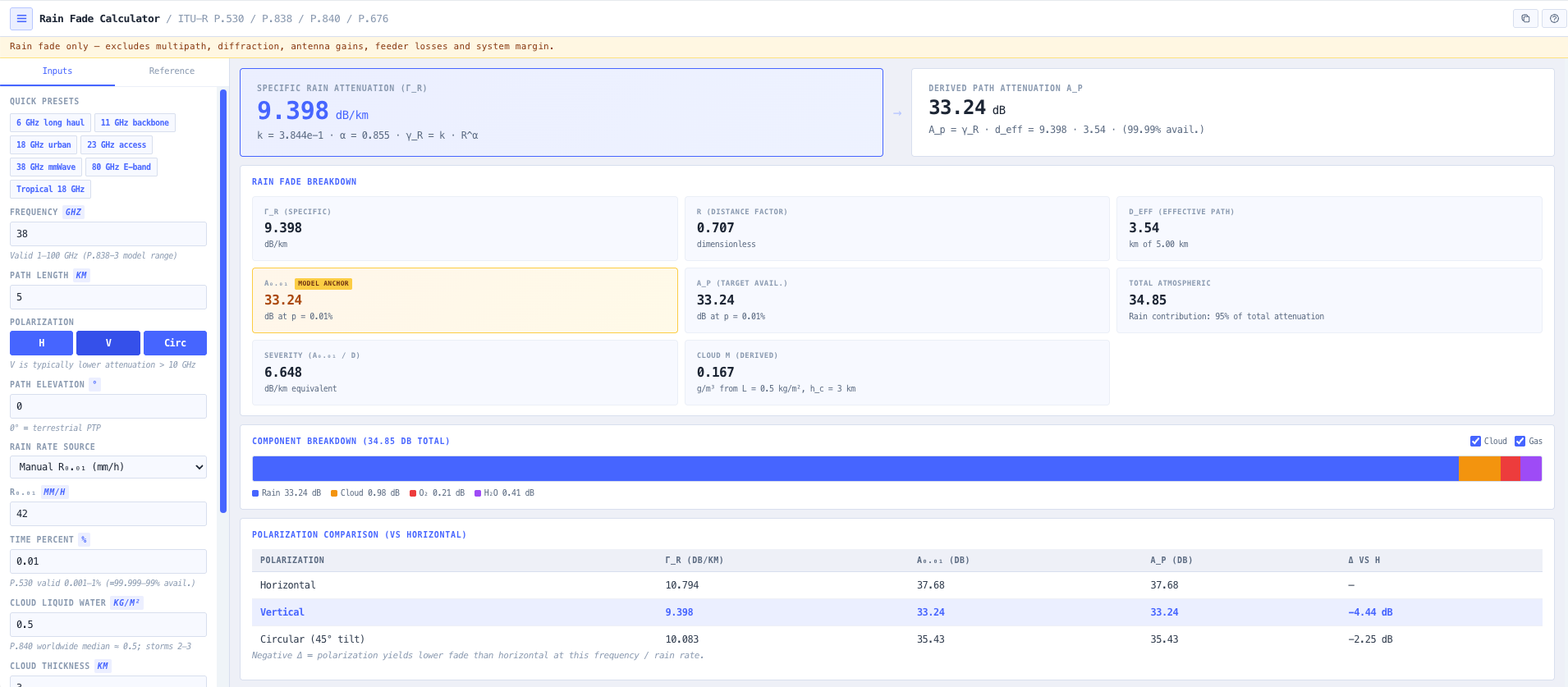
Specific rain attenuation gamma R equals k times R to the power of alpha (P.838). Distance reduction factor r and effective path length d effective (P.530). 0.01 per cent anchor attenuation A 0.01 equals gamma R times d effective. Time percent extrapolation A p derived from A 0.01. Each step shown explicitly so the calculation is reproducible and visibly wrong when something has been entered incorrectly.
Polarisation delta versus horizontal
Side by side horizontal, vertical, and circular polarisation results with the dB delta versus horizontal called out directly. Answers the integrator question how many dB do I gain switching to vertical polarisation at 38 GHz. Uses the full P.838 polarisation blend formula k equals (k H plus k V plus (k H minus k V) times cos squared tau times cos 2 theta) divided by 2 (and similar for alpha) rather than a simplified approximation.
Component breakdown with toggles
Stacked bar of rain, cloud, atmospheric oxygen, and atmospheric water vapour contributions in dB. Toggle cloud or gas off to isolate the rain only number, or on to see why millimetre wave links look so different from microwave. Useful for understanding the real attenuation budget at 26, 38, 60, and 80 GHz where the cloud and gas contributions can dominate the rain at low time percentages.
BOM site lookup for Australian deployments
Latitude and longitude input pulls the nearest Bureau of Meteorology weather station and returns live temperature, pressure, and water vapour density (derived from relative humidity). Falls back to ITU R P.835 standard atmosphere defaults if the station is offline. R 0.01 comes from the P.837 latitude band lookup or manual entry. Source provenance shown alongside the values so the engineering record is traceable.
Frequency sweep with band markers
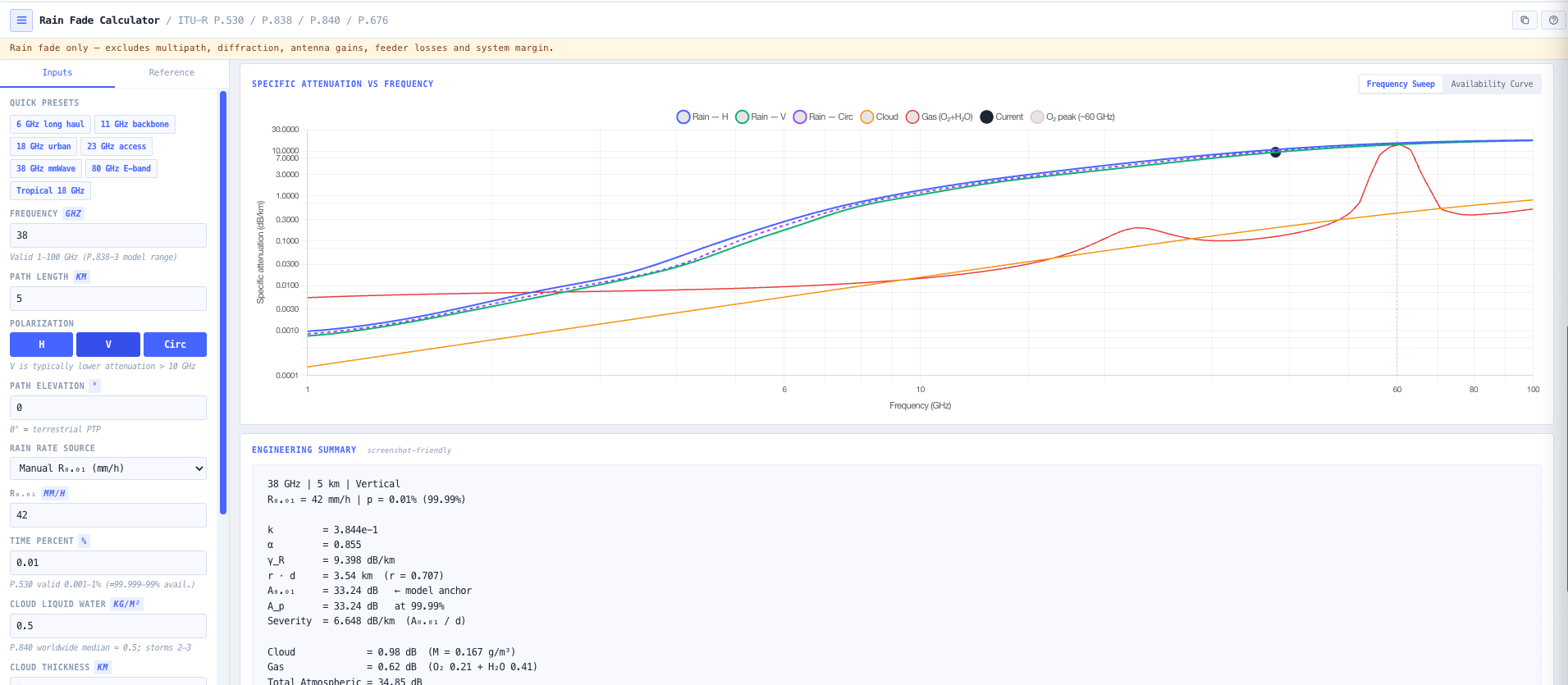
Sweep mode plots gamma R versus frequency from 1 to 100 GHz with horizontal, vertical, and circular polarisation curves overlaid. Standard band markers at 6, 11, 18, 23, 38, 60, and 80 GHz. Cloud and gaseous curves toggleable. Useful for choosing the operating band, understanding why a 38 GHz link is harder than an 11 GHz link in the same climate, and visualising the 60 GHz oxygen absorption line.
Availability curve mode
A p versus time percent on a logarithmic axis, anchored at the P.530 0.01 per cent base. Useful for sizing high availability targets (99.9, 99.99, 99.999 per cent corresponding to 0.1, 0.01, 0.001 per cent unavailability). Extrapolation warning fires for sub 0.001 per cent values where P.530 is at the edge of its validity and the result should be treated with engineering judgement rather than as definitive.
Copy paste engineering summary
One click copy emits a clean engineering snippet covering frequency, path length, polarisation, R 0.01, k, alpha, gamma R, r, d effective, A 0.01, A p, and the rain plus cloud plus gas breakdown. Ready to drop into a design document, project ticket, customer email, or licence application.
Browser only computation
Runs entirely in your browser. No path geometry, climate data, or design parameters are submitted to a server beyond the BOM lookup itself, which is anonymous and does not contain identifying information about the planned link. Useful for commercially confidential infrastructure planning and environments where information security policy prohibits sending engineering data to third party services.